Coffee & Links: Cookeville

Free local meetup · Cookeville, TN

Coffee & Links: Cookeville

Grab a coffee and learn link building that actually works — for AI answers and for Google. A free, no-pitch meetup for local SEOs and small business owners.

Get Directions → More local link ideas

🗓️ Event Details

📅

Date

July 7, 2026

🕘

Time

9:00 AM

📍

Place

Poet’s Coffee
230 E Broad St
Cookeville, TN 38501

💵

Cost

Free — just buy your own coffee

What we’ll talk about

Search is changing fast. Google still leans on links to judge authority, and now LLMs — the engines behind AI Overviews, ChatGPT, and Perplexity — are deciding who to cite based on who gets mentioned and linked across the web. The good news: the same white-hat moves that earn real links also make you more visible to AI. Over coffee, we’ll break down what’s working right now:

  • Why relevance beats domain metrics (DA/DR) for both Google and LLMs
  • How brand mentions and citations feed the “consensus engine” of AI search
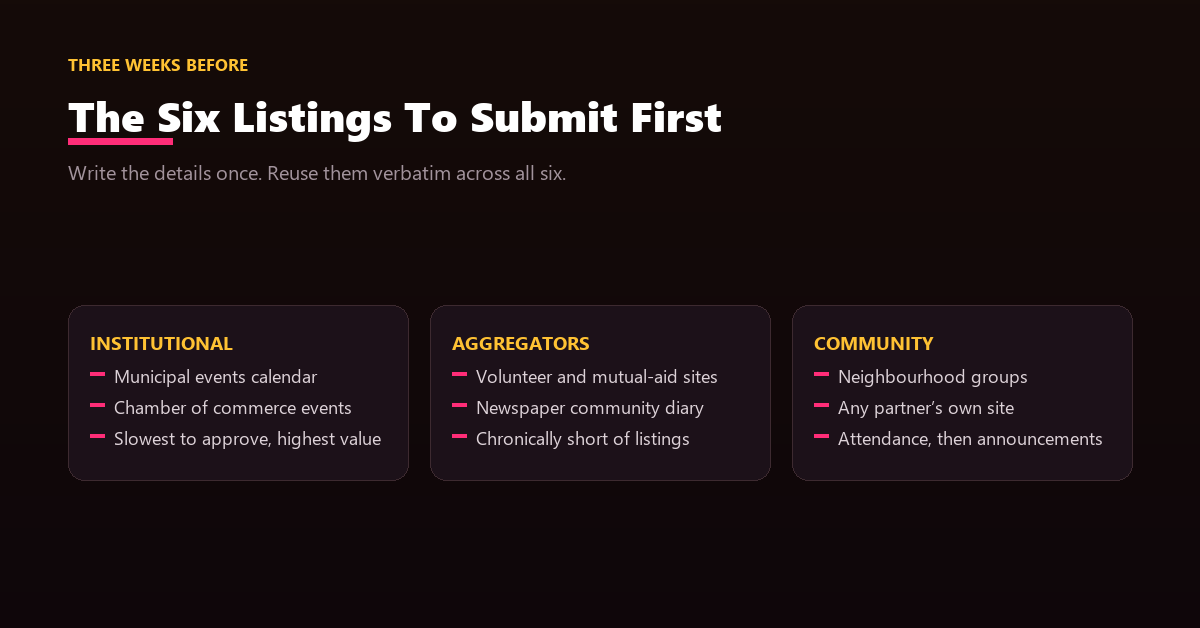
  • Local link plays SMBs can run this week — partners, chambers, community events
  • Turning conversations and podcasts into links that compound
  • Live Q&A on your specific site and niche

Who should come

Local SEOs, marketers, agency folks, and small business owners around Cookeville and the Upper Cumberland who want a clear, practical handle on link building for the AI era. No experience required — bring your questions.

Who’s hosting

Your host is Jeremy Rivera of SEO Arcade — Nashville-area SEO consultant and host of the Link Building Ideas podcast. If your team would rather have it handled, ask him about SEO Arcade’s done-for-you link building services. But this meetup is all about helping you do it yourself.

Come thirsty for coffee and links. See you at Poet’s Coffee on July 7 at 9 AM! Want a head start? Grab the free DIY Link Building Playbook before you come.

Can’t make it in person?

Book a free 30-minute link building call with Jeremy and get the same guidance one-on-one.

Book a Link Building Call →

Reclaim Unlinked Brand Mentions on Yelp, GBP & Directories

Somewhere out on the web, people are already talking about your business — on Yelp, in roundup articles, on supplier blogs, in local news, and across dozens of directories — and a surprising number of those mentions don’t link back to you. Every one of them is a link you have essentially already earned but never collected. On Unscripted SEO, veteran consultant Rob Bonham argued that chasing these unlinked mentions and building out your third-party footprint is “more important than ever,” because search engines and AI answer engines now triangulate trust across everywhere your name appears — not just your own site.

Your footprint is the ranking signal now

Rob’s framing is worth internalizing: ranking is no longer just about your domain, it is about how widely and how positively your brand shows up across the web. When someone searches for the best plumber nearby, Google checks the Google Business Profile and its reviews first, then fans out to Yelp, HomeAdvisor, and every other place that business is listed to decide whether it is trustworthy enough to promote above competitors. The more consistent, positive references you have, the stronger that signal gets.

Whoever has the bigger footprint and the more people talking about them across the web in a positive way — that is the ultimate be-all and end-all of winning and dominating the SERPs.— Rob Bonham, Unscripted SEO

Unlinked mentions are the fastest way to grow that footprint, because the hardest part is already done: someone decided you were worth writing about. All that’s missing is the hyperlink. That makes reclamation one of the highest-conversion tactics in local and offline link building, and it pairs naturally with the process in our guide to finding unlinked brand mentions. Convert even a fraction of what already exists and you strengthen both classic search rankings and the way AI tools describe your business.

How to find and convert mentions across the third-party footprint

Reclamation is a repeatable process, not a one-time hunt. Set it up once, work the backlog, then run it on a recurring schedule so new mentions get converted while they are fresh and the author still remembers writing them.

The unlinked mention reclamation workflow

Search for every version of your name

Run searches for your brand, common misspellings, product names, and key people — then filter out your own domain and social profiles. What remains is the third-party footprint where mentions live.

Separate linked from unlinked mentions

For each mention, check whether your brand name is actually hyperlinked to your site. The unlinked ones are your target list; a backlink tool or a manual pass through the top results will surface most of them.

Claim your presence on the big directories

Yelp, HomeAdvisor, your Google Business Profile, and industry-specific directories are structural mentions. Claim, complete, and verify each listing so your name, address, and website link are present and consistent.

Prioritize by authority and freshness

A recent mention on a trusted news site or supplier blog is worth chasing first. Old, low-quality pages can wait — focus outreach where a followed link will actually move the needle. Short on time for the chase? SEO Arcade offers professional link building services that run it for you.

Ask for the link with a specific, easy request

Email the author or editor, thank them for the mention, and ask if they’d be willing to link your name to your site — include the exact URL you want. The lift for them is tiny, which is why these convert so well.

Re-run the search on a schedule

New mentions appear constantly as you do PR, sponsor events, or launch products. A monthly or quarterly sweep turns reclamation into a steady, compounding stream of links.

Where unlinked mentions hide

Cast a wide net. The same brand can be mentioned without a link in all of these places at once — and each one you fix adds another node to your footprint.

The third-party footprint to audit

Every surface below is a place your name may appear without a link home.

Review platforms

Yelp, HomeAdvisor, Angi, and niche review sites — claim the listing and make sure the website field points to you.

📍

Google Business Profile

Your GBP and its reviews are the first thing checked in local searches; a complete, verified profile anchors your footprint.

📰

Press & roundups

Local news, industry roundups, and “best of” lists often name businesses in plain text — a quick email fixes it.

🤝

Partner & supplier pages

Suppliers and event sponsors mention you on their sites; ask them to turn that mention into a followed link.

Turn reclamation into a system, not a one-off

The businesses that win at this treat unlinked mentions as an ongoing asset class rather than a spring-cleaning project. As Rob pointed out, the bigger and more visible your brand, the more mentions accumulate — which means the reclamation opportunity grows right alongside your marketing. Every press release, sponsorship, product launch, and podcast appearance seeds new mentions, and a standing monthly sweep quietly converts them into links while your competitors leave theirs on the table.

There is also an AI dividend. Answer engines increasingly assemble their picture of a business from its broader footprint, so consistent, well-linked mentions across Yelp, your Google Business Profile, and trusted directories shape how you get described in AI results, not just where you rank in classic search. Start with the mentions you already have, fold reclamation into your local link building routine, and you build durable authority from work the rest of the web has already done for you.

Want these links built for you?

Book a free 30-minute link building call with Jeremy and we’ll put the right ethical tactics to work on your site.

Book a Link Building Call →

Fish in a Barrel: Partner & Supplier ‘Where to Buy’ Links

Most link building is a grind. You research prospects, chase contact info, write outreach that gets ignored, and follow up three times to earn a single link. When that grind isn’t worth your team’s time, SEO Arcade runs white-hat link building services at scale. But there is one category of links sitting in almost every business’s supply chain that is faster, cleaner, and more defensible than almost anything else you can do — and hardly anyone systematically claims it. On the Unscripted SEO podcast, two-decade SEO veteran Rob Bonham called it the closest thing to an easy win the discipline has left: getting legitimate “where to buy,” dealer, and partner links from the brands your company already carries or works with.

Why supplier links are the easiest legitimate links you’ll ever earn

The logic is simple. If you sell, install, distribute, or service another company’s products, that company has a commercial reason to point customers toward you. Manufacturers run “where to buy” pages, dealer locators, and “find a pro” directories precisely because they need buyers to reach a place that actually stocks or installs their gear. You are not asking for a favor — you are helping them close a sale. That alignment of incentives is what makes these links so much easier to land than cold guest-post pitches. Rob learned this running SEO for an e-commerce maintenance, repair, and operations (MRO) parts provider that carried hundreds of brands.

It’s like shooting fish in a barrel, but we’re still getting great results and improving our authority. We’re not doing anything bad — we’re not paying for these links, we’re not twisting their arm.— Rob Bonham, Unscripted SEO

That last part matters. These are not paid or coerced links, so they sidestep the guardrails that make so much of link building risky. You carry a brand; the brand tells its customers where to find it. It is the offline, relationship-driven end of link building — the same territory covered in our guide to local and offline link building and the deeper walkthrough on generating links through complementary business partners.

Build your partner link inventory before you send a single email

The mistake most teams make is treating this as ad-hoc outreach instead of an inventory problem. Every brand you carry, every supplier you buy from, every association you belong to, and every certification you hold is a potential link source with a pre-existing relationship attached. Map that footprint first, then work it systematically.

The fish-in-a-barrel workflow

List every brand and supplier you touch

Pull your product catalog, vendor invoices, and reseller agreements. Each manufacturer, distributor, and franchisor you have a commercial relationship with goes on the list — these are warm prospects, not strangers.

Check each brand for a “where to buy” or dealer locator

Search the manufacturer site for “where to buy,” “find a dealer,” “store locator,” “find a pro,” or “partners.” If the page exists, you often just need to submit your details to be added and linked.

Confirm the link is followed and points to the right URL

Not every locator links out, and some use JavaScript widgets that don’t pass equity. Prioritize brands whose pages render real, followed anchor links, and ask them to point to your most relevant category or location page.

Reach out using the relationship, not a pitch

You already buy from these companies. A short note to your account rep — “can you add us to your where-to-buy page?” — converts far better than cold outreach because you are helping them sell more product.

Track submissions and re-check quarterly

Dealer directories get rebuilt and links get dropped in redesigns. Log every submission in a sheet and re-verify each link on a quarterly cadence so you don’t silently lose the ones you earned.

Who has the most fish in their barrel?

Some business models are practically built for this tactic. If you fit one of these, you are almost certainly leaving supplier links on the table right now.

Businesses sitting on unclaimed supplier links

Each of these carries brands that want to send buyers their way.

🔧

Contractors & installers

HVAC, roofing, flooring, windows, and solar installers can earn “find a certified installer” links from every manufacturer they install.

🛒

Resellers & distributors

If you resell products online or locally, the brands you carry run “where to buy” pages that exist to link out to sellers like you.

🛠

Service & repair shops

Authorized service centers and warranty partners get listed in manufacturer “find a service provider” directories.

🏦

Franchisees & members

Franchise systems, trade associations, and certification bodies maintain member directories that pass real authority.

Why these links punch above their weight

Manufacturer and association sites tend to be old, topically focused, and genuinely trusted — exactly the profile search engines and AI answer engines reward. A link from the brand you carry is a third-party endorsement that you are a legitimate outlet for their products, which is a stronger trust signal than a random blog mention. It also reinforces the relevance of your commercial pages: a link from a flooring manufacturer to your flooring category page tells search engines exactly what that page is about. That combination of trust and topical relevance is why Rob singled it out as more valuable than ever in the current search landscape, and why it belongs at the top of any local link building plan.

The best part is durability. Because you are not manufacturing these links or paying for them, there is no penalty exposure and nothing to unwind later. You built a real business relationship and got a real link out of it — the way link building is supposed to work. Start with your five biggest suppliers this week, and you will likely have your first batch of new, defensible links before your next outreach campaign even warms up.

Want these links built for you?

Book a free 30-minute link building call with Jeremy and we’ll put the right ethical tactics to work on your site.

Book a Link Building Call →

Local Digital PR: Earn Editorial Links With Owner Quotes

There are two ways to get a link from a news site. You can chase the easy, low-quality placements — the directories and aggregators that pile up but barely move rankings — or you can earn a real editorial mention built around something no competitor can copy: a genuine quote from the actual business owner. On the Unscripted SEO podcast, SEO Interactive’s Robert Spinrad described this as the more challenging and more rewarding work his agency’s internal PR team actively hunts for, especially for home-service clients: the right mention, in an editorial context, sourced from the owner and never AI-generated.

That last detail is the whole game. Anyone can paste a prompt into ChatGPT and generate a bland quote. Editors can tell, readers can tell, and increasingly the signal-quality gap decides whether you earn the link at all. This is a cornerstone of our local & offline link building approach, and it pairs directly with earning guest citation links where the owner’s expertise is the reason the link exists.

Why the Quote Has to Come From a Human

Robert’s broader warning about AI applies precisely to digital PR. His agency uses AI tools daily and is transparent with clients about it, but they draw a hard line on advice and authenticity.

We encourage clients to be wary of people saying they are AI experts — because this whole thing is brand new. We’re all learning.— Robert Spinrad, Unscripted SEO

The same caution governs a PR quote. A journalist is not looking for a competent paragraph; they are looking for lived experience an AI cannot have. Robert made the point that an LLM can cite experience but never lived it, and that every client his agency serves is a family or small business with seasonality, pain points, and a specific market the model has no context for. That situational knowledge is exactly what makes an owner quote quotable. Strip it out and replace it with a generated sentence, and you have handed the reporter the one thing they will not print.

The Owner-Quote Pitch Process

Turn owner expertise into an editorial link

The process is deliberately human at every step — that is the point, not a limitation.

Find the reporter, not the outlet

Identify the specific journalist who covers your beat locally — housing, small business, home improvement, whatever fits. Read their recent pieces so your pitch matches what they actually write about.

Lead with a real angle

Offer a timely hook the owner can speak to: a seasonal surge, a local price trend, a common homeowner mistake. You are pitching a story the reporter needs sources for, not asking for a favor.

Interview your own owner

Get the business owner on a ten-minute call and capture their answer in their words. Keep the phrasing, the specifics, the local detail. Do not sand it into corporate copy and do not generate it.

Deliver a clean, attributable quote

Send two or three sentences the reporter can drop in verbatim, with the owner’s full name, title, and business. Make it effortless to use and effortless to link the business.

Never substitute AI for the owner

If the owner is unavailable, wait. An AI-written quote is worse than no quote — it risks the relationship and the credibility that earns future mentions.

Follow up and build the beat

Thank the reporter, share the published piece, and offer to be a standing local source. One good quote turns into a repeat relationship and a recurring link source.

What a Good Editorial Link Is Worth

Why owner-sourced editorial links outperform

One authentic quote earns a placement that scaled tactics cannot reach.

✍️

Genuine authority

An editorial quote signals to Google that a real, credentialed local expert stands behind the business — not a submitted listing.

🤖

AI-resistant by design

The value comes from lived experience an LLM cannot fabricate, which is exactly why it earns the mention when generated pitches get ignored.

📈

Compounding relationships

Reporters return to sources who make their job easier, so each genuine quote makes the next editorial link cheaper to earn.

These are the citations that show up when you check what an AI recommends locally. Robert noted that when you search a local business in ChatGPT or Gemini and read the sources, you see the multi-platform footprint that trust is built from. An editorial mention with a real owner quote lands squarely in that set of signals — and it does double duty by strengthening the citation and quote-based links that reinforce the owner’s expertise across the web.

Start With One Real Quote

You do not need a PR department to run this. Pick one story angle your owner can genuinely speak to, find the one reporter who covers it, and get a real quote on the record. Faithful, specific, human — that is the entire advantage. Robert’s team frames itself as humble experts who keep learning, and that same posture wins editorial links: show up with real knowledge, make it easy to attribute, and never let a language model speak for the person whose name is on the door.

Want these links built for you?

Book a free 30-minute link building call with Jeremy and we’ll put the right ethical tactics to work on your site.

Book a Link Building Call →

Turn a Park Cleanup Into City Hall & Event-Page Links

A local business shows up on a Saturday morning, fills a dozen trash bags at the neighborhood park, posts one photo, and moves on. That is a missed link-building opportunity worth more than most cold outreach campaigns. When SEO Interactive’s Robert Spinrad joined the Unscripted SEO podcast, he pointed to exactly this pattern: a real-world construction company that ran a park cleanup in Cookeville and earned a City Hall link, community event-page links, and other natural placements from a single afternoon of genuinely useful work. The event was already happening. Nobody captured the SEO value sitting on the table.

This is the kind of offline-to-online conversion that anchors durable local authority. If you want the bigger picture of why real-world activity outperforms scaled tactics, start with our local & offline link building hub. Below is the specific process for turning one cleanup into a cluster of municipal, chamber, and press links.

Why a Cleanup Beats Another Directory Submission

Robert’s core reporting philosophy applies here as much as it does to any campaign: chase outcomes, not vanity numbers. His agency’s tagline has been the same since day one.

It’s not about clicks, it’s about results. Clicks are great, numbers are great, but when it comes down to it, what people care about is how much money am I making?— Robert Spinrad, Unscripted SEO

A park cleanup produces links from sources you cannot buy: a municipal .gov domain, a chamber of commerce events calendar, a local newspaper’s community section. These are the exact citations Google leans on to confirm a business is a real, trusted part of its city, and they are increasingly the same sources LLMs surface when someone asks an AI to recommend a local provider. As Robert put it, some clients feel uncomfortable treating charitable work as a visibility play, but it moves the needle and it looks authentic to the customers who see it. The rule is simple: don’t brag, but do promote it.

The Playbook: One Cleanup, Many Links

Turn the event into a link cluster

Each step exists to create a linkable moment or a reason for someone with a webpage to point at you.

Pick a place with an owner

Choose a park, trail, or public space that a municipal department or a “friends of” nonprofit manages. Whoever owns the space owns a website, a calendar, and often a newsletter. That ownership is what you will convert into links.

Register the event before it happens

Add the cleanup to the city’s community calendar, the parks department events page, and the chamber of commerce listing while it is still upcoming. Most of these pages let organizers submit an event with a link back to their site. This single step is where the City Hall and event-page links come from.

Coordinate with the city contact

Email the parks or public works coordinator to confirm the cleanup, ask about permits or supplies, and offer to share photos afterward. This relationship is what earns a mention on the official recap page later.

Document it properly on the day

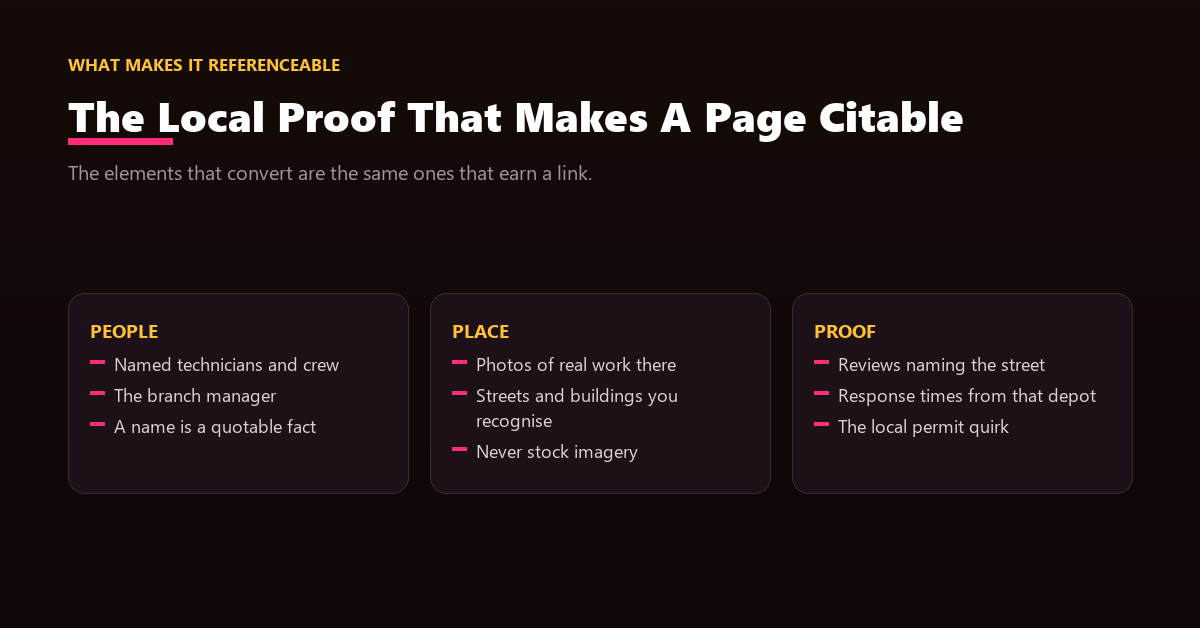
Capture wide shots of the team, before-and-after images, and a headcount or a bag count. Concrete numbers give a reporter or a city communications staffer a reason to write it up.

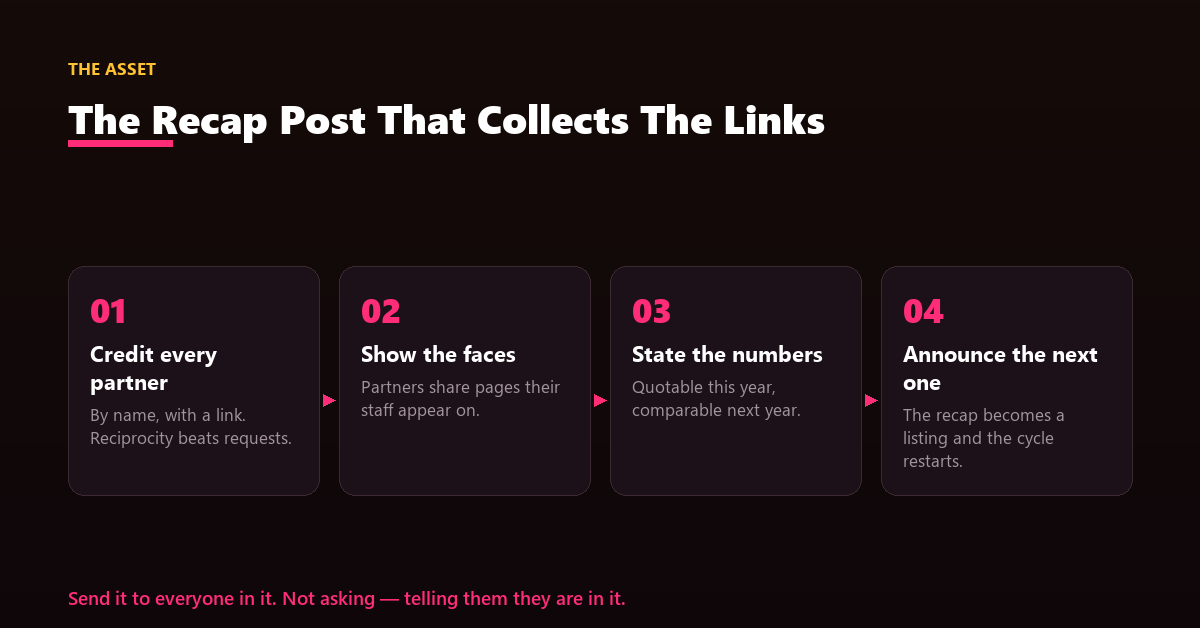
Publish your own recap first

Post a page on your site with the photos, the date, the location, and who took part. This is the destination every other link will point to, so make it worth linking to.

Send the recap to everyone who has a page

Email the city contact, the chamber, and the local paper a short note with two photos and a link to your recap. You are not pitching a story about yourself; you are handing them ready-made community content.

Who Actually Links Back

The links a single cleanup can produce

Map every organization touched by the event to the page where a link naturally lives.

🏛

City Hall & parks .gov

Municipal event calendars, parks department news, and public works recaps frequently credit and link the organizing business. These .gov links carry real trust weight.

🤝

Chamber & nonprofits

Chamber of commerce event listings and “friends of the park” groups publish calendars and thank-you posts that link participating members.

📰

Local press & blogs

Community newspapers and neighborhood blogs run good-news items with a link, especially when you hand them photos and a bag count instead of a bare press release.

Notice that none of these are the low-quality directory and aggregator links Robert says are easy to get but rarely worth much. This is the harder, higher-signal work: real placements tied to real activity. If you want it handled end to end, our community cleanup links service runs this exact playbook for local businesses, from event registration through recap outreach.

Make It Repeatable, Not a One-Off

The single biggest mistake is treating the cleanup as a one-time stunt. A quarterly cadence — spring cleanup, summer trail day, fall leaf haul, holiday drive — turns one link cluster into a recurring stream of fresh municipal and press mentions, each pointing at a new dated recap on your site. Over a year, that is a body of genuine local-authority signals no competitor can replicate by buying links. It also feeds the offline relationships that make the next event easier to organize and the next recap easier to place. Robert calls this the digital shadow of a real company: the bigger the real-world activity, the bigger the shadow you can accurately sketch online. A cleanup is one of the cheapest ways to cast a wider one.

Want these links built for you?

Book a free 30-minute link building call with Jeremy and we’ll put the right ethical tactics to work on your site.

Book a Link Building Call →

The Brand + Service + Location Anchor Formula for Local Links

Ask most local SEOs for their anchor text plan and you’ll get a list of city-plus-keyword phrases. On Unscripted SEO, Semantic Links founder Bradley Benner made the case that this is precisely the pattern that gets local sites into trouble — and that the safer, stronger play is an anchor formula built almost entirely from the brand itself.

The 90% rule: brand and compound anchors

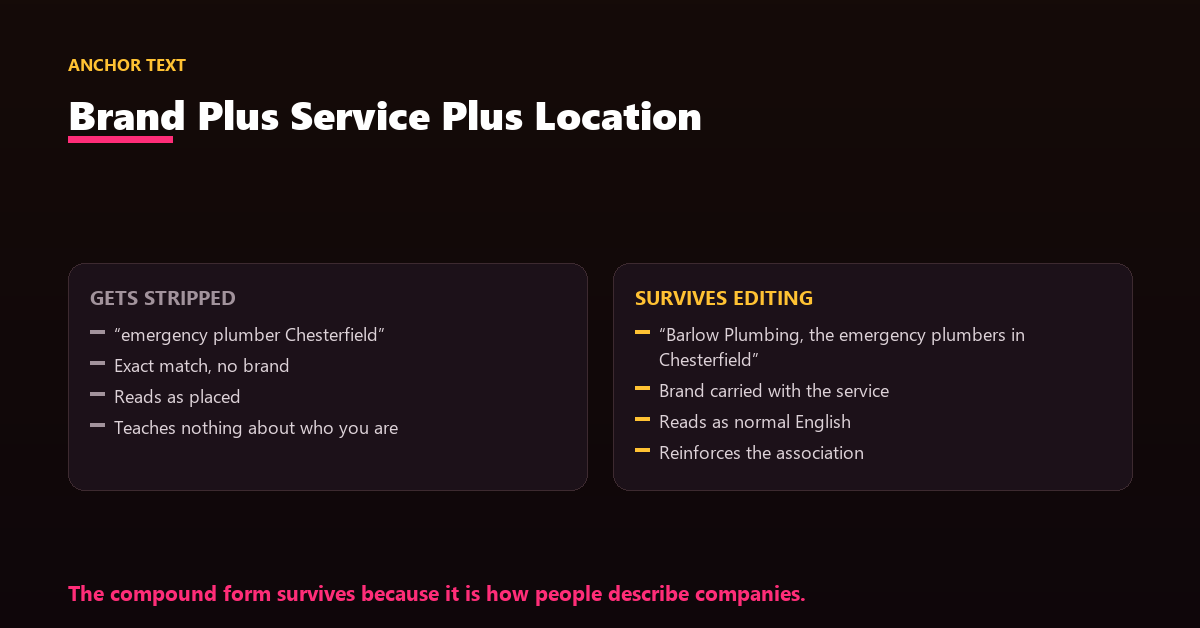
Benner’s team places off-page links for local businesses at volume, and roughly 90% of the tier-one links they build use a brand anchor or a compound anchor — the brand name plus one more entity. That leaves only a small slice for anything resembling exact-match keywords. The point is not caution for its own sake; it is that brand and compound anchors are what actually build the entity associations a local business needs to rank and to get cited.

Our job as SEOs now is not about pushing metrics. It should be about creating associations, strengthening those associations, and helping — forcing the models and the algorithms to recognize those associations. That’s our job.— Bradley Benner, Unscripted SEO

For a local business there are three entities that matter: who the brand is, what services it provides, and which areas it serves. A compound anchor packs two or three of those into a single, natural-looking link — which is exactly the kind of local and offline link building that reinforces a business as a real entity rather than a keyword target.

The four anchor shapes to rotate

The brand + service + location anchor formula

Build your tier-one anchor mix almost entirely from these four shapes. Benner’s own on-air example of a compound anchor: ‘McAllister’s tree service.’

🏷

Brand

Just the business name — ‘McAllister’s.’ The workhorse anchor. It is unimpeachably natural and it feeds the model a clean brand entity every time.

🛠

Brand + service

‘McAllister’s tree service.’ Ties the brand to what it does, associating your name with the service category you want to own.

📍

Brand + location

‘McAllister’s of Cookeville.’ Binds the brand to the area it serves — the association that powers local visibility.

🎯

Brand + service + location

‘McAllister’s tree service in Cookeville.’ The full semantic triple in one anchor — who, what, and where in a single link.

Rotating across these four shapes keeps your profile looking like something a real business earns while still packing every link with entity signal. You almost never need a bare exact-match keyword anchor to do that job.

Pair every link with a citation

Here is the move that makes local link building do double duty. Benner defines a citation as a brand mention plus at least one piece of NAPW data — Name, Address, Phone, Website. When your brand or compound anchor sits inside content that also mentions the business by name with a NAPW data point, the mention satisfies the language model and the link satisfies the backlink side. One placement, two signals.

He splits citations into two types, and the unstructured kind is currently the faster lever for AI search visibility:

Structured vs. unstructured citations

Both build entity associations. Right now, unstructured mentions are the quicker win for showing up in AI answers.

🗃

Structured citations

Strict NAP(W) listings in directories — the big directory sites and industry-specific ones. Consistent, foundational, and expected of any local business.

📰

Unstructured citations

Brand mentions with a data point appearing in the wild — press releases, branded assets, and blog mentions. Benner says these influence AI and LLM search visibility more than almost anything right now.

📢

Press releases specifically

Put a brand reference on high-authority media with a news-style freshness factor that the LLMs like to cite — a fast way to earn both a citation and, often, a relevant link.

Put the local anchor + citation method to work

A repeatable local entity-building loop

Map your three entities

Write down the exact brand name, the services you want to be known for, and the locations you serve. These are the only building blocks your anchors and citations should use.

Build your anchor mix around the 90% rule

Plan tier-one links so roughly nine in ten use a brand or compound anchor, rotating across the four shapes. Reserve exact-match keyword anchors for the rare case where nothing else reads naturally.

Lock down structured citations first

Get consistent NAPW listings in the major and niche directories so your foundational entity data is clean everywhere the models look.

Layer in unstructured citations

Earn brand mentions with a NAPW data point in relevant, local, or high-authority content — blog features, branded assets, and community write-ups — so each placement carries both a mention and, where natural, a link.

Use press releases for freshness

Publish newsworthy updates through press channels to land brand references on high-authority, fresh properties the LLMs favor when they cite local businesses.

Keep the placement genuinely relevant

Every anchor and citation should live in content and on sites that are actually about your service and area. Relevance is what turns a mention into a recognized association.

This is why community-driven placements work so well for local brands: a sponsorship writeup or a community cleanup link naturally carries your brand name, your area, and often a NAPW data point all at once — a compound anchor and a citation in a single, unimpeachably legitimate mention. Stack enough of those, built on the four anchor shapes, and you are doing exactly what Benner says the job now is: creating the associations, strengthening them, and forcing the models to recognize your business as the real, local entity it is.

Want these links built for you?

Book a free 30-minute link building call with Jeremy and we’ll put the right ethical tactics to work on your site.

Book a Link Building Call →

Join Your Local Chamber of Commerce

Chamber of Commerce

A chamber of commerce is usually a local organization of business owners that promote business and further business interest in the community. Some Chambers of Commerce are local to their city, county, statewide and some are even national.

All Chambers of Commerce also provide many opportunities for networking and community participation. Because of this, there may be many opportunities to build links through participating in your local chamber.

Link From the Chamber Website

Many Chambers of Commerce maintain a website that frequently lists their business members names, contact information, and web addresses. Inclusion onto this list should result in a link back to your website from the Chamber of Commerce’s website.

In some cases a Chamber of Commerce may even maintain a business directory for the general public which would also include links back to each businesses website.

If you are joining your chamber of commerce just for the link building opportunities it may be smart to check their website beforehand to verify that links to business websites are present and seo-friendly.

Don’t want to do the link building work all by yourself?

We can build links FOR you

Networking for Links

Links found on the chamber’s website are not the only opportunity for links from the Chamber of Commerce. Other opportunities to build links through the Chamber of Commerce may come from other business members that have their own websites.

You can take advantage of the chamber’s networking events to meet other business owners in your area that also have websites. In situations like this you can develop relationships with business owners that run complimentary businesses to your own where adding link to your business on their website would add value to their user experience as well as providing a value-add for your users if you were to link to them from your website.

This type of cooperation among business owners can be started by attending Chamber of Commerce networking events and other events in the community that put business owners in touch with each other.

You can find your local chamber of commerce at the US Chamber of Commerce Directory.

Generate Links Through Business Partners

SEO is not a solo sport.

Continue reading

Leverage Alumni Directories, List, and Publications

College Students at Graduation Throwing Their Caps In The Air in Celebration.

Many colleges and universities have alumni associations that allow them to fundraise from their former student population, and also can provide powerful networking opportunities for alumni that are members. Many of these organizations are given a special section of the University’s website for information about alumni or the activities of the organization.

Continue reading