As a 12 year veteran of the SEO industry and freelance SEO consultant, I have done SEO consulting for major brands, agencies and hundreds of "mom n pop" shops. I specialize in site audits and SEO ROI/Potential forecasts.
Most link vetting stops at one number. You check a DR, you check a DA, and if it clears the bar you place the link. Bradley Benner runs a white-label link service and says that order is backwards — relevance first, metrics only as a tiebreaker afterwards. The useful part is that he breaks relevance into three separate checks you can actually run on a prospect.
Layer one: is the link sitting in relevant content?
Not the site. The specific piece of content your link will live inside.
“Now you’ve got an anchor text link with the brand name that is now within relevant content, meaning it’s nearby entities that are related or relevant to that business and/or the area that they serve.”
So the check is: does the paragraph around my link mention the things my client actually does, and the place they do it? If the post is a general listicle and your client is the only plumber mentioned, layer one fails even if the domain is strong.
Layer two: are the site’s overall topics relevant?
One relevant post on an irrelevant site is a weaker signal than the same post on a site that is about the subject.
“If you publish that post on a blog or site where the overall topical themes of the site are also relevant to ultimately what it’s linking to, that provides a stronger signal from that entity association.”
Check the last twenty posts, not the About page. A site that published tree care, tree care, tree care, crypto, tree care is telling you what it is. A site that published forty unrelated topics in a row is telling you that too.
Layer three: what is linking to the site you’re about to use?
This is the one almost nobody runs, and it is the most interesting.
“Then if you’re looking at the backlink profiles that are already pointing to the referring domain that you’re going to publish the post on … you should be looking at the backlink profile to determine what is the relevance of the link profile pointing to this domain.”
You are asking what company the prospect keeps. A domain with an on-topic inbound profile sits inside the right neighbourhood. A domain whose inbound links come from everywhere and nowhere is a general-purpose link farm wearing a niche costume, and the metric will not tell you that.
The anchor decision this changes
Benner places brand anchors on about 90% of the links his service builds at tier one, or what he calls a compound anchor: brand plus service, brand plus location, or brand plus service plus location. The goal is proximity, not keyword matching.
Before you pitch or buy a placement, score the prospect out of three: relevant paragraph, relevant site, relevant inbound profile. Two out of three is usually worth doing. One out of three is a link you are buying because the number was green.
Then, and only then, look at DR. What would your last ten placements have scored?
There is a stretch in the life of most small brands where earned coverage clearly matters and there is no budget for anyone to go and get it. Allen Halas, who has worked the music side of this, describes the window plainly on the Unscripted Small Business podcast.
My background, I started as a journalist, worked through that.
That is Joshua Altman, and it is worth noting first because it reframes what follows. The people deciding whether to quote you came up through newsrooms, and they are reading for whether you can actually answer the question – not for whether you hired someone to ask.
The DIY window is real, and it closes
I left that thinking I’d go back to a newsroom after being a freelance reporter and didn’t go back to a newsroom.
Allen’s version of the same argument is about money rather than credentials. His point, lightly condensed from the recording: if you are an independent artist, learning to craft a press release and build a brand online carries you a long way – until there is enough revenue to hire a PR firm or a music PR agent at a couple of thousand a month.
What this means for links
The link-building version of this is that outreach and digital PR are the same motion at different budgets. A founder who can explain their subject clearly in an email is doing the job a publicist would be hired to do. The constraint is never the writing. It is knowing which reporter is asking, today.
Joshua Altman’s quotes are verbatim, verified against the raw transcript on 11 September 2026. Allen Halas’s contribution is paraphrased rather than quoted, because the cleaned version joined two of his turns and removed filler – the substance is his, the exact wording is not.
Good link building is tedious. That is normally the honest answer. Rob Bonham found the exception, and it was sitting inside his client’s accounts payable.
Rob has spent over two decades in SEO, more than half of it inside agencies, across local, e-commerce, SaaS and home services. When I asked him where the red lines are in link acquisition, he skipped the vendor question entirely and told me about a maintenance, repair and operations parts supplier.
The supplier link nobody asks for
The client was e-commerce, carried hundreds of brands, and sold to hotels and apartment complexes rather than the public. Every one of those brands had a store locator or a where-to-buy page.
“one thing that I’ve seen work quite a bit in in links is is getting links from like legitimate partners that that that you work with… And it worked tremendously well and it was very easy. Typically, good link building is is not very easy. It’s it’s tedious, it requires a lot of outreach.”
— Rob Bonham, on Unscripted SEO
His description of the pitch is the reason it converts:
“We’re not paying for these links. We’re we’re not we’re not twisting their arm. We’re just saying, hey, you know, we we have something that’s gonna be important to your business. You might want to use us so we can, you know, kinda kinda help each other grow.”
— Rob Bonham
He called it shooting fish in a barrel. That is a rare sentence in link building and the whole reason this post exists.
Make the list before you make the pitch
Every business already sits inside a web of commercial relationships that nobody has ever mapped for link purposes. Go and write them down:
Suppliers and manufacturers whose products you stock, install or resell. Where-to-buy pages, dealer locators, authorised installer directories.
Software and platforms you pay for. Most have a customer story programme nobody applies to.
Trade bodies, chambers and associations where you already pay dues and have never claimed the profile.
Subcontractors and referral partners in both directions.
Sponsorships, charities and events you already funded. Rob’s question about a donation is the one that stings: “did you did you even get a press release out about it?”
None of that is outreach. It is an audit of things you have already paid for.
The reason cold outreach stopped converting
Christopher Gimmer bootstrapped Snappa and now runs Goodmetrics. He does not think the tactic got worse. He thinks the channel got full:
“it’s it’s hard to do kind of traditional link building now just because like everyone’s inboxes are full of spam and stuff like that. And so I think people are more willing and likely to link out to a really good tool that actually solves a problem versus a yet another you know, blog post with you know, a wall of text.”
— Christopher Gimmer, on Unscripted SEO
That is a build instruction disguised as an observation. A calculator, a checker, a real dataset, a free tier — those earn links from people you never emailed. Christopher’s own free stock photo site is what launched a paid product.
What agencies are actually still doing
Jason Berkowitz founded Break The Web and has been doing SEO since 2010. Asked what still works when top-of-funnel traffic is down, his answer named the off-page work explicitly:
“Good off-page SEO, digital PR, link building, having good first-party data that journalists will eat up, connecting with other publications that maybe have content gaps, whatever it is. It’s still working. It’s still working well.”
— Jason Berkowitz, on Unscripted SEO
First-party data is the operative phrase. A journalist does not need your opinion. They need a number that only you have, which is a different production problem from writing another guest post.
Where the mention is now worth as much as the link
Rob’s current priority is not a link at all:
“the biggest thing right now… is you know the like unlinked mentions, getting b you know, visibility on on other third party publications and marketplace sites is more important than ever.”
— Rob Bonham
His example is a search for the best plumber nearby, where the answer gets assembled from listings scattered across the web: “It’s gonna look at Yelp. It’s gonna look at you know, maybe you know, like a home advisor or you know, other other places where that plumber might have listings across the web.” His conclusion, which applies well beyond local: “whoever has you know the bigger footprint and the more people talking about them across the web in a positive way.”
The order of operations
If you have a limited number of hours this month, spend them in this order: relationships you already have, assets worth linking to, data worth citing, then everything else. Cold email is last because it is where everyone else already is.
Quotes are verbatim from the raw Riverside transcripts, trimmed only for false starts and filler. More at Link Building Ideas and Unscripted SEO.
There is a set of pages in every industry that almost nobody competes for, that are maintained by companies who want them to be comprehensive, and that link out by design. They are the where-to-buy pages, dealer locators, partner directories and approved-installer lists run by the suppliers you already pay.
This is the least competitive link source in most industries and it is usually overlooked because it is not exciting.
The Pages Your Suppliers Already Maintain
Consider the incentive from the other side. A manufacturer’s where-to-buy page exists so their end customers can find someone to buy from. An incomplete list costs them sales. A partner directory exists to make the company look established and well-supported; a thin one is embarrassing. These pages want more entries.
Which means you are not asking for a favour. You are offering to solve a problem the page exists to solve. That is a fundamentally different conversation from every other kind of outreach, and it is why the completion rate is so much higher.
The categories worth checking, in rough order of yield:
Where-to-buy and stockist locators. The classic. If you resell anything, you probably qualify already.
Approved installer or certified partner lists. If anyone on your team holds a certification, there is very often a public directory attached to it that nobody told you about.
Software and platform partner directories. Every tool you pay for monthly likely has one, and they are frequently self-service.
Trade association member listings. You are already paying the membership. Check the listing actually links.
Franchise, distributor and regional-agent pages. Where they apply, they are usually the strongest pages of the lot.
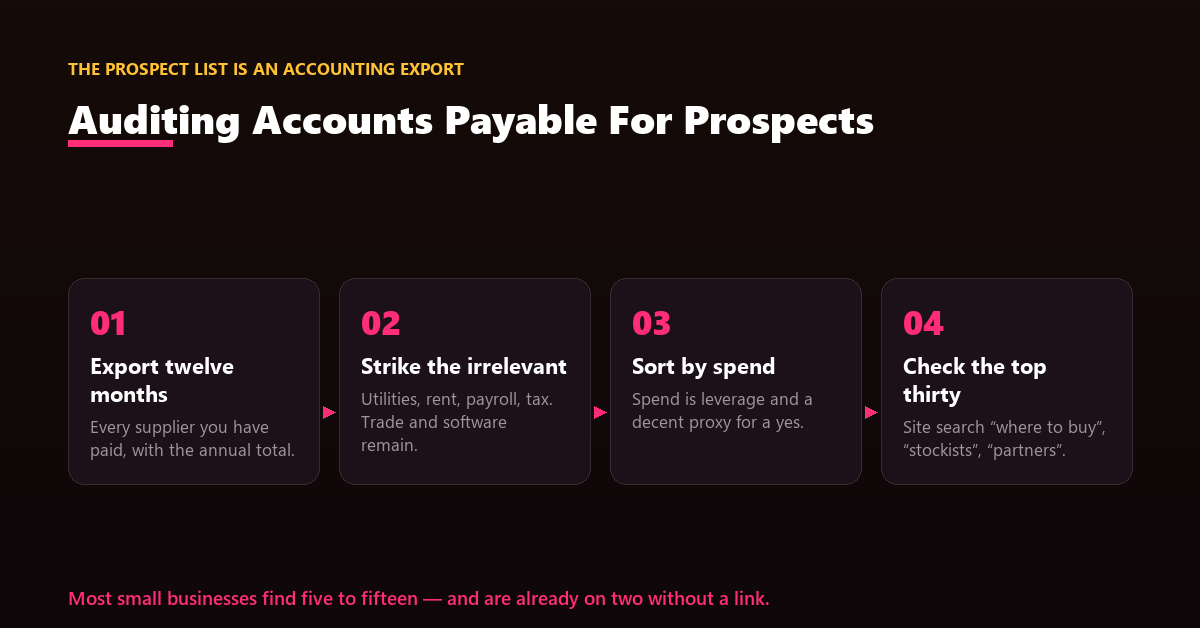
Auditing Your Own Accounts Payable For Prospects
The prospect list is not something you research. It is an export from your accounting system, and this is the single most useful hour in the whole play.
Export twelve months of supplier payments. Every company you have paid, with the annual total.
Strike out the irrelevant. Utilities, rent, payroll, tax. What remains is trade suppliers, software and services.
Sort by annual spend, descending. Spend is leverage, and it is also a reasonable proxy for how likely they are to say yes.
Check the top thirty for a partner page. Site search for “where to buy”, “stockists”, “partners”, “find a…”, “approved…”. Five minutes each.
Note who your contact is. The account manager, by name. This is what makes the email work.
A typical small business finds somewhere between five and fifteen qualifying pages, and is usually already listed on two of them without a link.
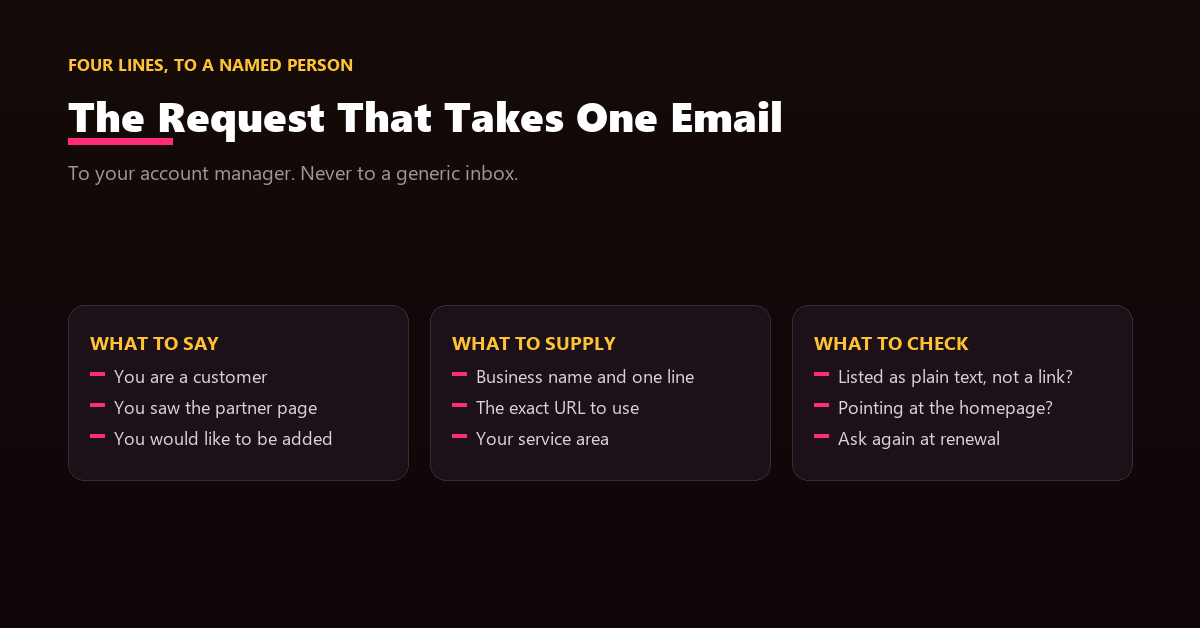
The Request That Takes One Email
Send it to your account manager, not to a generic address. They are commercially motivated to keep you happy and they know exactly who internally owns the website.
Keep it to four lines: you are a customer, you noticed the partner page, you would like to be added, and here are the exact details to use — business name, one-line description, the URL, the service area. Supplying the copy removes the only real obstacle, which is that somebody would otherwise have to write it.
Never mention SEO. You are a customer asking to be listed on a customer listing. That is all this is.
Ask for the right destination. The relevant service page, not the homepage, if the directory allows it.
Check what is there afterwards. Listings frequently go up with the business name as plain text. A one-line reply fixes it.
Do it at renewal. If you are about to place an order or renew a contract, that is the moment with the most goodwill in it.
Reciprocal Partner Pages Done Honestly
The obvious next step is a partner page of your own, and it is worth doing for reasons that are not primarily about links. A genuine “who we work with” page helps customers understand what you install, what you stock and who stands behind it.
The honest version is straightforward. List the suppliers you actually use. Say what the relationship is. Do not build a page whose only function is to trade links with anyone who will trade back, and do not solicit reciprocity as a condition — a partner page that exists to be swapped looks exactly like what it is, to editors and to search engines.
Built properly, it also gives you something to offer first. Adding a supplier to your page before asking about theirs converts the request into a reciprocation, which is an easier thing for anyone to agree to.
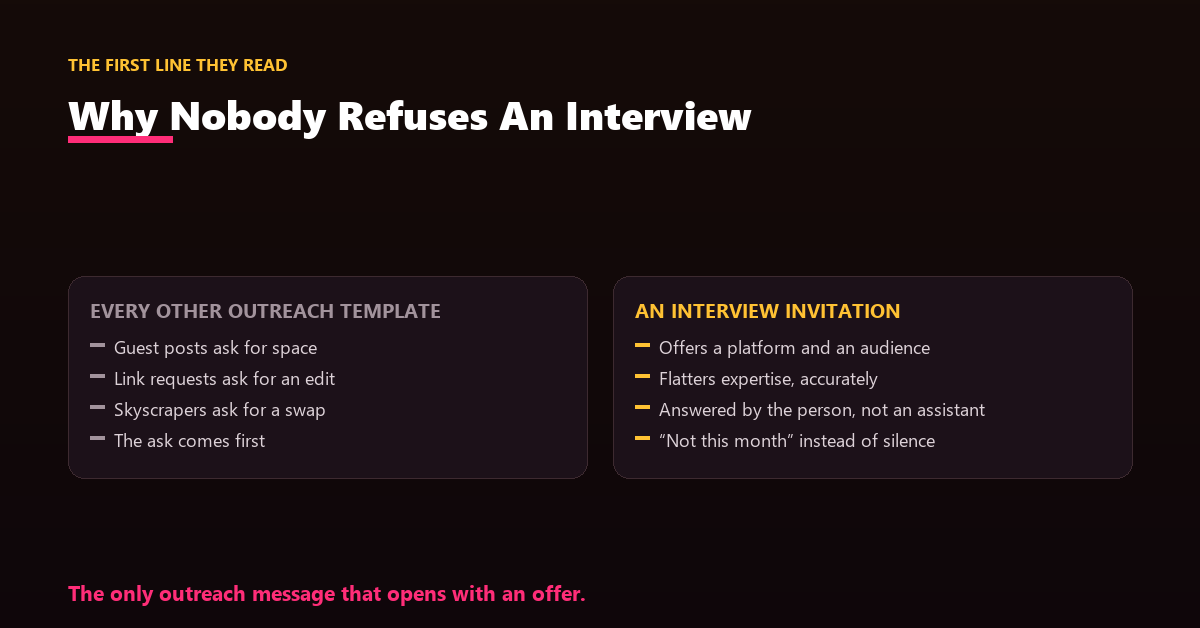
Outreach has a structural problem: almost every template asks a stranger for something before giving them anything. Guest post pitches ask for space. Link requests ask for an edit. Skyscraper emails ask for a swap. The recipient’s first thought is always the same, and it is not a warm one.
There is one common outreach format that inverts this completely, and it is the reason we keep recommending it: asking to interview someone.
Why Nobody Refuses An Interview
An interview invitation is the only outreach message where the first thing the recipient reads is an offer. You are proposing to give them a platform, an audience and a transcript that flatters their expertise, in exchange for an hour.
It is also, unusually, an ask that is easy to say yes to for reasons that have nothing to do with you. People like talking about their work. People want to be seen as the expert in their field. Very few people are asked. That combination is why the format converts where better-written pitches do not.
We are not going to give you a response-rate figure, because we do not have a clean one and neither does anybody else quoting them at you. What we can say from running both is that the shape of the reply is different: interview requests get answered by the person, not by an assistant, and the no is usually “not this month” rather than silence.
Value Before The Ask
Greg Digneo, who ran growth at Time Doctor and now runs Content Guppy, describes the strategic version of this — not as an outreach tactic, but as where brand conversation now happens. Asked how the approach had changed, his answer moved the activity off the blog entirely:
We’re going to put that stuff on Reddit. We’re going to put that stuff on other publications. We’re going talk about that in podcasts. We’re going to talk about that in YouTube channels— Greg Digneo, Content Guppy, Unscripted SEO
He is describing where the audience actually is rather than a link-building play, and we want to be exact about that rather than recruit him to an argument he did not make. What he does confirm is the payoff from the recipient side: describing why Time Doctor’s outbound and inbound were both warmer, he says people already knew them — they had signed up for the newsletter and forgotten, or read the blog once, “or because they had heard us on a podcast.”
His related warning is worth carrying: an SEO focused only on links and content is, in his words, siloed. The interview format is one of the cheapest ways out of that silo, because it produces a conversation, a page, a relationship and a link from a single hour.
One thing Digneo did not say, and we are flagging it because the claim circulates: he did not tell us that an hour on a microphone outperforms reworking your own content. That is not in the interview. What is in it is the argument for building and borrowing distribution rather than relying on a channel you do not own.
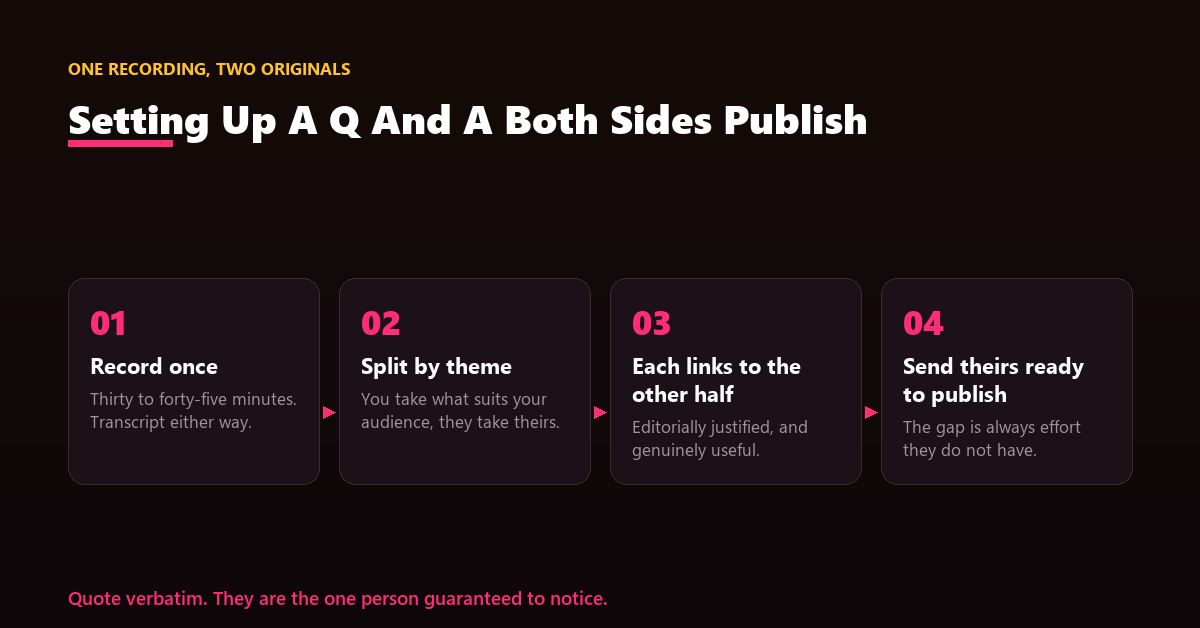
Setting Up A Q And A Both Sides Publish
The version that reliably produces a link on both sides. The key is that neither party publishes the same text, so both have something original.
Record once, properly. Thirty to forty-five minutes, video if they will, transcript either way.
Split by theme, not by half. You publish the part that suits your audience; they publish the part that suits theirs. Two distinct pieces from one conversation.
Each side links to the other half. Natural, editorially justified, and genuinely useful to the reader, who may well want the rest.
Send them their half ready to publish. Formatted, quotes checked, images included. The gap between a willing participant and a published page is almost always effort they do not have.
Keep the transcript. It is your evidence for every quote and it is where the next three pieces of content come from.
The Link That Follows Without Being Requested
The link is rarely the thing you ask for, and that is why the format works. Someone who has spent an hour talking to you, been quoted accurately, and received a finished page they can publish under their own name will almost always link back, mention it, or send it to their list.
The one discipline that decides this: quote them verbatim. A subject who reads a tidied-up version of their own words, however flattering, immediately trusts you less — and they are the one person guaranteed to notice. Accuracy is the whole basis of the reciprocity.
Scaling To Four Interviews A Month
Four a month is a realistic ceiling for one person doing this alongside other work, and it is enough to change a link profile within two quarters.
Batch the outreach. Twenty invitations in one sitting, monthly. It is the same twenty minutes whether you send two or twenty.
Batch the recording. Two afternoons a month, back-to-back slots. Context switching is what kills this.
Standardise the question set. Six core questions, two specific to the person. Comparable answers across interviews are worth more than bespoke ones, because they become roundups later.
Fix the turnaround. Publish within ten working days, every time. Late delivery is the single fastest way to lose the referral to the next guest.
There is a category of link that requires no prospecting, no relationship building and no persuasion, because the hard part already happened: somebody wrote about you and did not link. The page exists, the editor already decided you were worth mentioning, and the only thing missing is an anchor.
This is a weekend sprint. It has a beginning and an end, and most businesses have never run it once.
Why Unlinked Mentions Are The Cheapest Win
Every other link acquisition method has to overcome the same objection: why should this page reference you at all. Reclamation skips it entirely. The editorial judgement has been made, in your favour, by someone who was not asked.
That changes the email you are sending from a pitch into a correction, and corrections have a completion rate that pitches do not. You are not asking anyone to endorse you. You are pointing out that a reference they already made is missing the thing that makes it useful to their reader.
It also has a natural ceiling, which is why it is a sprint rather than a programme. Most businesses have somewhere between a handful and a few dozen unlinked mentions accumulated. You clear them, you set up monitoring, and you move on.
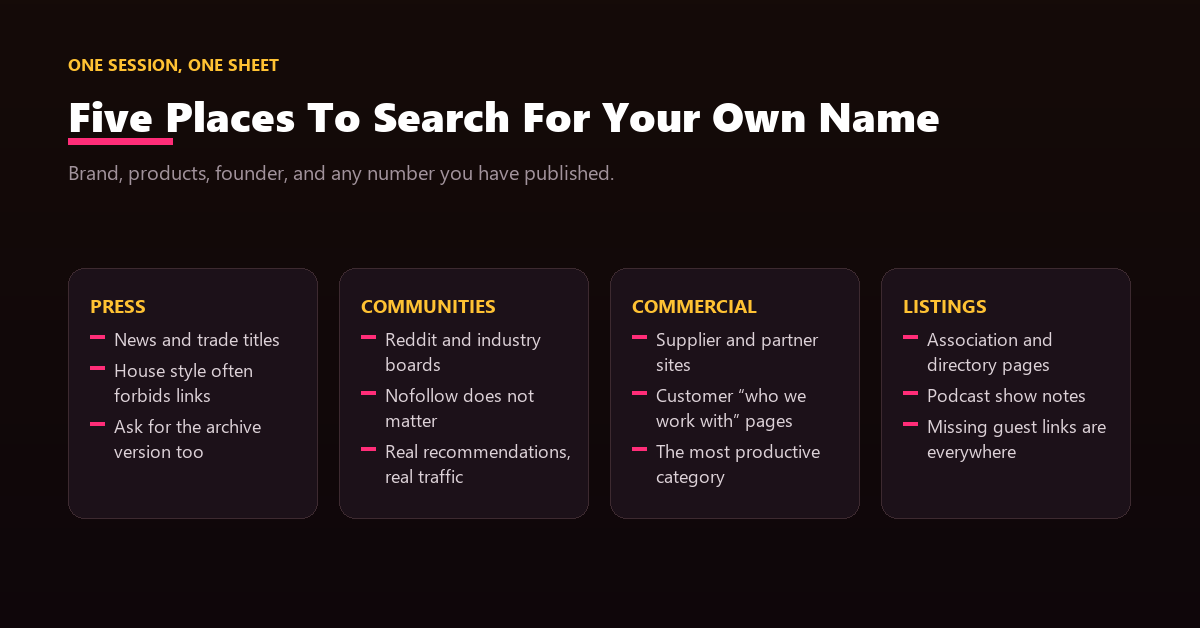
Five Places To Search For Your Own Name
Search your brand name, your product names, the founder’s name, and any proprietary number or phrase you have published. Then work these five sources.
News and trade press. Anywhere you were quoted, listed or referenced. Trade publications are the most likely to mention without linking, because house style often forbids it — ask anyway, and ask for the archive version.
Forums and communities. Reddit, Stack Exchange, industry boards. Many are nofollow and it does not matter; a recommendation from a real user is worth having as a citation and often as traffic.
Supplier, partner and customer sites. The most reliably productive category and the one everybody forgets. Companies list who they work with constantly and link inconsistently.
Directories and association pages. If you are a member of anything, check whether the listing actually links. A startling proportion do not.
Podcast show notes and transcripts. If anyone from your business has ever been a guest, check the episode page. Missing guest links are extremely common and are fixed in a day by a friendly host.
Do it in one session and keep a single sheet: URL, where the mention appears, who to contact, sent, outcome. The sheet is what makes the sprint finishable.
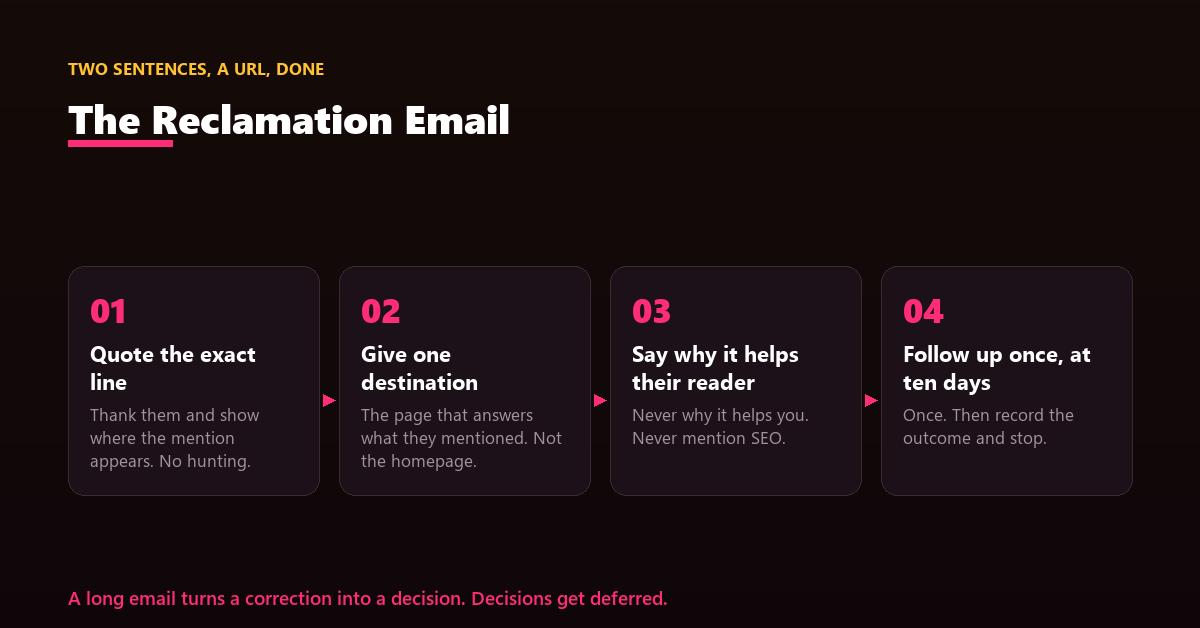
The Two-Sentence Reclamation Email
Length is the most common mistake. A long email turns a trivial correction into a decision, and decisions get deferred. Two sentences, a URL, done.
Sentence one: thank them and quote the exact line where the mention appears, so they do not have to go looking. Sentence two: give the URL you would like it to point to and say why it helps their reader — not why it helps you.
Send it to a person. The author or the editor by name. Contact forms are where these die.
Never mention SEO. The moment you do, you have converted a helpful correction into a favour with a commercial motive attached.
Give the exact destination. Not your homepage. The page that actually answers the thing they mentioned.
Follow up once, after ten days. Once. Then stop.
What To Do When They Say No
Some publications have a blanket policy against outbound commercial links, and the correct response is to believe them and be gracious. You have just had a friendly exchange with an editor who already thinks you are worth mentioning, which is a better position than you were in an hour ago.
Ask if they will correct anything factual instead. A wrong job title or an out-of-date figure is worth fixing on its own merits, and it makes the mention more useful.
Offer to be a source. “If you cover this again, I am happy to be quoted” converts a dead end into a relationship. This is where reclamation quietly turns into digital PR.
Record the no. Put it in the sheet so nobody on your team asks the same publication again in eight months.
Leave it alone. An unlinked mention still contributes as a citation. Not every mention has to become a link to have been worth something.
Then set up monitoring so this never becomes a backlog again — an alert on the brand name, checked monthly, turns a recurring sprint into a five-minute habit.
Most link building tries to earn a mention on a page that already exists. Event-based link building does the opposite: it creates a real-world occurrence that a number of organisations are already in the business of listing, and then makes sure you are the organisation attached to it.
A community cleanup is the cheapest version of this we know. Here is the full run sheet.
Why An Event Beats An Outreach Campaign
Outreach asks a stranger to change a page for your benefit. An event gives several organisations something they already want to publish: city calendars, chamber event pages, volunteer aggregators, community Facebook groups and local news all exist to announce things that are happening. You are supplying inventory, not requesting a favour.
The second advantage is that the links arrive from properties that are almost impossible to reach any other way. There is no editorial pitch that gets a business onto a municipal events calendar. Running an event does.
The third is that it produces things: photographs, names, a before-and-after, a number (bags collected, volunteers, hours). Those are the raw materials for the recap that collects the links afterwards.
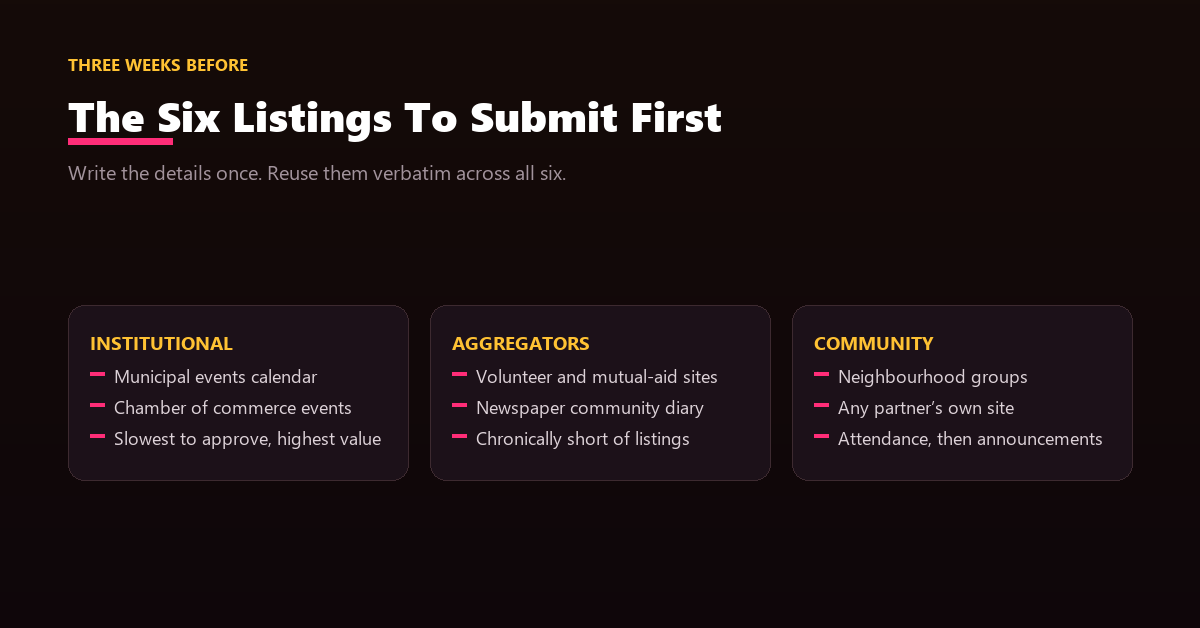
The Six Listings To Submit Before The Event
Submit these in the three weeks before the date, in this order. Most have a lead time and all of them want the same six fields, so write the details once and reuse them verbatim — consistency across listings is doing double duty here.
The municipal or city events calendar. Slowest to approve and the most valuable. Start here.
The chamber of commerce events page. If you are a member this is usually self-service and nobody uses it.
Volunteer and mutual-aid aggregators. These exist to list exactly this and are chronically short of listings outside major cities.
The local newspaper’s community diary. Free, still maintained, and often the one that gets picked up.
Neighbourhood and community groups. Lower link value, highest attendance value. You need people to actually turn up or the recap is thin.
Any partner’s own site. If a supplier donates bags or a cafe donates coffee, they will usually announce it, and their announcement names you.
Keep a sheet of where you submitted, the date, and whether it went live. Roughly a third will not publish and a polite follow-up recovers half of those.
Getting Local Press To Show Up
Press coverage is the difference between a good link haul and a very good one, and it is mostly a logistics problem rather than a persuasion one.
Give them a photograph they cannot take later. Local newsrooms are small. Tell them the time when the most people will be visible in one place.
Supply the human story, not the corporate one. The retired couple who have done every cleanup for six years is the story. Your company is the caption.
Send a number the day after. Bags, volunteers, hours, weight if you can get it. A number turns an event into a report and reports get filed.
Offer a named quote. The organiser, with a title, saying something specific and short.
If nobody comes, the day-after write-up sent to the community desk frequently gets published anyway, because it is free, local and finished.
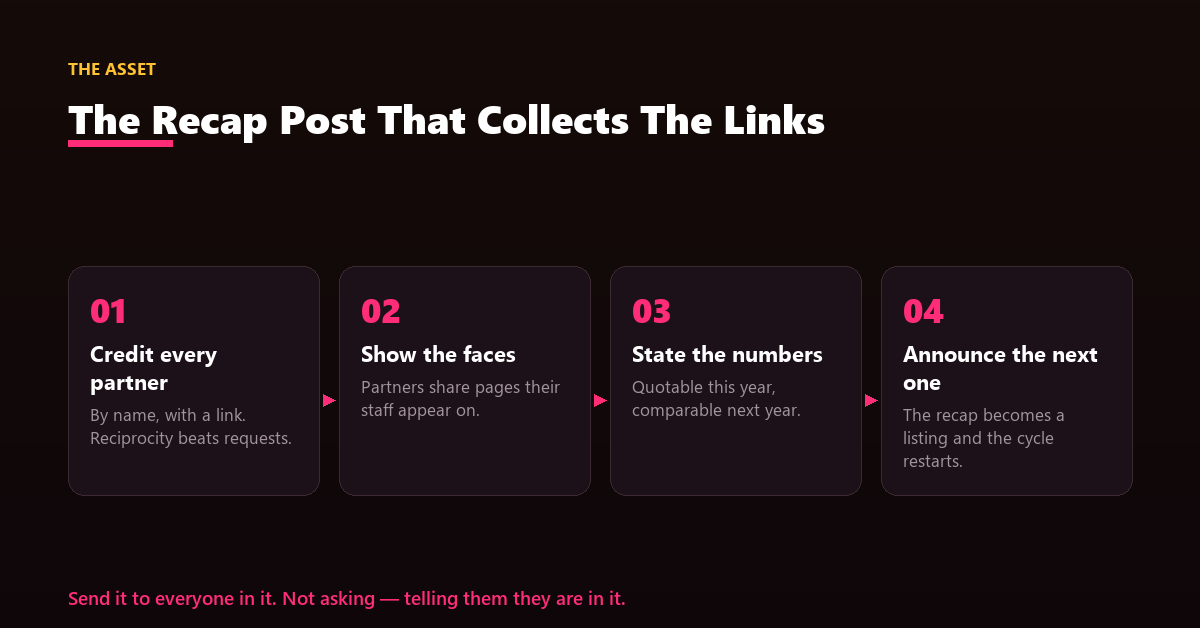
The Recap Post That Collects The Links
The recap is the asset. Everything before it produces attention; the recap converts that attention into pages that point at you.
Credit every partner by name, with a link. This is the mechanism. People reciprocate credit far more reliably than they respond to requests.
Include the photographs. Faces, not litter. Partners share pages their staff appear on.
State the numbers. They make the page quotable and they make year two comparable.
Name the volunteers who agreed to be named. Ask on the day.
Say when the next one is. This converts the recap into a listing, which starts the cycle again.
Then send the recap to everyone in it. Not asking for a link — telling them they are in it, with a photograph of their staff. The links follow from that far more often than from anything you could ask for directly.
Repeating It Quarterly Without Burning Out
The temptation after a successful first event is to schedule monthly. Do not. Quarterly is the cadence that survives, and the compounding comes from repetition rather than frequency: by the third one, the calendars know you, the newspaper knows you, and the partners ask when the next one is.
Freeze the operational details in a checklist immediately after the first event, while you still remember what went wrong. The whole play is one afternoon of work and three weeks of admin, and the admin is the part that gets dropped when nobody wrote it down.
Every link builder eventually notices the asymmetry: the pages that get referenced by other people are rarely the pages that were built to be referenced. They are usually the ones that contained a fact somebody needed, stated clearly enough to be repeated.
Drew Dorenfest, who runs Client Magnet CRM, gave the clearest mechanical account of this we have heard, and it has a specific implication for how you rewrite what you already have.
The Verification Loop In Plain English
Dorenfest built content for a financial services client with offices in California and Las Vegas, going deliberately narrow: California versus Nevada tax code, gambling taxes, overtime taxes for Vegas service workers, student loan interest deductions. His account of why it worked:
The key to getting cited is to cite your sources. Link to IRS.gov, link to the tax research that backs your claims. When crawlers come and cross-reference your information against those sources and verify them, they go: okay, this company is legitimate, has been around for ten years, has great reviews — I will treat this as an authoritative source.— Drew Dorenfest, Client Magnet CRM, Unscripted SEO
The loop, stated plainly: a claim with a named source can be checked; a claim that checks out is safe to repeat; a page full of claims that check out becomes the thing other people repeat.
Dorenfest reports strong outcomes for that client — the student loan interest deduction post ranking above IRS.gov, HR Block and TurboTax within two weeks. He is careful about attribution, though, and so are we: he credits the combination of sourcing, content depth at a specificity the national brands lacked, and tax professionals reviewing every post for accuracy. Citing sources on a shallow page is not the play he is describing.
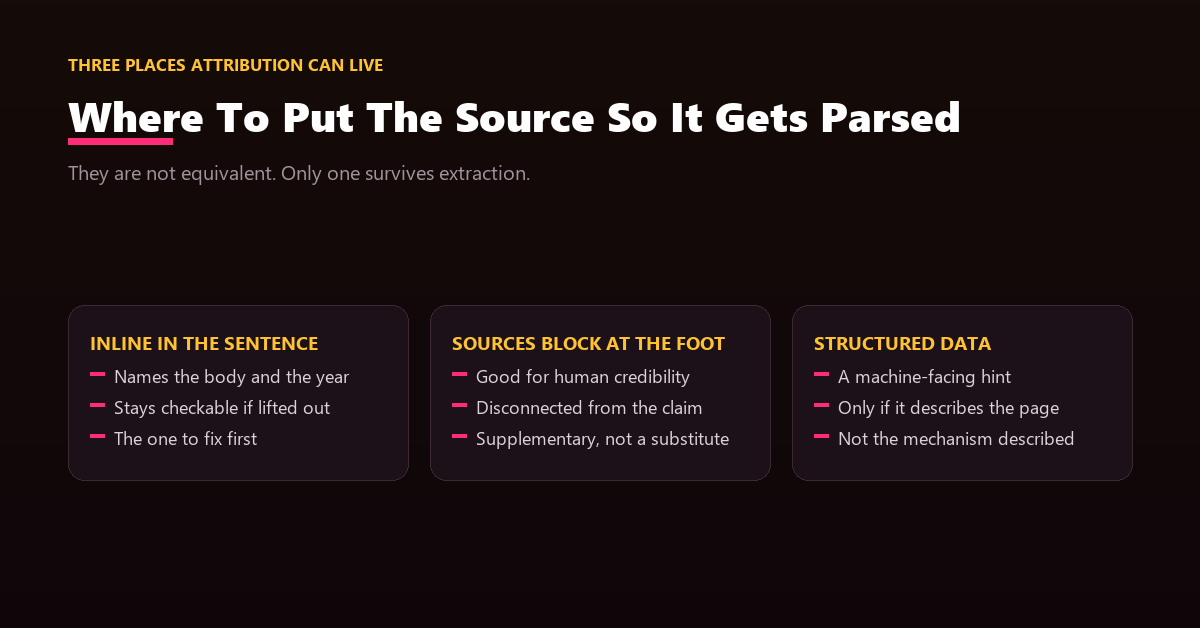
Where To Put The Source So It Gets Parsed
Our own guidance from here. There are three places attribution can live, and they are not equivalent.
Inline, in the sentence. The strongest form. “According to the Office for National Statistics’ 2025 release, X” remains a complete, checkable statement if the sentence is extracted from the page entirely. A bare link on the word “research” does not.
A sources block at the foot. Useful for human credibility and for anything that would clutter the prose, but it is disconnected from the claim it supports. Supplementary, not a substitute.
Structured data. Worth having where it genuinely describes the page, and worth being honest that it is a machine-facing hint rather than the mechanism Dorenfest describes. His account is about the claim being checkable, not about the markup.
If you only change one thing, change the inline form. It costs nothing, it improves the page for humans, and it makes every sentence portable.
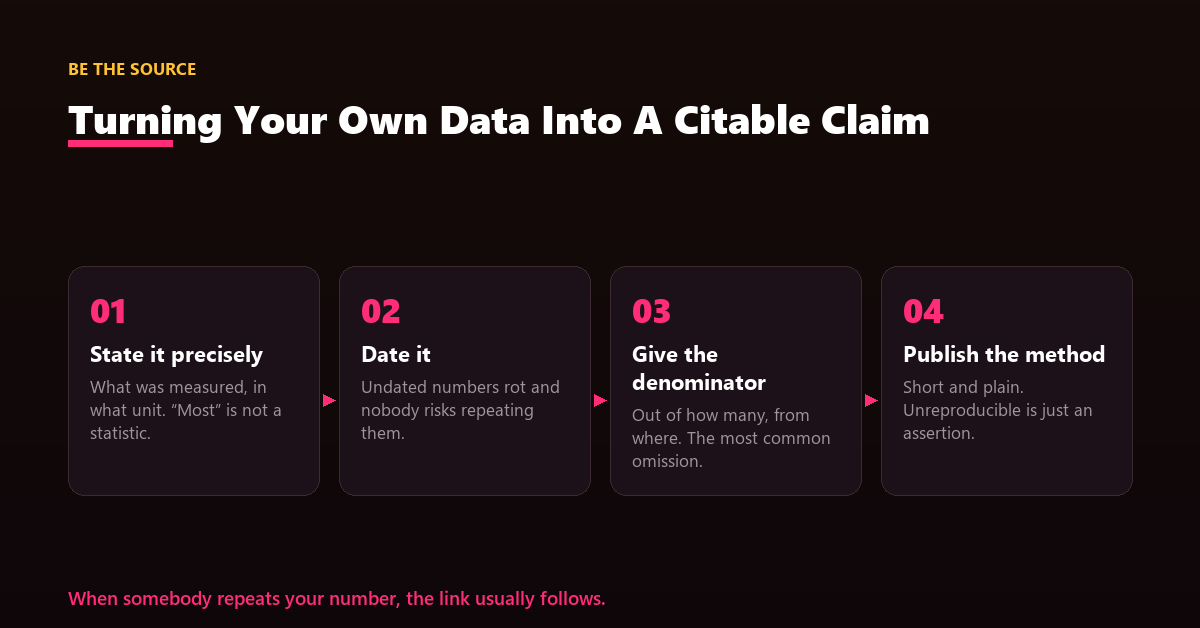
Turning Your Own Data Into A Citable Claim
The other half of the loop, and the half most businesses ignore: you can be the source. Most companies are sitting on numbers nobody else has — job durations, failure rates, seasonal patterns, quote-to-close ratios, response times.
To turn an internal number into something citable it needs four things, and missing any one of them makes it unusable to anybody else:
A precise statement. What was measured, in what unit. “Most” is not a statistic.
A period. Undated numbers rot silently and nobody will risk repeating them.
A denominator. Out of how many, from where. This is the single most common omission and the one that gets a claim dismissed.
A method anyone could repeat. Short, plain, on the page. A number nobody can reproduce is an assertion with a decimal point.
Do that and the loop runs in your favour: your page is the source other people cite, and their citation is the link you did not have to ask for.
The Rewrite Pass On Your Top Twenty Pages
This is the practical programme, and it is deliberately small. Take the twenty pages that already earn something — traffic, leads, links. Do not start with the archive.
Highlight every factual claim on the page. Most pages have between three and eight.
For each one, find the origin. Some will be sourceable in a minute; some will turn out to be industry folklore nobody can trace.
Rewrite the sourceable ones with the attribution inside the sentence.
Cut or properly research the ones that are not. This is the uncomfortable step and the valuable one.
Where the honest source is your own data, apply the four-part test above and make the page the citable original.
Budget about forty minutes a page. Twenty pages is a fortnight of afternoons, and it improves the pages for readers regardless of whether any machine ever notices.
What To Watch After The Rewrite
Do not measure this in referring domains for the first quarter; that is the wrong instrument and it will tell you it failed. Track instead: unlinked mentions of your brand and your specific claims; what the answer engines name when asked the questions your buyers ask, recorded monthly in identical wording; and whether the specific statistics you published start appearing in other people’s writing.
That last one is the real signal. When somebody repeats your number, the link usually follows, and when it does not you have a clean, courteous reclamation email to send.
Location pages are the most-produced and least-linked asset in local SEO. Agencies build them by the hundred, they occasionally rank, and in years of link building we have never once seen anybody link to one voluntarily. Melissa Popp, who runs content strategy at Rickety Roo, explains why in language we are not going to soften.
Nobody Links To A Find-And-Replace Page
Popp’s assessment of the category is unambiguous:
anybody who works in local will tell you that location pages are probably some of the worst content that’s ever existed in search.— Melissa Popp, Rickety Roo, Unscripted SEO
Her diagnosis is about intent rather than effort. The amount of low effort that goes into these pages, she says, is because the sole idea is that they need to rank on page one — and then that is it. The conversion job is ignored entirely. She describes what that produces: pages where the cities have simply been swapped out, and pages that still have lorem ipsum on them, ranking anyway because the competitive space is thin.
And, plainly:
the majority of location pages I see out there. They suck I’m not gonna mince words there— Melissa Popp, Rickety Roo
For a link builder the consequence is mechanical. A page produced by find-and-replace contains nothing a third party could have a reason to reference. There is no fact, no name, no photograph, no number — nothing a chamber newsletter, a local blog or a supplier could point at and say this is the useful bit.
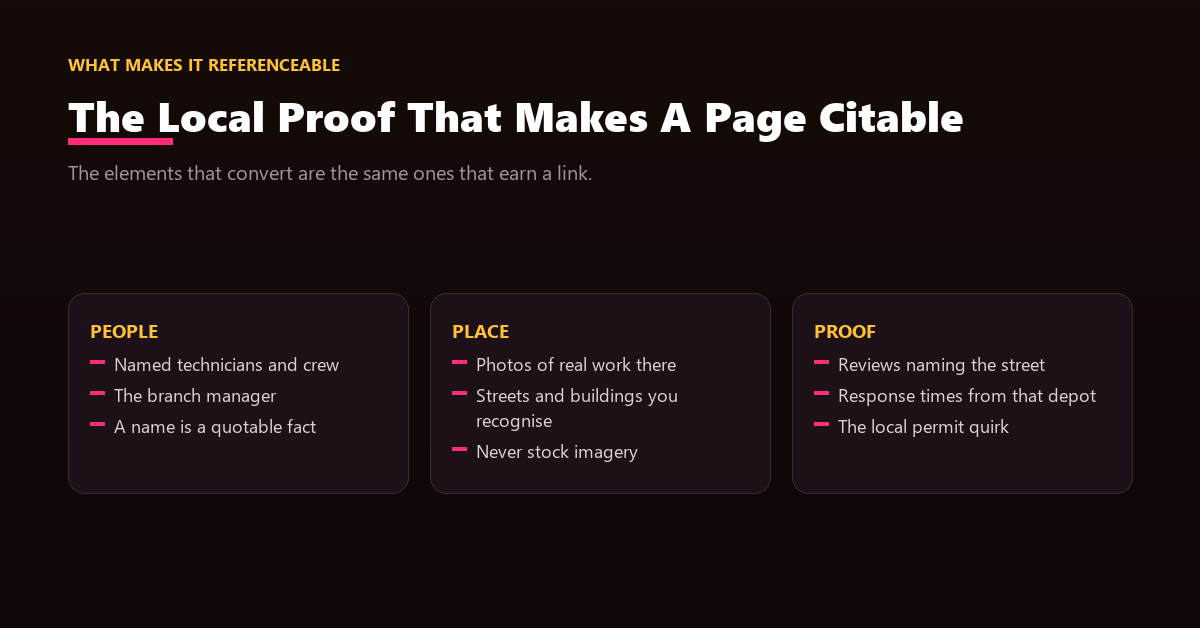
The Local Proof That Makes A Page Citable
Popp is clear about what the page is for. In her framing, location pages are supposed to be bottom-of-funnel content — people landing there should already be convinced or have an immediate need, and should take an action rather than come back to it later. Her own team’s approach is to build pages that actually convince someone who lands on them to click to call or fill out a form.
What follows is our own translation of that into link-earning terms, not her checklist. The elements that make a page convert are, conveniently, the same elements that make it referenceable, because both require the page to contain something true and specific.
Named people. The technicians, the branch manager, the crew who actually work that area. A name is a fact and facts are quotable.
Photographs of real work in that place. Recognisable streets, buildings, projects. Stock imagery is the visual equivalent of find-and-replace.
Specifics only a local would know. Response times from that depot, the permit quirk in that town, the two neighbourhoods you actually cover versus the one you do not.
Reviews with detail in them. Not five stars — a customer naming the street and the problem.
Something genuinely useful. The local permit process, the seasonal timing, the thing everyone in that town asks. This is the part a community site can link to.
Popp also makes the coverage argument that gets these pages built in the first place, and it is worth keeping: for service-area businesses in particular, having location pages for the suburbs, neighbourhoods and neighbouring cities is how you show up organically outside the map pack, which she considers incredibly important where the proximity factor works against you.
Getting A Community Site To Link To A Service Page
Our own play, and the one that turns the above into links. Popp did not discuss outreach; this is what we do with pages built to her standard.
Find the page that already lists businesses like yours. A chamber directory, a town-centre association, a “local services” roundup on a community site. Ask to be listed where you already qualify before asking for anything else.
Give them the useful section, not the sales page. If your Chesterfield page contains a genuinely helpful explanation of the local permit process, that is the thing worth referencing, and it is a much easier ask than “link to our service page”.
Offer the named human. Community sites and local press want a person to quote. The named technician on your location page is a source.
Make the page independently worth the click. Nobody links to a page they would be embarrassed to send a neighbour to.
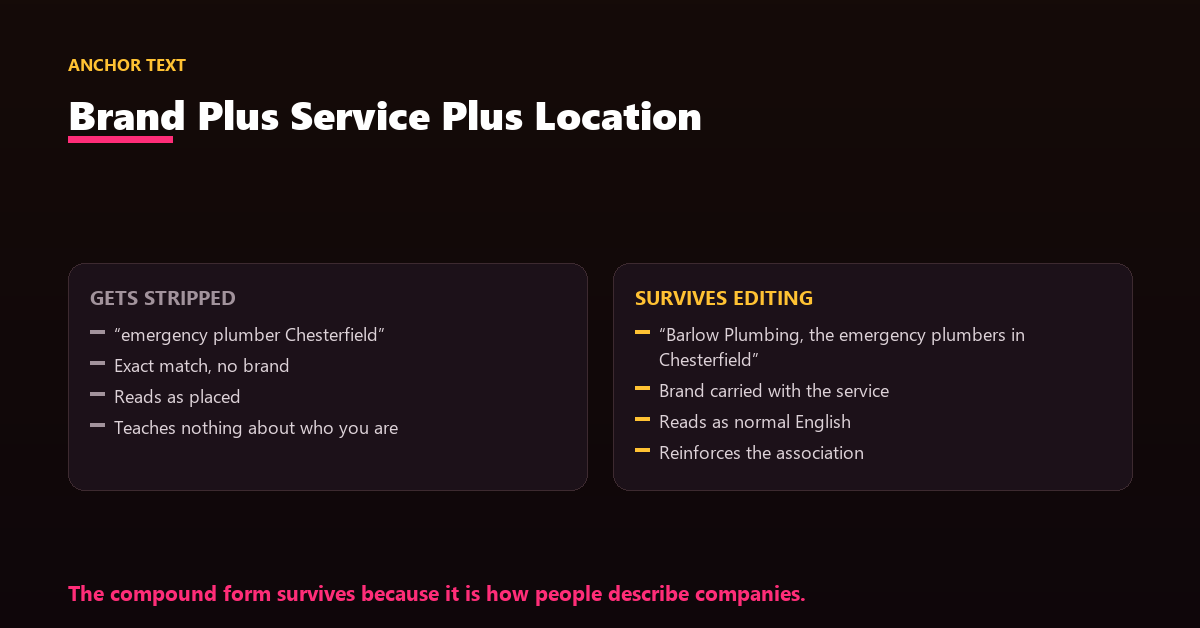
Anchor Text For Brand Plus Service Plus Location
Our standing guidance, unchanged by this episode but worth restating in context. The compound form — brand plus service plus place — reads as a normal English description of a company, which is exactly why it survives editorial review and why it reinforces the association you actually want.
The failure mode is the exact-match service-plus-city anchor with no brand attached. It looks like what it is, editors strip it, and it teaches nothing about who you are. Our full treatment is in the brand + service + location anchor formula.
Auditing Your Existing Location Pages
If you already have forty of these, do not rewrite forty. Sort them by whether they currently receive anything — traffic, calls, form fills — and then apply one test to the top ten: cover the city name and read the page. If it could be about anywhere, it will never be linked to and probably will not convert either.
Rebuild those ten properly, to Popp’s standard rather than to a word count. Leave the rest until you have evidence the rebuilt ones perform. A smaller number of pages that contain real local proof beats a complete set of pages nobody would cite.
The most linkable thing most agencies could produce this quarter is not a guide. It is a number nobody else has, about something everybody argues about, gathered by doing something tedious that no competitor will bother to repeat.
Jake Melendy of Ignitvio did exactly that, more or less by accident, and the result is a useful worked example of what a small original study looks like when you are not a research firm.
Why Original Calling Data Earns Links
Melendy’s study did not start as a study. His mother called five roofers for a quote and none got back to her within three days. Two months later he called five local law firms on a Sunday afternoon as a prospective client, left voicemails, and none of them called back either. His reaction: “okay, this has got to be happening everywhere. So then we started testing it.”
That origin is the point. The research question came from an irritation he had personally experienced twice, which is why it was worth answering and why the answer is interesting to anyone in the industry. Studies designed backwards from a desired headline read like what they are.
The other reason this format earns links is supply. Opinions about follow-up speed are infinite and free. Measurements are rare, because measuring requires somebody to actually make the calls.
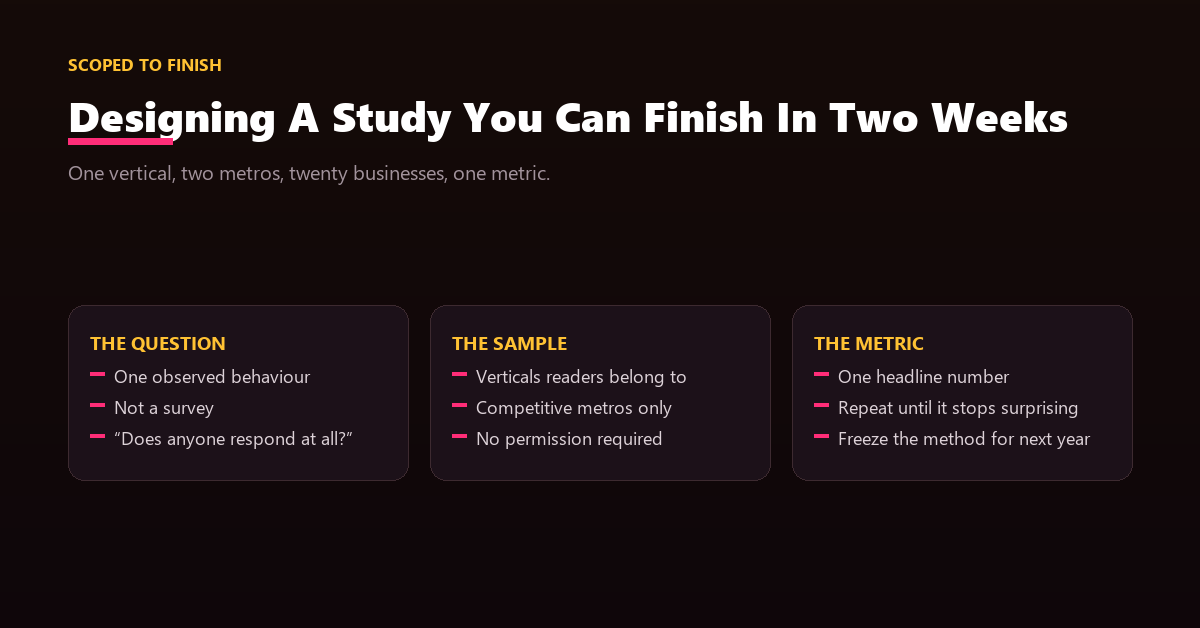
Designing A Study You Can Finish In Two Weeks
Melendy describes his method in outline: “I started running these tests in individual metros — in the most competitive metros for certain verticals. So roofing, HVAC, accounting, dentists. And every single time the same thing kept happening.”
The design principles worth copying, as we read them, are ours to state but his to demonstrate:
One question. His was: if I present as a real prospect, does anyone respond? Not a survey. One behaviour, observed.
Verticals a reader belongs to. Roofing, HVAC, accounting, dental. Every business in those categories has a personal stake in the answer, which is what makes it shareable.
Competitive metros. Choosing the hardest markets pre-empts the obvious objection that the sample was full of amateurs.
Repeat until it stops being interesting. The finding got strong because the same result kept appearing, not because one round produced a big number.
Behaviour you can observe without permission. Nobody has to agree to participate for you to record whether they called back.
Two weeks is realistic for a scoped-down version. One vertical, two metros, twenty businesses, one contact method, one metric. That is a couple of afternoons of calls and a spreadsheet.
Melendy’s Numbers As A Benchmark
Here are his figures, in his words, with the framing he gave them:
Every single time, over fifty percent would never get back to me. And of the ones that did, only two percent followed up more than once, which is insane to me.— Jake Melendy, Ignitvio, Unscripted SEO
The second half is what makes it a story rather than a statistic. He sets it against a sales fundamental: “you need five touches generally to get a sale. The majority of sales happen after the fifth touch.” So the market is not merely slow — almost nobody in it is running the follow-up sequence that the sale actually requires.
He also supplies the line that turns the finding into a decision. His account of what happens when he tells a service business its three-hour response time is fine: “Yeah, but your competitors are responding within ninety seconds, and they’re booking that same person. So where are we really at?”
A note on precision, because it matters for anyone citing this. Melendy describes running these tests across those four verticals in competitive metros and getting the same result every time; he does not state a total sample size in the interview. If you reference the finding, reference it as he framed it — over fifty per cent, two per cent, across roofing, HVAC, accounting and dental — and do not attach a headline count he did not give.
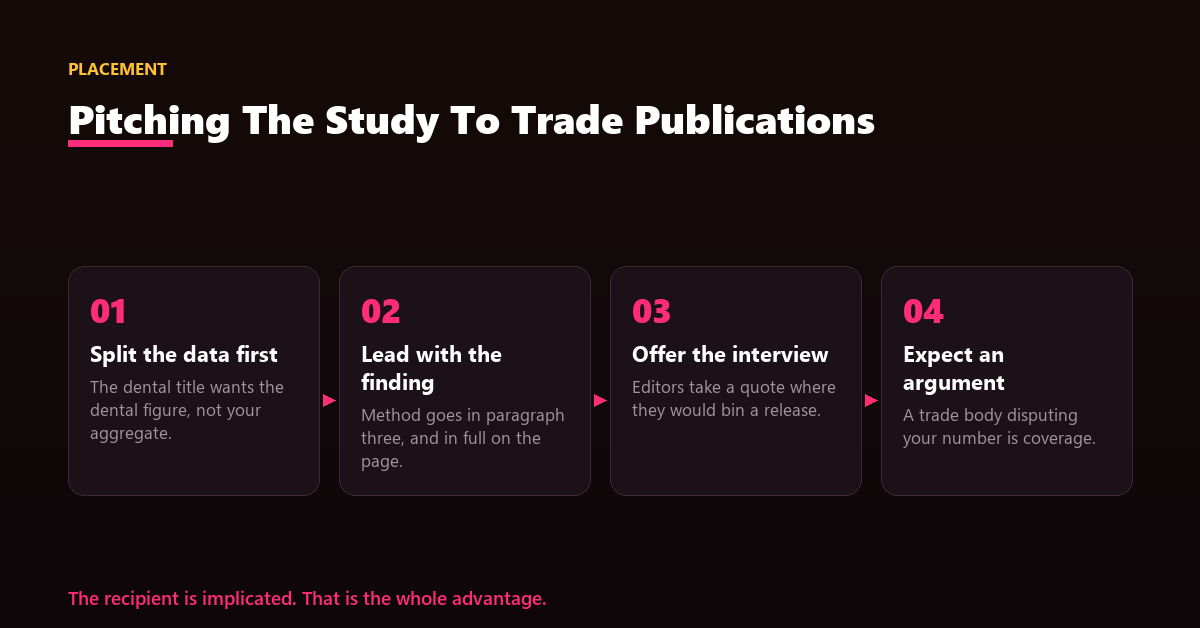
Pitching The Study To Trade Publications
Our own guidance on placement. A finding like this has one enormous advantage over almost any other outreach asset: the recipient is implicated. A roofing trade editor reading “over half of roofers never returned a lead call” has a story whether they agree with you or not.
Pitch the vertical its own number. Split the data before you send it. The dental publication wants the dental figure, not your aggregate.
Lead with the finding, not the methodology. Method goes in paragraph three and on the page, where sceptics will look for it.
Publish the method in full anyway. This is what separates a study from a marketing claim, and it is what makes the next journalist trust the first one.
Offer the interview. An editor will often take a quote when they will not take a press release.
Expect to be argued with. A trade body disputing your number is coverage, and usually links.
Refreshing The Data Next Year
An annual study is a different asset from a one-off, and the difference is worth more than the second dataset. Year two gives you a trend, a reason to contact everyone who covered year one, and a defensible claim to being the source on the question.
Keep the method frozen even where you have thought of improvements — a comparable number is more valuable than a better one. Record the exact scripts, times of day and selection criteria now, because in twelve months you will not remember them and an unreproducible study cannot be refreshed.
If you accept that a meaningful part of modern SEO is public relations, the immediate problem is that PR is hard to start. You cannot decide to be covered by a trade publication. You can, however, decide to be on a podcast, and there are more shows looking for guests than there are people volunteering.
The Two Types Of SEO Left
Zak Ali, who leads SEO at Finder in the US, put the shift more sharply than anyone we have interviewed:
there’s two types of SEOs that exist today. There are the technical SEOs, and there are SEOs who haven’t realized yet that their job is digital PR and branding.— Zak Ali, Finder US, Unscripted SEO
He is not speaking hypothetically. He describes deciding, in May of the previous year, to dissolve his SEO team and run a generalist marketing team instead — telling people who had spent years building the discipline that they were growth marketers now. He describes it as rough at the beginning. That is a real organisational cost, paid on the strength of the argument.
The relevant consequence for link building is that if the job is PR, then the deliverable is coverage rather than placements, and the cheapest coverage available to a person with no media relationships is a conversation on somebody else’s show.
Why Guesting Is PR You Can Actually Book
Jason Wade makes the supply-side argument for the same conclusion, and it is the most practical case for this channel we have heard. His observation is about how few people ever actually do it: on his account most podcasts that start do not get far — he cites seven episodes as the typical stopping point — and only a small fraction of people even say they want to.
His conclusion is about friction: “If a company can take that friction away of the work and you can do that, you or I can take that friction away and do the stuff they won’t do. That’s where the magic was.” The same logic runs in reverse for a guest. Hosts need people willing to talk. Most people are not. Being willing is most of the qualification.
Wade is also direct about the ranking side, from his own experience: “I did a podcast and it ranked instantly.” He attributes it to nobody else competing for the space, and is specific that it works best when the subject is specific or when the guest has an unusual name. His summary is worth stealing: if you know that works, do a podcast every time.
One caveat we would add and he did not: that is his account of his own results in his own niches, not a general law. A guest spot on an unindexed show about a saturated topic will not rank instantly for anybody.
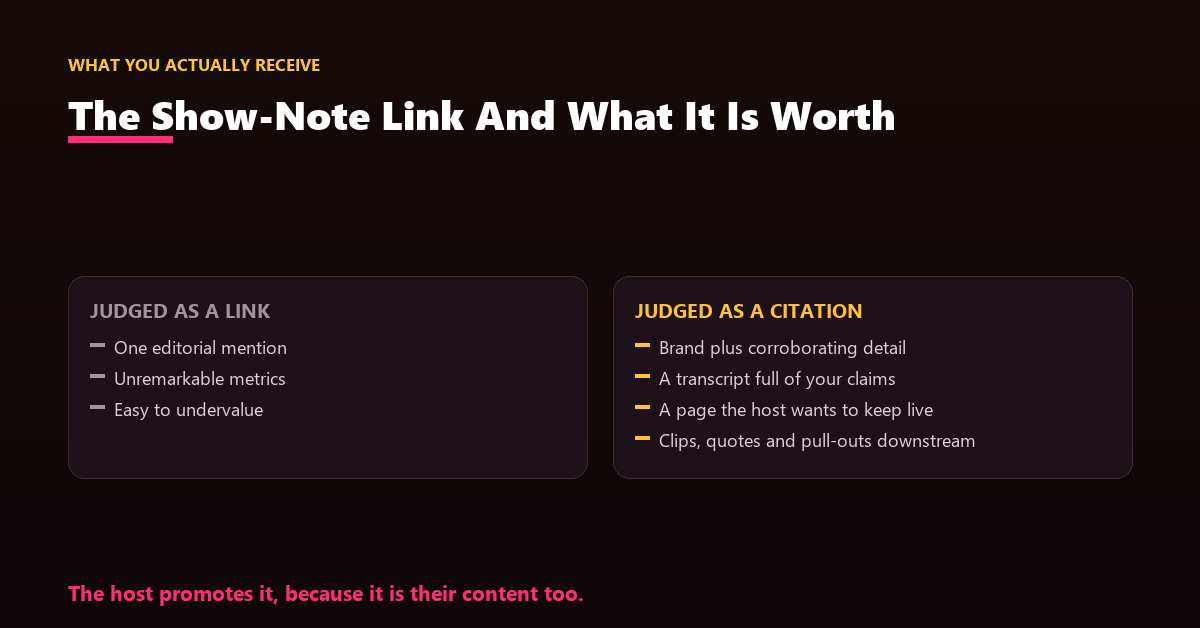
The Show-Note Link And What It Is Worth
Our own assessment of the asset, since neither guest priced it. A show-notes link is an editorial mention on a page that exists specifically to be about you for an hour. It usually sits alongside a transcript containing your name repeatedly, your company, what you do, and sentences you actually said.
Judged purely as a link it is unremarkable. Judged as a citation — a brand reference with corroborating detail, on a page a machine can read — it is one of the densest artefacts you can produce in an hour. And unlike a guest post, the host wants to publish it, promote it and keep it live, because it is their content too.
The second-order effect is the one people miss. A good episode produces clips, quotes, a transcript and a set of claims attributed to you by name on somebody else’s domain. Wade’s framing of that is that one podcast could become fifty assets. That is his estimate of the ceiling, not a promise, but the direction is right.
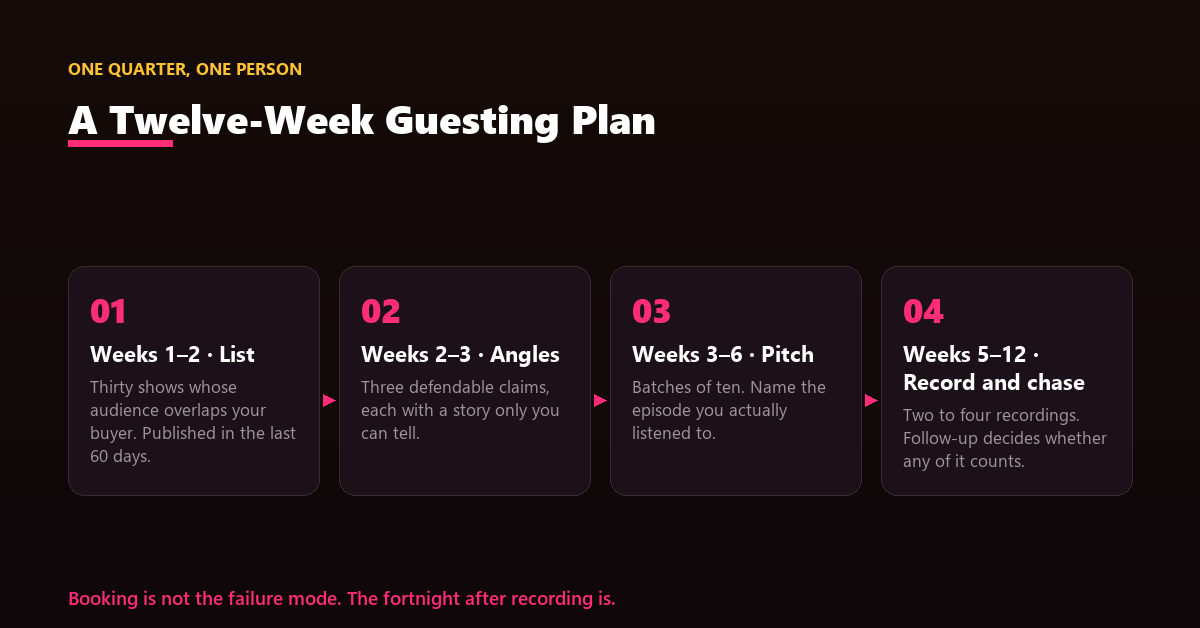
A Twelve-Week Guesting Plan
This plan is ours. Neither Ali nor Wade laid out a schedule; we are turning their argument into something a person can put in a calendar.
Weeks 1–2: build the list. Thirty shows whose audience overlaps your buyer. Check they have published in the last sixty days — a dormant show is a dead link.
Weeks 2–3: prepare three angles. Not topics. Angles, with a specific claim you will defend and one story only you can tell. Hosts book angles, not CVs.
Weeks 3–6: pitch in batches of ten. Short, specific, name the episode of theirs you actually listened to. Expect most to go unanswered and treat that as normal.
Weeks 5–10: record. Two to four is a realistic quarter for one person with a job.
Weeks 6–12: follow up. This is the step that determines whether any of it counts.
Following Up So The Link Goes Live
The failure mode of this channel is not booking. It is the fortnight after recording, when the episode sits in an edit queue and everyone forgets. Our own follow-up sequence:
Same day, send the host exactly what you want in the notes — name, one-line description, the URL, correctly spelled. Do not make them retype it from the recording.
Send anything that makes their job easier: a headshot, three pull-quotes, the links you mentioned. Hosts remember guests who reduce work.
When it publishes, check the notes actually contain the link. A surprising share do not, and this is the single highest-yield check in the whole process.
Promote it properly from your side. The reciprocity buys you the next booking, and the next booking is where this channel starts compounding.
Local link building is the part of the discipline that resists tooling. There is no database to filter, no volume play, and the prospects are not a list — they are the businesses, groups and organisations physically around a company. Apurva Bose of Overtake Digital, interviewed on Unscripted SEO, frames it in a way that explains why the usual outreach machinery underperforms here.
Bose On Links As Relationship Byproducts
His framing puts the link at the end of a process rather than at the start of one:
local link building transcends mere online interactions; it’s fundamentally about establishing and nurturing real-world business relationships within the community.— Apurva Bose, Overtake Digital, Unscripted SEO
He is specific about what that involves in practice — putting the brand and its representatives out there, networking, participating in events that are not limited to your own business niche, including charity and community activities. And he is explicit that the goal is broader than your sector: building relationships “not just with businesses in your sector but across a broad spectrum of the local community.”
Bose also notes something that changes the channel choice. Because these organisations receive a high volume of email, he says a more direct approach — phone calls or personal visits — can be more effective. That is an uncomfortable finding for an industry whose entire prospecting stack is email, and it is probably the single most actionable line in the interview.
One more, on where the emphasis belongs: he argues that in local SEO the focus should shift towards identifying and engaging with shared audiences rather than concentrating solely on link authority. Same instinct as the relevance-first argument in our vetting checklist, arriving from the community side instead of the metrics side.
Mapping The Twenty Businesses Nearest You
The following is our own process rather than something Bose laid out step by step. It exists because “go build relationships” is true and unusable, and a repeatable version needs a starting list.
Sit down with the owner and write out twenty organisations, in four groups of five. Twenty is deliberately small — it is a quarter’s work, not a database.
Suppliers and vendors. Anyone the business already pays. There is an existing commercial relationship and often an existing web page listing customers or dealers.
Complementary trades. Bose’s own example is a gym collaborating with a local smoothie maker — non-competing businesses serving the same person at a different moment.
Membership bodies. The chamber, trade associations, BID or town-centre groups. Bose notes chamber membership often comes with a listing on an authoritative domain, and that if the business is already a member but not listed — or listed without a link — the first move is simply to ask for the inclusion or the link.
Community and charity. Sports clubs, schools, festivals, causes the owner already cares about. He specifically encourages participating in or sponsoring community events and charity causes.
Run the audit before the outreach. A meaningful share of the twenty will already have a page you belong on, and asking to be listed where you already qualify is a materially different conversation from asking a stranger for a link.
The Three Reasons They Will Link Without Being Asked
Practitioner observation, from running this: unprompted local links almost always come from one of three situations, and none of them is a pitch.
You are a customer or a supplier. Partner, dealer, stockist and “who we work with” pages exist because the other business wants to look established. Adding you helps them.
You gave them something they needed. A venue, a sponsorship, equipment, hours, a prize. Organisations credit contributors as a matter of course, and the credit is usually a link.
You made something the community actually uses. A schedule, a map, a guide to a local process, a list nobody else maintains. This is the only one that scales, and it is the slowest.
What none of the three requires is an email asking for a link. That is the practical content of Bose’s framing: the ask is a formality at the end of a relationship that already exists, which is why cold outreach into this segment converts so poorly.
Turning One Coffee Into A Referral Loop
Bose stresses that this requires active participation from the business owner to ensure authenticity, and that it needs consistent presence and engagement rather than a campaign. Our own version of the mechanics: one genuine meeting reliably produces three separate assets if you follow through, and most people collect one of the three and stop.
The mention. A partner page, a supplier listing, a “recommended by” block. Ask while the meeting is fresh, and offer the reciprocal listing first.
The referral. Worth more than the link and harder to measure. Track it anyway — it is what keeps the owner willing to do this.
The joint thing. A co-hosted event, a shared offer, a workshop. Joint activities generate listings on third-party calendars and community sites you could never reach by asking.
Tracking Relationship Links Without A Tool
No software required, and no software will help. A four-column sheet is enough: organisation, the human’s name, last real contact, what came of it. Review it monthly and the failure mode reveals itself immediately — almost every stalled local programme stalls because nobody made contact for four months, not because the strategy was wrong.
The number to watch is not links per month. It is conversations per month, because that is the input Bose is actually describing and the one you control. Links are the lagging indicator.
Press releases have the worst reputation of any tactic in link building, and they earned it. For about a decade they were sold as a link product: pay a wire, get several hundred syndicated copies of the same optimised text, count the referring domains, invoice the client. Search engines took that apart, correctly.
Bradley Benner is making a different argument, and it is worth separating from the old one before you dismiss it. His case for the format has nothing to do with the links.
The Old Reason Press Releases Failed
The failure mode was structural. Syndication produces near-identical copies across domains that have no editorial relationship with the subject, which means the “links” were never editorial decisions. Nobody at those properties chose to reference you. The wire did, once, on your instruction, and then a distribution network copied it.
That is a scheme by any reasonable definition, and treating it as one is not a Google quirk. So the corrective advice — do not buy press releases for links — was right, and remains right. What has changed is that links are no longer the only way a mention pays.
Benner On Freshness And AI Visibility
Benner runs Semantic Links, a white-label off-page agency, alongside Semantic Mastery. On Unscripted SEO he framed the whole off-page category around citations rather than links. In his terms a citation is a brand mention plus one corroborating data point — name and website, name and phone, name and address — and it does not have to be a directory listing to count.
His words: “press releases, branded assets, brand mentions on blog posts, things like that, those all can act as unstructured citations. And that’s what influences LLM or AI search visibility right now, more than anything.” On the format specifically:
Press releases work really, really good for helping to improve AI search visibility because you get brand references on high authority media and news style like freshness factor type properties that the LLMs like to cite.— Bradley Benner, Semantic Mastery / Semantic Links
He is explicit that this sits alongside on-page work rather than replacing it — he says you can and should still optimise on page to improve the chance of your own domain being referenced. The release is a way to get the brand attached to a fact somewhere that is read and re-quoted, faster than you can earn the same placement editorially.
One more thing from him worth carrying into this: he treats relevance as the governing filter across all off-page work, and describes the job as forcing the models to recognise the associations between a brand, its services, and the places it serves. A release is one more chance to state those three things in a place a machine will read.
What A Citable Release Contains
This section is our own guidance rather than Benner’s prescription. If the value is in being quotable, then the release has to be written to be quoted, which is almost the opposite of how release copy is usually produced.
One fact in the first two sentences. Not a summary of the company. A dated, specific, checkable statement. Machines and journalists both stop reading at the same place.
A named person with a title. An unattributed sentence cannot be safely quoted by anything. A named operations director can.
An original number. If you have data nobody else has — response times, volumes, survey results — that is the sentence that gets lifted.
A source for anything you did not generate. Cite the study you are referencing rather than asserting it. A claim that can be verified is a claim that can be repeated.
Entity clarity. Brand, what it does, where it does it, spelled out plainly at least once in a full sentence.
Boilerplate that is not stuffed. No optimised anchors, no keyword lists. The moment the release is written for anchor text you have rebuilt the tactic that failed.
Wire Tiers Worth The Money
Honest caveat first: Benner did not name specific wires, tiers or prices, and neither will we invent them. What the mechanism implies is a way to evaluate any distributor rather than a shopping list.
If the value is a brand reference on a property that gets read and re-quoted, then the only question that matters about a distributor is which properties actually publish the release as a page with your named quote intact. Not how many outlets are claimed. Not the total “potential audience” figure. Ask for example placements from the last month in your sector, open them, and check whether the quote and the attribution survived. Most of the price difference between tiers evaporates under that single check.
How To Measure Something That Is Not A Link
This is where most programmes will fail, because the reporting habit is older than the tactic. If you commission releases on this rationale and then report referring domains, you will conclude it did not work — and your report will be measuring the mechanism you were explicitly told not to buy.
Log placements, not domains. A list of URLs where the release actually appeared as a page, with a note on whether the named quote survived.
Track unlinked mentions of the brand over time. The release should raise the rate at which the brand name appears in text you did not publish.
Ask the answer engines the question your customer would ask. Record what gets named, monthly, in the same wording, so the comparison means something.
Watch branded search. Blunt, laggy, and the hardest to argue with.
None of this is a reason to move budget out of earned coverage. It is a reason to stop pretending the format has only one use. If you want the version of this argument built around earning the citation rather than buying the placement, that is digital PR for the AI consensus engine, and the local variant is earning editorial links with owner quotes.
Ask most teams for a linkable asset and you will get a long article. It is the default because it is the thing content teams already know how to make. It is also the thing every other team in your niche is making this quarter, which is precisely why it no longer earns anything.
Christopher Gimmer has built two bootstrapped SaaS products, Snappa and GoodMetrics, and got his original distribution from exactly that kind of article — a free stock photos post that ranked first and went viral. He is now unusually clear-eyed about why that playbook has stopped paying.
The Linkable Asset Nobody Builds
On Unscripted SEO he connected two things that are usually discussed separately: the collapse of cold outreach, and what people are actually willing to link to now.
Another benefit of the tools and stuff is that it’s hard to do traditional link building now, just because everyone’s inbox is full of spam. So I think people are more willing and likely to link out to a really good tool that actually solves a problem versus yet another blog post with a wall of text.— Christopher Gimmer, Snappa & GoodMetrics
Both halves matter. Outreach got harder because every inbox is saturated, and the asset most people are pitching got weaker at the same time. A tool changes the arithmetic on both sides at once.
He also described where he is putting effort for GoodMetrics, and it is not the blogging treadmill. His view is that the top of the funnel is more or less dead because those queries are being answered by AI Overviews, so the investment has gone into comprehensive documentation, landing pages that describe the product in detail, and free or interactive tools rather than posts.
That is the opportunity. Almost nobody in your niche is shipping small tools, because it feels like an engineering project. Scoped properly, it is not.
Scoping A Tool You Can Ship In A Week
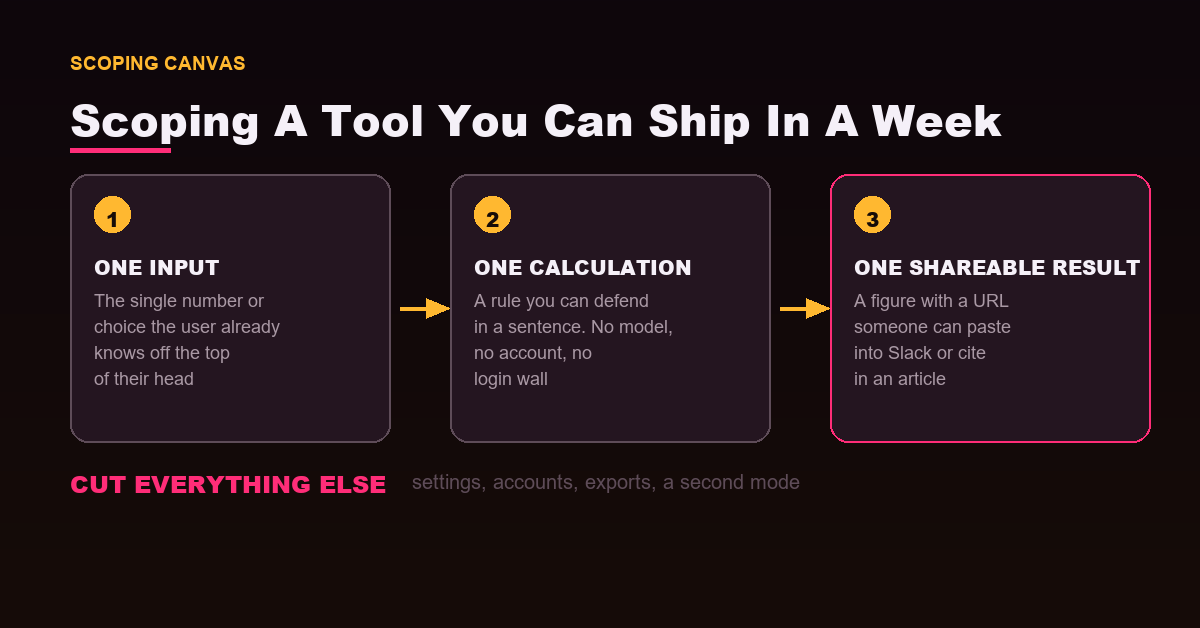
The reason most linkable tools never ship is that they get scoped like products. Cut them to three things instead. This scoping frame is our own; Christopher named the category, not the method.
One input. A single number or choice the user already knows without looking anything up. If your tool needs three fields, you have a form, and forms do not get linked. If it needs data the user has to go and find first, most of them will not come back.
One calculation. A rule you can defend in a plain sentence, published openly on the page. No account, no login wall, no model. The transparency is not a nice-to-have — an editor deciding whether to cite you needs to see the method, and a black box is not citable.
One shareable result. A figure or verdict at a URL that someone can paste into Slack or reference in an article. If the result cannot leave your page, the tool cannot earn a link.
Then cut everything else. Settings, saved history, export, a second mode, an accounts system: every one of those is a week of work that adds nothing to the linkability of the thing. Ship the narrowest useful version and let demand tell you what to add.
The best candidates are usually the calculation your own team already does by hand for every client in a spreadsheet. You have already validated that it is useful and you already know the rule. Publishing it is mostly a matter of putting a front end on something that exists.
Where The Data Comes From
This section is practitioner guidance rather than anything from the interview, and it is where most tool projects quietly die, so it is worth being concrete. There are four honest sources, roughly in order of how much work they cost.
A published rule. Tax bands, postage rates, building code minimums, standard industry formulas. Zero data collection. You are packaging a lookup that is annoying to do manually, and the maintenance burden is one update a year.
Your own operational data. Benchmarks derived from work you have already done, anonymised and aggregated. This is the strongest option because nobody can replicate it, and it is the one most likely to get cited by name rather than just linked.
A public dataset. Government statistics, open APIs, published industry surveys. Free, credible, and the citation obligation cuts both ways — naming your source clearly makes your tool more linkable, not less.
A one-off survey. The most expensive and the most defensible. Only worth it if the tool is a genuine pillar asset rather than an experiment.
Whichever you choose, put the source and the last-updated date on the page. It is the cheapest thing you can do to make a journalist comfortable citing you.
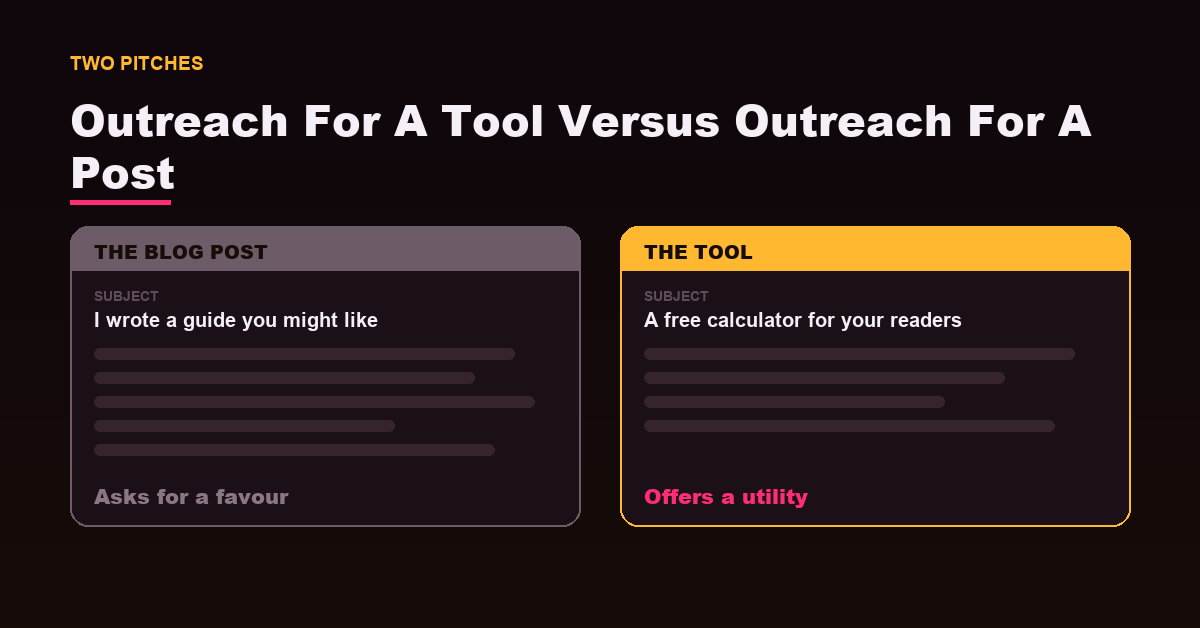
Outreach For A Tool Versus Outreach For A Post
The pitch is structurally different, and this is the part teams get wrong by reusing their article template.
Pitching a post asks for a favour. You have written something and you would like the recipient to link to it, and the only benefit on offer is that it is good. In an inbox already full of that exact message, it is indistinguishable from spam even when it is sincere.
Pitching a tool offers a utility. The message is that their readers have a job to do and here is something free that does it, no signup required. That is a different email: shorter, specific about which of their existing pages it belongs on, and with the value stated in terms of their audience rather than yours.
Three differences worth building into your template. Name the exact page you think it fits and why, because a tool has an obvious home in a way an article does not. Lead with what it does, not how you built it. And make the no-strings part explicit — no email gate, no account — because the recipient will assume it is a lead magnet in disguise.
The other route worth running in parallel is to get the tool into the hands of people who already publish in your space, which overlaps heavily with how attribution-driven expert roundups and graphics earn placements. If the surrounding campaign structure is new to you, start with outreach and content link building and slot the tool in as the asset.
Keeping The Tool Alive So Links Persist
Also our guidance rather than Christopher’s, and the least glamorous section here. A tool is not a campaign that ends. It is an asset with an ongoing failure mode that an article does not have: articles get stale, tools get wrong, and a wrong tool loses links permanently rather than gradually.
Four habits keep it earning.
Put a visible last-reviewed date on it and honour it. An editor deciding whether to keep a citation checks whether anyone is still home.
Monitor it like infrastructure, not content. An uptime check and an alert. A broken calculator that nobody notices for three weeks costs you every link pointing at it, and those referring pages will not tell you.
Never change the URL. If you rebuild it, rebuild it in place. The accumulated links are the entire return on the project and a migration is the most common way teams throw them away.
Re-pitch on genuine updates. New data or a new capability is a legitimate reason to contact everyone who linked before, and it is a far warmer email than the original pitch was.
Do that and one week of work keeps compounding for years, which is more than the article you were going to write instead would have done. If you are working through the fundamentals of what earns a link in the first place, our learn how to link build guide is the place to start.
Version one of this checklist argued that relevance, not Domain Authority, should be the first filter on a link prospect. That argument still holds. What it lacked was a procedure — a specific, ordered set of things a person on your team can actually do before an outreach email leaves the outbox.
This is version two. It adds the procedure, and borrows its governing standard from Kristiyan Yankov of the SaaS link-building agency Above Apex, who put it on Unscripted SEO better than we had.
The first was that “is it relevant?” is not a check. It is a conclusion. Two people looking at the same prospect reached opposite verdicts and both believed they were applying the rule correctly, because nothing in the checklist told them what evidence to gather before deciding.
The second was that removing DA as the qualifier left a vacuum, and vacuums get filled by whatever is easiest to measure. Teams quietly reinstated a metric floor under a different name. If you do not replace the number with something concrete, the number comes back.
So version two defines a standard of proof, then turns the relevance judgement into ten specific observations you can make in about two minutes per prospect.
Yankov’s Verify Do Not Trust Standard
The first question we ask every guest is why the audience should trust them. Kristiyan rejected the premise of the question immediately.
You shouldn’t trust anyone. You should verify. You should verify, especially in our industry.— Kristiyan Yankov, Above Apex
He was talking about his own credentials, but it is the correct operating posture for link prospecting, and it is the standard version two is built on. Applied to a prospect list, it means something quite specific and slightly annoying: every claim about a prospect must be observed, not inferred.
You do not infer that a site has an audience because it has a high DR. You look for the audience. You do not infer that a page is editorially reviewed because the site looks professional. You look for the policy. You do not infer that a link will sit in real copy because the vendor said so. You look at where their last five placements landed.
Kristiyan is explicit that his team looks at five to ten different signals as a starting point rather than domain rating alone, examining the site first, then the page, then whether it is a genuine website that serves a purpose rather than a private blog network, whether it carries relevant content, and whether the link is seamlessly integrated into the actual copy. Version two is our attempt to write that down as steps.
The Google Is Not More Stupid Than Me Test
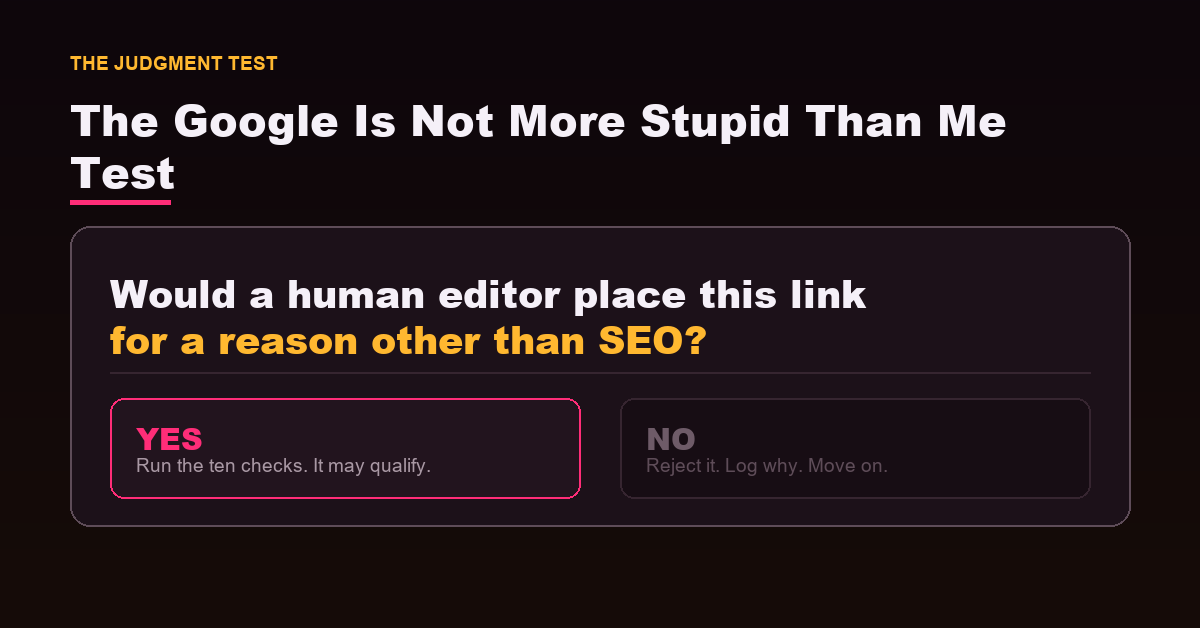
Before you spend two minutes on the ten checks, spend ten seconds on one question. Kristiyan’s version of it is the most useful heuristic we have added to this process in a year.
If I look at a link-building opportunity and it makes sense to me, it would be the same for Google, because Google is definitely not more stupid than me. It’s quite the opposite — it’s actually smarter.— Kristiyan Yankov, Above Apex
Run it as a gate, phrased from the other side of the transaction: would a human editor place this link for a reason other than SEO?
If the honest answer is no — if the only reason that link could exist is that someone wants a link — then no combination of metrics rescues it, because the thing you are hoping to fool is smarter than the person trying to fool it. Reject it and move on. You have just saved yourself the ten checks and an outreach email.
If the answer is yes, the prospect has earned the two minutes. Proceed.
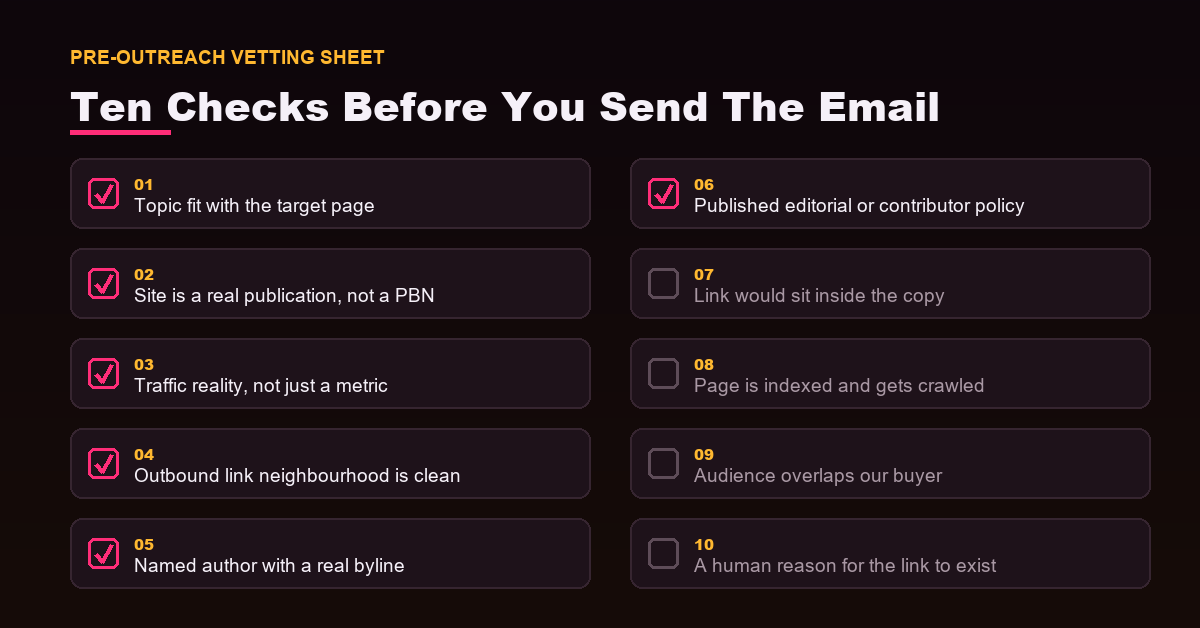
Ten Checks Before You Send The Email
Run these in order. The early ones are cheap and disqualify fastest, which is the whole point — you want most of a bad list gone before you have paid a tool a single API call.
Topic fit with the target page. Not the domain and the client. The specific page the link will sit on, and the specific page it will point at. Write the connection in one sentence. If the sentence needs a “well, broadly speaking,” it fails.
Genuine site, not a network. Kristiyan’s explicit check: does this website serve a purpose beyond hosting links? Look for a real about page, a real contact route, and a reason for the site to exist.
Traffic reality. Not a traffic estimate treated as gospel — evidence of humans. Comments, shares, a newsletter, a forum thread linking in, anything that indicates readership rather than existence.
Outbound link neighbourhood. Open the last few published posts and look at who they link out to. A marketing site that also links to casino and loan pages has told you exactly what it is, regardless of its metrics.
Named author with a real byline. A person who exists elsewhere on the internet, with a profile that predates the site. Anonymous or single-generic-author sites are a strong negative signal.
Published editorial or contributor policy. Its existence tells you there is a process. Its absence does not disqualify a site outright, but it moves the burden of proof onto you.
The link will sit inside the copy. Kristiyan’s phrasing is that the link should be seamlessly integrated into the article itself. Author bio boxes, footers and resource dumps are not that.
The page is indexed and crawled. Trivial to check, embarrassing to skip. A placement on a page that is not in the index is a placement that does not exist.
Audience overlap with the buyer. Topical relevance and audience relevance are not the same thing. A developer blog can be perfectly on-topic for your product and read entirely by people who will never hold the budget.
A human reason for the link. The gate from the previous section, applied one final time now that you know more. If nothing you learned in checks one through nine changed the answer, you are clear to pitch.
Checks two, three, four, seven and ten map directly onto what Kristiyan described. The rest are ours, added because they are the disqualifiers our own reviews kept catching late. Once a prospect clears all ten, it belongs in a real campaign structure rather than a one-off blast — that is what our outreach and content link building process is for.
Logging Rejections So The Team Learns
This last step is entirely our own practice rather than anything Kristiyan prescribed, and it is the one most teams skip.
Every rejection gets one line in a shared sheet: the domain, the check number it failed on, and a five-word reason. That is the whole format. It takes about eight seconds and it does three things that compound.
It stops you re-prospecting the same dead domain in four months, which every team does. It shows you which check is doing the most work, so you can move it earlier and disqualify faster. And it turns a subjective judgement into a training artefact — a new team member reads two hundred logged rejections and absorbs the standard far faster than from any document.
Kristiyan mentioned that when his team faced an unusually demanding client with hyper-specific criteria, they deliberately treated it as a case study for their own team rather than dismissing it. Anything that stress-tests your standard is worth capturing.
Review the log monthly. If one check accounts for most of your rejections, your prospecting source is the real problem, not your vetting. If you are documenting this as a team process, our DIY link building SOPs cover the surrounding workflow.
Verify, do not trust. Then write down what you verified.
Our newest episode is a quick one — barely three minutes, three sharp minds on what actually makes link building work now. We pulled the best link insights from Bradley Benner, Rob Bonham, and Justin Oberman into one short listen. Here’s the expanded version, with a link to each full interview.
Bradley Benner: relevance beats every metric
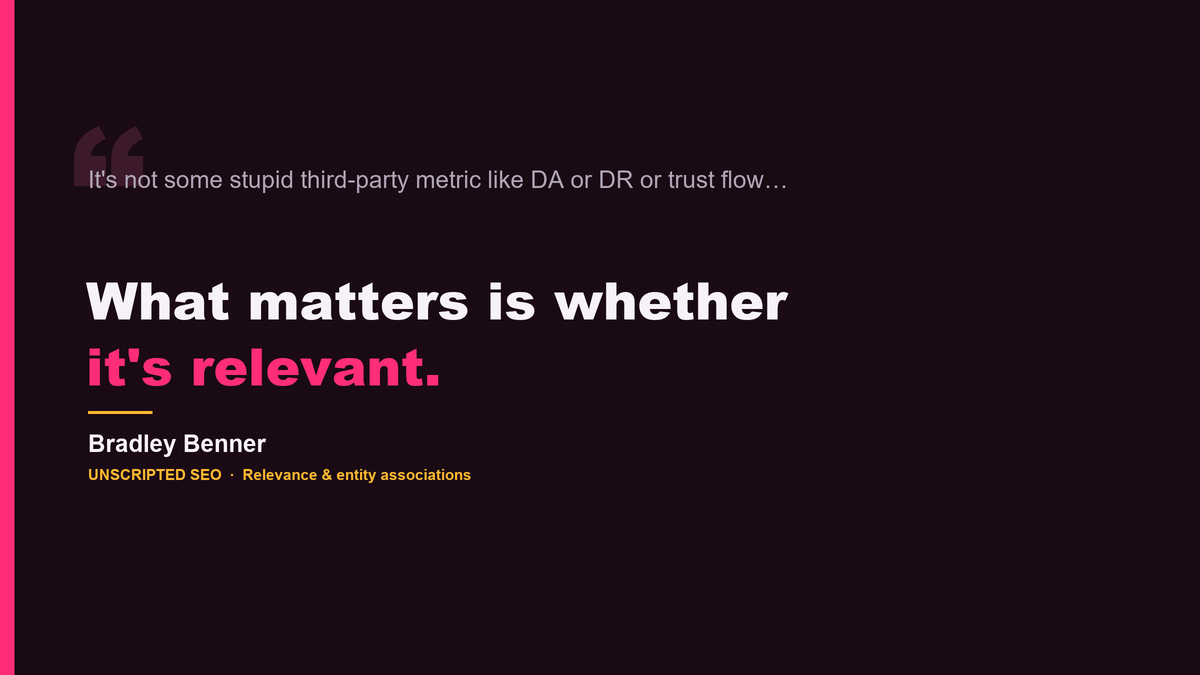
Benner flips the old link-buying checklist on its head. Stop chasing Domain Authority, Domain Rating, and trust flow — those are third-party scores, not signals Google actually passes. What decides a link’s worth is relevance: does this page, on this site, in this context, genuinely relate to yours? His bigger point for anyone building a service is that the job isn’t pushing metrics — it’s creating and strengthening the entity associations that teach the algorithms (and the AI models) what you’re about.
Bonham zooms out from the single link to the whole picture. Links, mentions, citations, reviews — they add up to a footprint, and the size and positivity of that footprint is what ultimately wins the SERPs. It reframes “link building” as reputation building at scale: the more of the web that talks about you in a good way, the more both Google and the AI answer engines treat you as the obvious answer.
“Whoever has the bigger footprint and the more people talking about them across the web in a positive way — that is the ultimate be-all and end-all of winning and dominating the SERPs.”
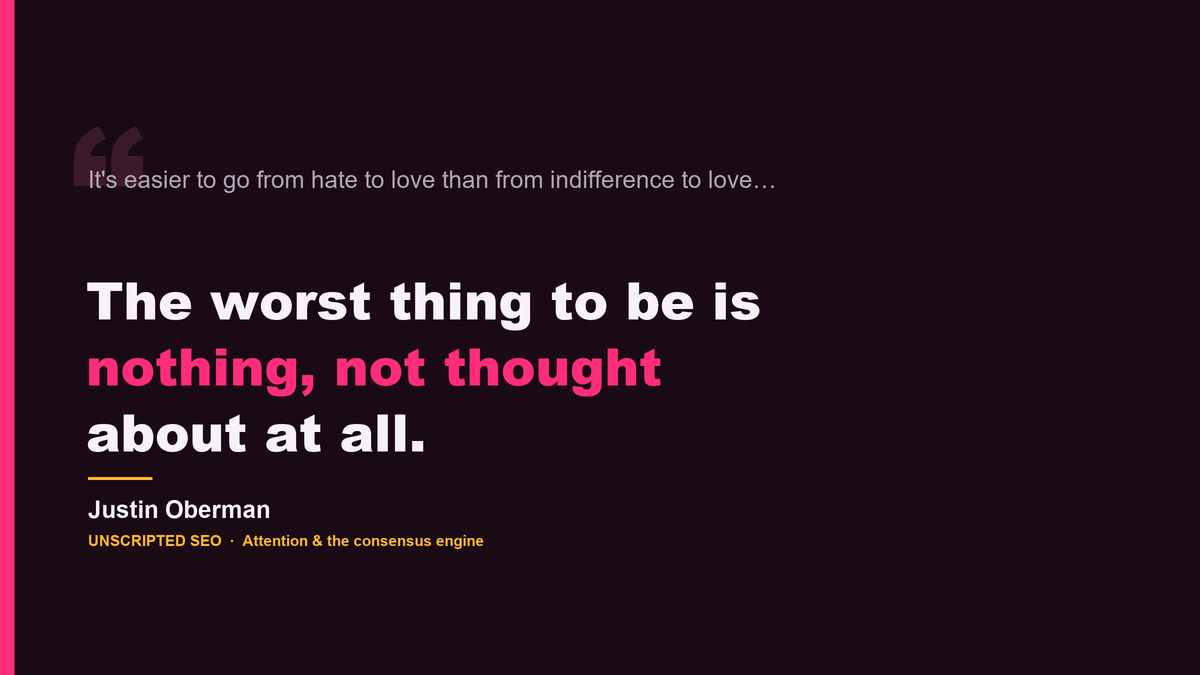
Oberman comes at links from the attention side. AI search, he argues, is a consensus engine — it surfaces what the ecosystem already says about you. So the goal isn’t persuasion, it’s being talked about at all. It’s easier to move someone from hate to love than from indifference, because indifference means you’re invisible. Links and mentions are how you stop being invisible.
The through-line: relevant links = a footprint search and AI both trust
Three lenses, one conclusion. Benner says make it relevant. Bonham says make it big and positive. Oberman says make sure you’re talked about at all. Put them together and that’s the modern link-building brief: earn relevant mentions across the web, and you build the footprint that Google ranks and the AI models cite.
Link Building Ideas × SEO Arcade
Want links that are relevant, positive, and everywhere that matters?
That’s exactly the brief the three of them describe — and exactly what we build. Relevant, editorial links that grow your footprint across the web and the AI answer engines.
Grab a coffee and learn link building that actually works — for AI answers and for Google. A free, no-pitch meetup for local SEOs and small business owners.
Search is changing fast. Google still leans on links to judge authority, and now LLMs — the engines behind AI Overviews, ChatGPT, and Perplexity — are deciding who to cite based on who gets mentioned and linked across the web. The good news: the same white-hat moves that earn real links also make you more visible to AI. Over coffee, we’ll break down what’s working right now:
Why relevance beats domain metrics (DA/DR) for both Google and LLMs
How brand mentions and citations feed the “consensus engine” of AI search
Local link plays SMBs can run this week — partners, chambers, community events
Turning conversations and podcasts into links that compound
Live Q&A on your specific site and niche
Who should come
Local SEOs, marketers, agency folks, and small business owners around Cookeville and the Upper Cumberland who want a clear, practical handle on link building for the AI era. No experience required — bring your questions.
Who’s hosting
Your host is Jeremy Rivera of SEO Arcade — Nashville-area SEO consultant and host of the Link Building Ideas podcast. If your team would rather have it handled, ask him about SEO Arcade’s done-for-you link building services. But this meetup is all about helping you do it yourself.
Come thirsty for coffee and links. See you at Poet’s Coffee on July 7 at 9 AM! Want a head start? Grab the free DIY Link Building Playbook before you come.
Can’t make it in person?
Book a free 30-minute link building call with Jeremy and get the same guidance one-on-one.
Somewhere out on the web, people are already talking about your business — on Yelp, in roundup articles, on supplier blogs, in local news, and across dozens of directories — and a surprising number of those mentions don’t link back to you. Every one of them is a link you have essentially already earned but never collected. On Unscripted SEO, veteran consultant Rob Bonham argued that chasing these unlinked mentions and building out your third-party footprint is “more important than ever,” because search engines and AI answer engines now triangulate trust across everywhere your name appears — not just your own site.
Your footprint is the ranking signal now
Rob’s framing is worth internalizing: ranking is no longer just about your domain, it is about how widely and how positively your brand shows up across the web. When someone searches for the best plumber nearby, Google checks the Google Business Profile and its reviews first, then fans out to Yelp, HomeAdvisor, and every other place that business is listed to decide whether it is trustworthy enough to promote above competitors. The more consistent, positive references you have, the stronger that signal gets.
Whoever has the bigger footprint and the more people talking about them across the web in a positive way — that is the ultimate be-all and end-all of winning and dominating the SERPs.— Rob Bonham, Unscripted SEO
Unlinked mentions are the fastest way to grow that footprint, because the hardest part is already done: someone decided you were worth writing about. All that’s missing is the hyperlink. That makes reclamation one of the highest-conversion tactics in local and offline link building, and it pairs naturally with the process in our guide to finding unlinked brand mentions. Convert even a fraction of what already exists and you strengthen both classic search rankings and the way AI tools describe your business.
How to find and convert mentions across the third-party footprint
Reclamation is a repeatable process, not a one-time hunt. Set it up once, work the backlog, then run it on a recurring schedule so new mentions get converted while they are fresh and the author still remembers writing them.
The unlinked mention reclamation workflow
Search for every version of your name
Run searches for your brand, common misspellings, product names, and key people — then filter out your own domain and social profiles. What remains is the third-party footprint where mentions live.
Separate linked from unlinked mentions
For each mention, check whether your brand name is actually hyperlinked to your site. The unlinked ones are your target list; a backlink tool or a manual pass through the top results will surface most of them.
Claim your presence on the big directories
Yelp, HomeAdvisor, your Google Business Profile, and industry-specific directories are structural mentions. Claim, complete, and verify each listing so your name, address, and website link are present and consistent.
Prioritize by authority and freshness
A recent mention on a trusted news site or supplier blog is worth chasing first. Old, low-quality pages can wait — focus outreach where a followed link will actually move the needle. Short on time for the chase? SEO Arcade offers professional link building services that run it for you.
Ask for the link with a specific, easy request
Email the author or editor, thank them for the mention, and ask if they’d be willing to link your name to your site — include the exact URL you want. The lift for them is tiny, which is why these convert so well.
Re-run the search on a schedule
New mentions appear constantly as you do PR, sponsor events, or launch products. A monthly or quarterly sweep turns reclamation into a steady, compounding stream of links.
Where unlinked mentions hide
Cast a wide net. The same brand can be mentioned without a link in all of these places at once — and each one you fix adds another node to your footprint.
The third-party footprint to audit
Every surface below is a place your name may appear without a link home.
⭐
Review platforms
Yelp, HomeAdvisor, Angi, and niche review sites — claim the listing and make sure the website field points to you.
📍
Google Business Profile
Your GBP and its reviews are the first thing checked in local searches; a complete, verified profile anchors your footprint.
📰
Press & roundups
Local news, industry roundups, and “best of” lists often name businesses in plain text — a quick email fixes it.
🤝
Partner & supplier pages
Suppliers and event sponsors mention you on their sites; ask them to turn that mention into a followed link.
Turn reclamation into a system, not a one-off
The businesses that win at this treat unlinked mentions as an ongoing asset class rather than a spring-cleaning project. As Rob pointed out, the bigger and more visible your brand, the more mentions accumulate — which means the reclamation opportunity grows right alongside your marketing. Every press release, sponsorship, product launch, and podcast appearance seeds new mentions, and a standing monthly sweep quietly converts them into links while your competitors leave theirs on the table.
There is also an AI dividend. Answer engines increasingly assemble their picture of a business from its broader footprint, so consistent, well-linked mentions across Yelp, your Google Business Profile, and trusted directories shape how you get described in AI results, not just where you rank in classic search. Start with the mentions you already have, fold reclamation into your local link building routine, and you build durable authority from work the rest of the web has already done for you.
Want these links built for you?
Book a free 30-minute link building call with Jeremy and we’ll put the right ethical tactics to work on your site.
Most link building is a grind. You research prospects, chase contact info, write outreach that gets ignored, and follow up three times to earn a single link. When that grind isn’t worth your team’s time, SEO Arcade runs white-hat link building services at scale. But there is one category of links sitting in almost every business’s supply chain that is faster, cleaner, and more defensible than almost anything else you can do — and hardly anyone systematically claims it. On the Unscripted SEO podcast, two-decade SEO veteran Rob Bonham called it the closest thing to an easy win the discipline has left: getting legitimate “where to buy,” dealer, and partner links from the brands your company already carries or works with.
Why supplier links are the easiest legitimate links you’ll ever earn
The logic is simple. If you sell, install, distribute, or service another company’s products, that company has a commercial reason to point customers toward you. Manufacturers run “where to buy” pages, dealer locators, and “find a pro” directories precisely because they need buyers to reach a place that actually stocks or installs their gear. You are not asking for a favor — you are helping them close a sale. That alignment of incentives is what makes these links so much easier to land than cold guest-post pitches. Rob learned this running SEO for an e-commerce maintenance, repair, and operations (MRO) parts provider that carried hundreds of brands.
It’s like shooting fish in a barrel, but we’re still getting great results and improving our authority. We’re not doing anything bad — we’re not paying for these links, we’re not twisting their arm.— Rob Bonham, Unscripted SEO
That last part matters. These are not paid or coerced links, so they sidestep the guardrails that make so much of link building risky. You carry a brand; the brand tells its customers where to find it. It is the offline, relationship-driven end of link building — the same territory covered in our guide to local and offline link building and the deeper walkthrough on generating links through complementary business partners.
Build your partner link inventory before you send a single email
The mistake most teams make is treating this as ad-hoc outreach instead of an inventory problem. Every brand you carry, every supplier you buy from, every association you belong to, and every certification you hold is a potential link source with a pre-existing relationship attached. Map that footprint first, then work it systematically.
The fish-in-a-barrel workflow
List every brand and supplier you touch
Pull your product catalog, vendor invoices, and reseller agreements. Each manufacturer, distributor, and franchisor you have a commercial relationship with goes on the list — these are warm prospects, not strangers.
Check each brand for a “where to buy” or dealer locator
Search the manufacturer site for “where to buy,” “find a dealer,” “store locator,” “find a pro,” or “partners.” If the page exists, you often just need to submit your details to be added and linked.
Confirm the link is followed and points to the right URL
Not every locator links out, and some use JavaScript widgets that don’t pass equity. Prioritize brands whose pages render real, followed anchor links, and ask them to point to your most relevant category or location page.
Reach out using the relationship, not a pitch
You already buy from these companies. A short note to your account rep — “can you add us to your where-to-buy page?” — converts far better than cold outreach because you are helping them sell more product.
Track submissions and re-check quarterly
Dealer directories get rebuilt and links get dropped in redesigns. Log every submission in a sheet and re-verify each link on a quarterly cadence so you don’t silently lose the ones you earned.
Who has the most fish in their barrel?
Some business models are practically built for this tactic. If you fit one of these, you are almost certainly leaving supplier links on the table right now.
Businesses sitting on unclaimed supplier links
Each of these carries brands that want to send buyers their way.
🔧
Contractors & installers
HVAC, roofing, flooring, windows, and solar installers can earn “find a certified installer” links from every manufacturer they install.
🛒
Resellers & distributors
If you resell products online or locally, the brands you carry run “where to buy” pages that exist to link out to sellers like you.
🛠
Service & repair shops
Authorized service centers and warranty partners get listed in manufacturer “find a service provider” directories.
🏦
Franchisees & members
Franchise systems, trade associations, and certification bodies maintain member directories that pass real authority.
Why these links punch above their weight
Manufacturer and association sites tend to be old, topically focused, and genuinely trusted — exactly the profile search engines and AI answer engines reward. A link from the brand you carry is a third-party endorsement that you are a legitimate outlet for their products, which is a stronger trust signal than a random blog mention. It also reinforces the relevance of your commercial pages: a link from a flooring manufacturer to your flooring category page tells search engines exactly what that page is about. That combination of trust and topical relevance is why Rob singled it out as more valuable than ever in the current search landscape, and why it belongs at the top of any local link building plan.
The best part is durability. Because you are not manufacturing these links or paying for them, there is no penalty exposure and nothing to unwind later. You built a real business relationship and got a real link out of it — the way link building is supposed to work. Start with your five biggest suppliers this week, and you will likely have your first batch of new, defensible links before your next outreach campaign even warms up.
Want these links built for you?
Book a free 30-minute link building call with Jeremy and we’ll put the right ethical tactics to work on your site.
There are two ways to get a link from a news site. You can chase the easy, low-quality placements — the directories and aggregators that pile up but barely move rankings — or you can earn a real editorial mention built around something no competitor can copy: a genuine quote from the actual business owner. On the Unscripted SEO podcast, SEO Interactive’s Robert Spinrad described this as the more challenging and more rewarding work his agency’s internal PR team actively hunts for, especially for home-service clients: the right mention, in an editorial context, sourced from the owner and never AI-generated.
That last detail is the whole game. Anyone can paste a prompt into ChatGPT and generate a bland quote. Editors can tell, readers can tell, and increasingly the signal-quality gap decides whether you earn the link at all. This is a cornerstone of our local & offline link building approach, and it pairs directly with earning guest citation links where the owner’s expertise is the reason the link exists.
Why the Quote Has to Come From a Human
Robert’s broader warning about AI applies precisely to digital PR. His agency uses AI tools daily and is transparent with clients about it, but they draw a hard line on advice and authenticity.
We encourage clients to be wary of people saying they are AI experts — because this whole thing is brand new. We’re all learning.— Robert Spinrad, Unscripted SEO
The same caution governs a PR quote. A journalist is not looking for a competent paragraph; they are looking for lived experience an AI cannot have. Robert made the point that an LLM can cite experience but never lived it, and that every client his agency serves is a family or small business with seasonality, pain points, and a specific market the model has no context for. That situational knowledge is exactly what makes an owner quote quotable. Strip it out and replace it with a generated sentence, and you have handed the reporter the one thing they will not print.
The Owner-Quote Pitch Process
Turn owner expertise into an editorial link
The process is deliberately human at every step — that is the point, not a limitation.
Find the reporter, not the outlet
Identify the specific journalist who covers your beat locally — housing, small business, home improvement, whatever fits. Read their recent pieces so your pitch matches what they actually write about.
Lead with a real angle
Offer a timely hook the owner can speak to: a seasonal surge, a local price trend, a common homeowner mistake. You are pitching a story the reporter needs sources for, not asking for a favor.
Interview your own owner
Get the business owner on a ten-minute call and capture their answer in their words. Keep the phrasing, the specifics, the local detail. Do not sand it into corporate copy and do not generate it.
Deliver a clean, attributable quote
Send two or three sentences the reporter can drop in verbatim, with the owner’s full name, title, and business. Make it effortless to use and effortless to link the business.
Never substitute AI for the owner
If the owner is unavailable, wait. An AI-written quote is worse than no quote — it risks the relationship and the credibility that earns future mentions.
Follow up and build the beat
Thank the reporter, share the published piece, and offer to be a standing local source. One good quote turns into a repeat relationship and a recurring link source.
What a Good Editorial Link Is Worth
Why owner-sourced editorial links outperform
One authentic quote earns a placement that scaled tactics cannot reach.
✍️
Genuine authority
An editorial quote signals to Google that a real, credentialed local expert stands behind the business — not a submitted listing.
🤖
AI-resistant by design
The value comes from lived experience an LLM cannot fabricate, which is exactly why it earns the mention when generated pitches get ignored.
📈
Compounding relationships
Reporters return to sources who make their job easier, so each genuine quote makes the next editorial link cheaper to earn.
These are the citations that show up when you check what an AI recommends locally. Robert noted that when you search a local business in ChatGPT or Gemini and read the sources, you see the multi-platform footprint that trust is built from. An editorial mention with a real owner quote lands squarely in that set of signals — and it does double duty by strengthening the citation and quote-based links that reinforce the owner’s expertise across the web.
Start With One Real Quote
You do not need a PR department to run this. Pick one story angle your owner can genuinely speak to, find the one reporter who covers it, and get a real quote on the record. Faithful, specific, human — that is the entire advantage. Robert’s team frames itself as humble experts who keep learning, and that same posture wins editorial links: show up with real knowledge, make it easy to attribute, and never let a language model speak for the person whose name is on the door.
Want these links built for you?
Book a free 30-minute link building call with Jeremy and we’ll put the right ethical tactics to work on your site.
A local business shows up on a Saturday morning, fills a dozen trash bags at the neighborhood park, posts one photo, and moves on. That is a missed link-building opportunity worth more than most cold outreach campaigns. When SEO Interactive’s Robert Spinrad joined the Unscripted SEO podcast, he pointed to exactly this pattern: a real-world construction company that ran a park cleanup in Cookeville and earned a City Hall link, community event-page links, and other natural placements from a single afternoon of genuinely useful work. The event was already happening. Nobody captured the SEO value sitting on the table.
This is the kind of offline-to-online conversion that anchors durable local authority. If you want the bigger picture of why real-world activity outperforms scaled tactics, start with our local & offline link building hub. Below is the specific process for turning one cleanup into a cluster of municipal, chamber, and press links.
Why a Cleanup Beats Another Directory Submission
Robert’s core reporting philosophy applies here as much as it does to any campaign: chase outcomes, not vanity numbers. His agency’s tagline has been the same since day one.
It’s not about clicks, it’s about results. Clicks are great, numbers are great, but when it comes down to it, what people care about is how much money am I making?— Robert Spinrad, Unscripted SEO
A park cleanup produces links from sources you cannot buy: a municipal .gov domain, a chamber of commerce events calendar, a local newspaper’s community section. These are the exact citations Google leans on to confirm a business is a real, trusted part of its city, and they are increasingly the same sources LLMs surface when someone asks an AI to recommend a local provider. As Robert put it, some clients feel uncomfortable treating charitable work as a visibility play, but it moves the needle and it looks authentic to the customers who see it. The rule is simple: don’t brag, but do promote it.
The Playbook: One Cleanup, Many Links
Turn the event into a link cluster
Each step exists to create a linkable moment or a reason for someone with a webpage to point at you.
Pick a place with an owner
Choose a park, trail, or public space that a municipal department or a “friends of” nonprofit manages. Whoever owns the space owns a website, a calendar, and often a newsletter. That ownership is what you will convert into links.
Register the event before it happens
Add the cleanup to the city’s community calendar, the parks department events page, and the chamber of commerce listing while it is still upcoming. Most of these pages let organizers submit an event with a link back to their site. This single step is where the City Hall and event-page links come from.
Coordinate with the city contact
Email the parks or public works coordinator to confirm the cleanup, ask about permits or supplies, and offer to share photos afterward. This relationship is what earns a mention on the official recap page later.
Document it properly on the day
Capture wide shots of the team, before-and-after images, and a headcount or a bag count. Concrete numbers give a reporter or a city communications staffer a reason to write it up.
Publish your own recap first
Post a page on your site with the photos, the date, the location, and who took part. This is the destination every other link will point to, so make it worth linking to.
Send the recap to everyone who has a page
Email the city contact, the chamber, and the local paper a short note with two photos and a link to your recap. You are not pitching a story about yourself; you are handing them ready-made community content.
Who Actually Links Back
The links a single cleanup can produce
Map every organization touched by the event to the page where a link naturally lives.
🏛
City Hall & parks .gov
Municipal event calendars, parks department news, and public works recaps frequently credit and link the organizing business. These .gov links carry real trust weight.
🤝
Chamber & nonprofits
Chamber of commerce event listings and “friends of the park” groups publish calendars and thank-you posts that link participating members.
📰
Local press & blogs
Community newspapers and neighborhood blogs run good-news items with a link, especially when you hand them photos and a bag count instead of a bare press release.
Notice that none of these are the low-quality directory and aggregator links Robert says are easy to get but rarely worth much. This is the harder, higher-signal work: real placements tied to real activity. If you want it handled end to end, our community cleanup links service runs this exact playbook for local businesses, from event registration through recap outreach.
Make It Repeatable, Not a One-Off
The single biggest mistake is treating the cleanup as a one-time stunt. A quarterly cadence — spring cleanup, summer trail day, fall leaf haul, holiday drive — turns one link cluster into a recurring stream of fresh municipal and press mentions, each pointing at a new dated recap on your site. Over a year, that is a body of genuine local-authority signals no competitor can replicate by buying links. It also feeds the offline relationships that make the next event easier to organize and the next recap easier to place. Robert calls this the digital shadow of a real company: the bigger the real-world activity, the bigger the shadow you can accurately sketch online. A cleanup is one of the cheapest ways to cast a wider one.
Want these links built for you?
Book a free 30-minute link building call with Jeremy and we’ll put the right ethical tactics to work on your site.
There’s a single word in your outreach email that decides whether people say yes. Ask a busy expert for a “link” and their guard goes up — links are currency, and you’re asking them to spend some on you. Ask that same expert for “attribution” and the whole exchange changes tone. Now you’re offering to credit their work, which flatters rather than costs. It’s the same outcome for your SEO, wrapped in a request that’s far easier to grant.
This reframe came up in a conversation with Stephanie Long, an SEO veteran of nearly twenty years, alongside host Jeremy Rivera on Unscripted SEO. The setup is a classic expert roundup with one twist: instead of just publishing a wall of quotes, you turn those quotes into a shareable graphic — and then ask each contributor for attribution when they share it. The softer language does real work.
Why ‘attribution’ beats ‘link’
When you ask for a link, you trigger a mental accounting problem. The recipient weighs the SEO value they’re handing over, wonders whether linking to you helps a competitor, and often defaults to no. When you ask for attribution — “please credit us or tag the source when you share this” — you’re framing the request as basic courtesy around a piece of content that features them. People who would hesitate to “give a link” will happily “credit the source,” and in practice that credit is the link.
On the show, that attribution ask was described as landing yes far more often than a naked link request — the host’s own experience puts the close rate strikingly high compared to cold link asks. We’d stop short of promising a specific ratio for your niche, but the direction is consistent with everything in our outreach and content link building approach: reduce the perceived cost of saying yes and more people say it.
None of mine are vetted by AI. It is me, or I know them.— Stephanie Long, Unscripted SEO
That line was about how Stephanie builds her marketplace, but it captures why roundups work at all: they run on real relationships. You’re not scraping quotes from strangers — you’re assembling a graphic from people you know or want to know, and the attribution ask is simply how you keep that relationship warm while earning a citation.
Turning quotes into a graphic worth sharing
The graphic is what upgrades a plain roundup into a link magnet. A text post full of expert quotes is fine; a clean, branded graphic that each contributor can drop into their own social feed is something they want to share — and every share is a natural moment to ask for the credit. If you’ve worked through our guide on building link-generating expert roundups, this is the visual layer that makes the outreach almost self-propelling.
Running the attribution-first roundup
Pick a question your contributors love answering
Choose a prompt that’s specific enough to produce sharp, quotable answers but broad enough that a dozen experts can each say something distinct. Good questions make great graphics.
Collect short, verbatim quotes
Keep each answer tight — one or two punchy sentences that fit cleanly on a card. Preserve their exact words so the credit feels genuine and the expert recognizes themselves in it.
Design a clean, branded graphic
Put each quote on its own card or a shared roundup image with your site clearly marked as the source. The branding is what makes attribution mean a link back to you when the image travels.
Ask for attribution, not a link
When you send contributors their card, request that they credit or tag the source when they share it. The word matters: “attribution” reads as courtesy, “link” reads as a cost.
Make sharing effortless
Hand over the finished image, a suggested caption, and the exact source URL. The less work it takes to say yes, the more contributors follow through — and the more consistent your citations become.
The elegance here is that everyone wins on their own terms. Contributors get a professional graphic featuring their expertise, ready to post. You get a credited citation from each person who shares — a link earned through generosity rather than extraction. And because you asked for attribution instead of a favor, nobody feels used, which means they’ll say yes again the next time you build a roundup.
Why the soft ask compounds
Link building that you can explain in one honest sentence is link building that survives audits, algorithm updates, and your own conscience. “We made a graphic featuring industry experts and asked them to credit the source when they share it” is about as clean as an outreach story gets — there’s no scheme to hide, no paid placement to disclose, just credited content moving through a network of people who like being featured.
That cleanliness is why the tactic compounds. Each roundup deepens relationships with the experts you feature, and those experts become the easiest yeses for your next one. Over time you’re not cold-pitching links at all — you’re running a recurring content engine where attribution is the currency and goodwill is the moat. Swap one word in your outreach, add a graphic worth sharing, and a request people used to dodge becomes one they’re glad to grant.
Want these links built for you?
Book a free 30-minute link building call with Jeremy and we’ll put the right ethical tactics to work on your site.
Most link-building advice falls apart the moment a real client hears it. You explain that a guest post on an industry site will earn a strong editorial link, and the founder freezes: they don’t want to write 1,200 words, they don’t want to look like they’re fishing for a favor, and they’re not sure they have anything to say that a stranger’s audience would care about. The pitch is sound. The person is just not comfortable being the one asking.
On a recent conversation with Stephanie Long — nearly two decades in SEO and the founder behind the Junction Jack marketplace — a simple reframe came up that dissolves that hesitation. Instead of a one-directional guest post, you propose a two-way Q&A between your client and a peer in their industry. Both people answer each other’s questions, both publish the exchange, and both walk away with a link. Nobody is the supplicant, because everybody is giving something.
Why the one-way guest post scares clients
A traditional guest post is a lopsided transaction. Your client produces the value — the writing, the expertise, the time — and hopes the host site rewards it with a link and a byline. That imbalance is exactly what makes cautious founders uneasy. It reads as self-service: “here is a free article, please link to me.” Even when the content is genuinely good, the ask feels like a request for a favor, and people who dislike selling hate asking for favors even more.
Stephanie’s point is that outreach lands better when it doesn’t look like outreach. Link building is really just showing up in the right places to prove you’re worthy of being cited — and the fastest way to look worthy is to arrive with something the other person wants, not just something you want from them. That principle sits at the heart of every tactic in our outreach and content link building playbook, and the two-way Q&A is one of the cleanest expressions of it.
SEO is kind of like a black hole. You believe what you believe online unless somebody is good enough to really explain it to you.— Stephanie Long, Unscripted SEO
That trust gap is why the format works. When two named practitioners interview each other in public, readers get context they can actually evaluate — two people willing to put their reasoning on the record. It’s the opposite of an anonymous, spun-up article, and it gives the host site a reason to say yes that has nothing to do with doing anyone a favor.
How the two-way Q&A actually works
The mechanics are refreshingly boring, which is what makes them repeatable. You find a non-competing peer in your client’s industry, propose a short set of questions in each direction, and publish the resulting exchange on both sites (or on one site with both parties clearly credited and linked). Each participant contributes expertise, each gets a contextual link, and the content is genuinely useful because it’s two informed people talking — not one brand talking about itself.
Running a two-way Q&A your shy client will say yes to
Find a complementary, non-competing peer
Look for someone who serves the same audience without selling the same thing — a bookkeeper for a fractional CFO, a photographer for a wedding planner. They share readers, so a link between them is natural rather than promotional.
Pitch the exchange, not a favor
Lead with what they get: a link, fresh content for their own site, and exposure to your client’s audience. Because it’s reciprocal, the email reads as a collaboration invite, not a cold begging note.
Send 4–6 real questions each way
Keep them specific and answerable from experience, so neither party has to research or agonize. Short, expert answers beat padded essays and lower the effort barrier that scares reluctant clients.
Publish with clean, contextual links
Each participant links to the other from within the relevant answer — not a generic author bio. In-content links from a topically related page carry more weight and read as an editorial endorsement.
Repeat with the peer’s own network
One good Q&A introduces your client to someone whose contacts are now warm. Ask who else in their circle would be a fit, and the second exchange is easier than the first.
Notice how much friction this removes. Your client never has to write a full guest article, never has to pitch a stranger cold, and never has to feel like they’re asking for a handout — they’re answering a few questions from a peer, which most experts are happy to do. If you’ve read our guide on how to use strategic guest blogging, think of the two-way Q&A as the low-anxiety on-ramp: the version you hand to the founder who wants the link but hates the traditional pitch.
Why this scales into a relationship engine
The best part isn’t the single link — it’s what the exchange starts. Once a client has done one Q&A and seen it work, the mindset shifts from “I don’t want to do this” to “where else can we go.” Stephanie described exactly that evolution with her own clients: after they get the pitch, they start asking what other links they can chase and whether they should bring in dedicated help to do more of it. The reluctance turns into appetite.
That’s the quiet power of relationship-first outreach. Each Q&A partner becomes a node in a growing network, and every collaboration surfaces the next introduction. You’re not grinding through a cold outreach list; you’re compounding a small set of genuine industry relationships into a steady stream of contextual links. For a founder who was terrified of a single guest post a month ago, that’s a remarkable place to end up — and it started with a format designed so neither side could reasonably say no.
Want these links built for you?
Book a free 30-minute link building call with Jeremy and we’ll put the right ethical tactics to work on your site.
Ask most local SEOs for their anchor text plan and you’ll get a list of city-plus-keyword phrases. On Unscripted SEO, Semantic Links founder Bradley Benner made the case that this is precisely the pattern that gets local sites into trouble — and that the safer, stronger play is an anchor formula built almost entirely from the brand itself.
The 90% rule: brand and compound anchors
Benner’s team places off-page links for local businesses at volume, and roughly 90% of the tier-one links they build use a brand anchor or a compound anchor — the brand name plus one more entity. That leaves only a small slice for anything resembling exact-match keywords. The point is not caution for its own sake; it is that brand and compound anchors are what actually build the entity associations a local business needs to rank and to get cited.
Our job as SEOs now is not about pushing metrics. It should be about creating associations, strengthening those associations, and helping — forcing the models and the algorithms to recognize those associations. That’s our job.— Bradley Benner, Unscripted SEO
For a local business there are three entities that matter: who the brand is, what services it provides, and which areas it serves. A compound anchor packs two or three of those into a single, natural-looking link — which is exactly the kind of local and offline link building that reinforces a business as a real entity rather than a keyword target.
The four anchor shapes to rotate
The brand + service + location anchor formula
Build your tier-one anchor mix almost entirely from these four shapes. Benner’s own on-air example of a compound anchor: ‘McAllister’s tree service.’
🏷
Brand
Just the business name — ‘McAllister’s.’ The workhorse anchor. It is unimpeachably natural and it feeds the model a clean brand entity every time.
🛠
Brand + service
‘McAllister’s tree service.’ Ties the brand to what it does, associating your name with the service category you want to own.
📍
Brand + location
‘McAllister’s of Cookeville.’ Binds the brand to the area it serves — the association that powers local visibility.
🎯
Brand + service + location
‘McAllister’s tree service in Cookeville.’ The full semantic triple in one anchor — who, what, and where in a single link.
Rotating across these four shapes keeps your profile looking like something a real business earns while still packing every link with entity signal. You almost never need a bare exact-match keyword anchor to do that job.
Pair every link with a citation
Here is the move that makes local link building do double duty. Benner defines a citation as a brand mention plus at least one piece of NAPW data — Name, Address, Phone, Website. When your brand or compound anchor sits inside content that also mentions the business by name with a NAPW data point, the mention satisfies the language model and the link satisfies the backlink side. One placement, two signals.
He splits citations into two types, and the unstructured kind is currently the faster lever for AI search visibility:
Structured vs. unstructured citations
Both build entity associations. Right now, unstructured mentions are the quicker win for showing up in AI answers.
🗃
Structured citations
Strict NAP(W) listings in directories — the big directory sites and industry-specific ones. Consistent, foundational, and expected of any local business.
📰
Unstructured citations
Brand mentions with a data point appearing in the wild — press releases, branded assets, and blog mentions. Benner says these influence AI and LLM search visibility more than almost anything right now.
📢
Press releases specifically
Put a brand reference on high-authority media with a news-style freshness factor that the LLMs like to cite — a fast way to earn both a citation and, often, a relevant link.
Put the local anchor + citation method to work
A repeatable local entity-building loop
Map your three entities
Write down the exact brand name, the services you want to be known for, and the locations you serve. These are the only building blocks your anchors and citations should use.
Build your anchor mix around the 90% rule
Plan tier-one links so roughly nine in ten use a brand or compound anchor, rotating across the four shapes. Reserve exact-match keyword anchors for the rare case where nothing else reads naturally.
Lock down structured citations first
Get consistent NAPW listings in the major and niche directories so your foundational entity data is clean everywhere the models look.
Layer in unstructured citations
Earn brand mentions with a NAPW data point in relevant, local, or high-authority content — blog features, branded assets, and community write-ups — so each placement carries both a mention and, where natural, a link.
Use press releases for freshness
Publish newsworthy updates through press channels to land brand references on high-authority, fresh properties the LLMs favor when they cite local businesses.
Keep the placement genuinely relevant
Every anchor and citation should live in content and on sites that are actually about your service and area. Relevance is what turns a mention into a recognized association.
This is why community-driven placements work so well for local brands: a sponsorship writeup or a community cleanup link naturally carries your brand name, your area, and often a NAPW data point all at once — a compound anchor and a citation in a single, unimpeachably legitimate mention. Stack enough of those, built on the four anchor shapes, and you are doing exactly what Benner says the job now is: creating the associations, strengthening them, and forcing the models to recognize your business as the real, local entity it is.
Want these links built for you?
Book a free 30-minute link building call with Jeremy and we’ll put the right ethical tactics to work on your site.
Every link prospecting spreadsheet you have ever opened probably sorts by one column first: Domain Authority. On a recent episode of Unscripted SEO, Semantic Links founder Bradley Benner argued that habit is exactly backwards — and that the fix is a vetting order most teams never bother to write down.
The metric-first habit is quietly wasting your budget
Benner has been buying and placing links at scale since launching his white-label off-page service in 2022, and after months of testing he landed on a conclusion that reorders the entire qualification process. A high DA number on an irrelevant page does nothing for the entity you are trying to build. A modest domain that is genuinely on-topic does a lot.
It’s not some stupid third-party metric like DA or DR or trust flow or anything else that matters about whether a link is valuable or not. What matters is whether it’s relevant.— Bradley Benner, Unscripted SEO
This is not an argument to throw metrics away. It is an argument about order. Relevance is the qualifier; DA, DR, and Trust Flow are a secondary tiebreaker you only reach for after a prospect has already passed the relevance test. If you are running structured campaigns, the same principle underpins good outreach and content link building — fit before firepower.
Why relevance beats authority in an LLM-shaped search world
Benner’s reasoning is mechanical, not philosophical. A language model now sits behind nearly every search surface, and those models do not treat a link as a unit of PageRank to be counted. They treat it as navigation — a path they crawl to test whether a relevant association exists between two things. If a link points from a page that has no topical relationship to its target, the model has no reason to care that it was placed. The link has, in his framing, no purpose. A big authority score cannot rescue a connection the model reads as noise.
That reframe is why he is blunt about agencies still selling DA-chasing packages: the metric was only ever a proxy for relevance and trust, and it stopped being a reliable one years ago. The good news is that putting relevance first makes vetting cheaper — you can disqualify most of a bad list on relevance alone before you ever pay for a metrics tool.
The three layers of link relevance
The heart of Benner’s method is that relevance is not a single yes/no check on the page where your link will sit. It compounds across three layers, and a strong prospect earns a yes on all three.
Score every prospect on all three layers
A link is only as relevant as its weakest layer. Run each prospect through all three before you look at a single metric.
📄
Layer 1 — The content
Is the specific piece of content your link lives in actually about the topic your target page covers? A tree-service link inside a tree-care how-to passes; the same link dropped into a generic ‘business tips’ roundup does not.
🌐
Layer 2 — The host site
Zoom out from the page to the whole domain. Are the site’s overall topical themes relevant to your target? One on-topic post on an otherwise unrelated site is a weaker signal than a post on a site that lives and breathes the subject.
🔗
Layer 3 — The referring domain’s own backlinks
Look at the backlink profile already pointing at the host domain. Is that profile topically relevant too? Relevance flows through the neighborhood, so a domain trusted by the right sites passes value your target can actually use.
The relevance-first vetting checklist
Run every prospect through this order
Define the target entity first
Before you touch a prospect list, write down the brand, the specific service, and the location you are trying to strengthen. Everything downstream is judged against that trio, not against a keyword.
Check Layer 1 — content relevance
Read the actual placement context. If the surrounding content is not genuinely about your target topic, disqualify it now and save yourself the metrics lookup.
Check Layer 2 — site theme relevance
Scan the site’s categories, recent posts, and navigation. Confirm the domain’s overall themes align with your target before you go further.
Check Layer 3 — referring-domain profile
Pull the host domain’s backlinks and eyeball whether its own inbound links come from a relevant neighborhood. A relevant profile compounds the value; an off-topic one dilutes it.
Only now, apply metrics as a tiebreaker
Two prospects both cleared all three relevance layers? Fine — now DA, DR, or Trust Flow can break the tie and help you prioritize. Never let the metric jump the line.
Confirm a natural anchor fits
A relevant placement should let you use a brand or compound anchor without contorting the sentence. If the only anchor that fits is an exact-match keyword, the placement is probably less relevant than it looked.
The payoff of doing this in order is speed and spend: you kill most weak prospects on Layer 1 for free, and you reserve your paid tools and your outreach hours for links that will actually move an entity. If you would rather hand the vetting and placement to a team that already works this way, our link building outreach service is built around relevance-first qualification rather than DA quotas.
Benner’s bottom line is almost freeing: stop grading links on a number that stopped meaning what you think it means, and start grading them on whether they make sense. The links that survive that test are the ones a language model — and a human reader — can actually justify.
Want these links built for you?
Book a free 30-minute link building call with Jeremy and we’ll put the right ethical tactics to work on your site.
Ask an AI search tool who the best in your field is and it will not read your title tags. It answers from consensus — from what the web collectively appears to agree on. That is why publicist Justin Oberman calls modern AI search a ‘consensus engine,’ and why he argues the most durable visibility play is no longer a clever outreach template. It is being genuinely talked about across the places both journalists and language models look.
For anyone who builds links, this is a strategic gift disguised as a threat. The same ubiquity that makes an AI cite you also makes journalists cite you, and both produce the earned, in-context links that hold their value over time. The job shifts from sending requests to engineering the conditions under which you get mentioned without asking.
It’s easier to go from hate to love than it is to go from indifference to love. The worst thing to be is nothing and not thought about at all.— Justin Oberman, Unscripted SEO
Why a consensus engine ignores your old SEO tricks
Traditional SEO was engineered findability: keywords, structure, technical compliance. Oberman and host Jeremy Rivera landed on the point that you cannot keyword-stuff your way into an AI recommendation, because the model is contextual — it surfaces what everyone is talking about, not what one page claims about itself. So the best ‘SEO strategy’ for AI search turns out to be the best publicity strategy: do things that get talked about, get into the news, get into the conversation. SEO and PR are converging, a shift we explore further in our look at link building in the age of AI Overviews.
This reframes cold email link building as the weakest possible signal. A single link you negotiated one-to-one tells a consensus engine almost nothing. A pattern of independent mentions across many publications tells it that you are a real reference point. The web’s opinion of you is built from breadth, and breadth is what you have to manufacture.
How to engineer ubiquity
Oberman’s method is concrete rather than mystical. It starts with consistent output, uses paid amplification to reach the people who create coverage, and compounds as those people start referencing you on their own. The steps below adapt his press-targeting model into a repeatable ubiquity engine you can point at any niche.
Building the ubiquity engine
Publish consistently in public
Give yourself permission to have a public, opinionated self and put it on display. You discover what you are known for by doing, not by writing a brand strategy document first.
Find what already resonates
Let organic engagement identify your strongest ideas. The posts that travel on their own are the raw material for everything downstream.
Amplify toward the talkers, not the buyers
Boost those proven ideas to the editors, journalists, and industry voices who set the conversation. Repetitive exposure to the right few beats one-time reach to the many.
Turn one topic into a chorus
Oberman describes a company whose whole team posted on the same topic for two weeks and landed a cover story in the trade press. Coordinated, repeated signals read as consensus.
Harvest the mentions as earned links
As you become the name people reach for, the citations, quotes, and references accumulate — and each one is an editorial link no cold email could have won.
Ubiquity you can rent: the podcast shortcut
You do not have to boil the ocean to start showing up everywhere. Being a repeat guest across relevant shows is one of the fastest ways to plant your name in many contexts at once, each with its own audience and its own linkable show-notes page. That is the logic behind our white-label podcast link building program — it manufactures the kind of distributed, third-party presence that a consensus engine reads as authority, without you pitching every host yourself. For the broader system that ties content and placement together, the outreach and content link building hub is the place to start.
Fame is the multiplier that lifts every link
Oberman leans on ad veteran Bob Hoffman’s claim that the only thing in marketing that reliably works is fame — that if a CMO could give an agency just one brief, it should be ‘make me famous.’ Fame is a rising tide: direct response performs better, search performs better, and links perform better, because a name people already recognize gets clicked, cited, and linked more readily than an unknown one. The worst position, as he puts it, is being nothing and thought about by no one.
So the durable link-building move in the AI era is not a better outreach sequence. It is becoming the source enough people mention that both editors and algorithms treat you as the consensus answer. Engineer the ubiquity first, and the links stop being something you chase — they become something you collect.
Want these links built for you?
Book a free 30-minute link building call with Jeremy and we’ll put the right ethical tactics to work on your site.
Most link building starts with a pitch: find a journalist, cold-email them, and hope a busy editor answers a stranger. Publicist Justin Oberman flips that sequence on its head. On the Unscripted SEO podcast he described a paid-to-earned funnel that turns a founder’s ordinary LinkedIn activity into the kind of press coverage that carries editorial links with it — not by asking journalists for anything, but by making sure they already recognize your face before you ever send a note.
The mechanism is deceptively simple, and it borrows a page from a century-old advertising playbook. Instead of spending ad budget chasing clicks from your buyers, you spend it making editorial staff at the publications you want coverage in see your best ideas over and over until you become the obvious person to call for a quote.
I manufacture attention for my clients by any means possible.— Justin Oberman, Unscripted SEO
Why boost posts instead of writing them cold?
Oberman built a seven-figure agency by posting on LinkedIn every day, so he already knew which content earns attention and which dies quietly. His insight was that you should not guess what will resonate — you should let the platform tell you. Post consistently, watch which posts perform organically, and treat those winners as validated creative. A post that already earned engagement from a cold audience is proof of concept; it has passed the only test that matters before you put a single dollar behind it.
That is the difference between this approach and traditional digital PR. Cold outreach asks a journalist to evaluate an untested idea in a crowded inbox. Boosting a proven post puts a message that has already won attention in front of the exact people who assign stories. If you want the fuller philosophy behind pairing content with placement, our outreach and content link building hub walks through how the two reinforce each other.
The paid-to-earned link funnel
Post consistently and let the data pick your winners
Publish on LinkedIn on a regular cadence and track which posts earn real organic engagement. You are not looking for your favorite post — you are looking for the one the audience already voted for.
Boost the winners as thought-leadership ads
Take those proven posts and put paid spend behind them as promoted thought-leadership content, not conversion ads. You are amplifying reach, not chasing a form fill.
Target editorial staff, not your buyers
Aim the ad targeting at journalists and editors at the publications you want to appear in — Adweek, AdAge, the New York Times, and the trade publications in your niche — rather than at your customer audience.
Optimize for repetitive exposure, not clicks
Judge the campaign by how often the right journalist sees you, not by click-through rate. The goal is that every time an editor opens LinkedIn, your face and your idea are there.
Let the exposure convert you into the cited source
After enough exposures you become ‘that guy’ — the person a journalist calls when they need a quote or a story angle. The quote becomes a mention, and the mention becomes an editorial link you never had to pitch for.
The pennies-in-the-street principle
Oberman traces this to Harry Reichenbach, the early-20th-century press agent he calls the real inventor of Hollywood. Reichenbach would walk an unknown actor toward the New York studios while dropping pennies out of his back pocket; by the time they arrived, a curious crowd had formed behind them, and the studio assumed the actor was already famous. The manufactured crowd created real credibility. Boosting winning posts to journalists is the digital version of dropping pennies — you engineer the perception of prominence, and the actual prominence follows.
For a link builder, the payoff is durable. A link earned because a journalist chose to cite you in a real story sits inside genuine editorial context, which is exactly the kind of placement that survives algorithm updates. If you would rather have a team run this press-targeting motion for you end to end, that is what our link building outreach service is built to do — combining the paid amplification with the human follow-through that converts attention into placements.
Where the funnel breaks (and how to tell)
Oberman is blunt about the limits of his own work: attention is not the same as conversion. If you generate exposure but no business results, the problem usually is not the attention — it is something in the middle, like your messaging, your offer, or your product-market fit. The same honesty applies to links. Press exposure will feed you brand mentions and editorial links, but those links only compound when the page they point to actually earns the click. Build the funnel, but keep watching what happens after the journalist arrives.
The takeaway is a reframe of what link outreach even is. You are not begging for a favor from a stranger. You are becoming familiar to the people who hand out coverage, so that when the story comes up, you are already the name on the page.
Want these links built for you?
Book a free 30-minute link building call with Jeremy and we’ll put the right ethical tactics to work on your site.
If you had one free hour this week, would you spend it re-chunking an old blog post or recording a podcast interview? For SEO strategist Greg Digneo, that’s not even a close call.
Why Guesting Beats the On-Page Tweak
This podcast, me going on your podcast right now, is way more valuable to me as a SEO agency than going through my content and being like, all right, is this content too long or is this content chunked? That’s way more valuable.— Greg Digneo, Unscripted SEO
Digneo isn’t dismissing on-page work; he’s ranking it. An hour spent optimizing content length or heading structure produces a marginal gain on a page that may already be near its ceiling. An hour spent on someone else’s podcast puts you in front of a brand-new audience, earns you a mention on a domain you don’t control, and frequently produces a link back to your site from the episode page. In a world where LLMs and search engines both reward brand mentions and third-party citations, that trade is lopsided. It’s the core argument behind moving spend into outreach-driven content link building.
Reflecting on his years at Time Doctor, Digneo remembers putting eighty percent of the budget into SEO content and links and only twenty percent into partnerships, podcasts, YouTube, and outreach. His verdict in hindsight: the brand work built from roughly 2015 to 2020 is what’s still paying off, and the advice now is to flip the budget toward outreach. If outreach isn’t your team’s strength, SEO Arcade’s link building services can handle it.
How to Get Booked on the Right Shows
Turn cold outreach into confirmed episodes
Build a target list of audience-overlap shows
Podcasts whose listeners are your buyers, not your competitors. Prioritize niche shows with engaged audiences over huge-but-irrelevant ones.
Approach hosts as a journalist would
Lead with genuine, value-driven questions and a specific angle you can speak to, not a copy-paste ‘I’d be a great guest’ blast. Give the host a reason their audience wins.
Bring a sharp, ownable point of view
Hosts book guests who say something. Show up with a framework, a contrarian take, or a data point people will remember and quote.
Come with stories, screenshots, and specifics
Anecdotes and concrete examples beat generic advice; they’re what listeners repeat and what gets clipped and shared afterward.
Make follow-up effortless for the host
Have your bio, headshot, links, and a suggested title ready so booking you is the path of least resistance.
Turn Every Appearance Into Links and Citations
A podcast appearance isn’t one link, it’s a distribution event. The episode page almost always links to your site, but the real yield comes from what you do next: the show notes, the guest bio, the audiogram clips, and the social posts all become citable mentions. Ask the host how they’d like your links formatted, then repurpose the appearance into your own recap so the same conversation earns guest citation links across multiple surfaces.
This matters more now because recommendation engines pull from exactly the sources podcasting feeds. Digneo notes that platforms like Reddit, YouTube, and LinkedIn are common non-linkable sources that LLMs lean on when making recommendations, and brand mentions increasingly carry weight even without a traditional hyperlink. A guest spot seeds your name across audio, video, and text at once, which is precisely the footprint AI search rewards. You can browse our podcast for more on turning appearances into durable citations.
Measure It Like Digneo Does
Don’t judge a podcast tour by the DA of one link. Track branded queries as the leading indicator, which Digneo watches in Ahrefs as the sign that visibility work is penetrating, and tie everything back to revenue as the ultimate metric. As you stack appearances, you should see branded search climb, referral traffic arrive from episode pages, and citations accumulate in both traditional search and AI answers. That’s the compounding return the on-page tweak can never match, and it’s why guesting has quietly become one of the highest-ROI link channels in SEO.
Want these links built for you?
Book a free 30-minute link building call with Jeremy and we’ll put the right ethical tactics to work on your site.
Most link building fails before the first email is ever sent, because the prospect list is a graveyard of direct competitors who will never link to you. SEO strategist Greg Digneo, who spends roughly eighty percent of his time on brand visibility for B2B and SaaS clients, has a better starting point: a Nexus document built entirely from people who share your audience but don’t compete for your customers.
What a Nexus Document Actually Is
The Nexus document is a living brainstorm of every non-direct competitor, hobbyist, and influencer with a marketing budget who already reaches the audience you want. Next to each name you write one concrete thing: the reason they would want to promote you. That second column is what separates a Nexus document from a scraped list of URLs. If you can’t articulate why a person benefits from mentioning you, they belong nowhere near your outreach and content link building pipeline yet.
Digneo’s logic is that the highest-leverage links come from relationships, not from tools. He points to influencers like Rand Fishkin, Lily Ray, and Mike King as the kind of audience-holders worth a real relationship, then works outward to the long tail of smaller creators, newsletter writers, and niche podcasters who are hungry for good guests and good stories.
This podcast, me going on your podcast right now, is way more valuable to me as a SEO agency than going through my content and being like, all right, is this content too long or is this content chunked? That’s way more valuable.— Greg Digneo, Unscripted SEO
Build the Document Step by Step
From blank page to outreach-ready list
Map your true audience
Write down who actually buys from you, then who else is already talking to those same people. Skip your direct competitors entirely; you want the adjacent orbit.
List non-competitors with a budget
Complementary tools, agencies, consultants, hobbyist bloggers, YouTubers, and newsletter operators who serve your buyer but sell something different. A marketing budget signals they value distribution and are open to cross-promotion.
Add the influencers who hold the audience
Named voices in your space whose mention or share moves the needle. These are relationship plays, not one-off asks.
Write the ‘reason to promote you’ column
For each entry, one concrete hook: a data set they’d cite, a guest slot you can fill, an audience you can introduce them to, a tool their readers would love.
Prioritize by audience overlap and reachability
Sort by how tightly their audience matches yours and how warm the connection is. Warm-and-overlapping goes to the top of the queue.
Outreach as a Journalist, Not a Pitch
Once the document exists, the outreach style is what makes it convert. Digneo’s rule is to approach people the way a journalist would: lead with a few genuine, value-driven questions rather than a scammy broken-link pitch or a naked link request. You are opening a conversation and gathering a real point of view, not spraying templates. That framing also gives you something to offer back, whether that’s a quote, a co-created piece, or a guest appearance.
This is the same instinct behind treating third-party mentions as more valuable than another on-page tweak. Rather than auditing whether your content is ‘chunked’ correctly, you spend the hour building a relationship that produces a mention, a citation, or a link you could never have earned from the keyword tool. If you’d rather have this run for you, our link building outreach service is built on exactly this journalist-first approach.
Track Whether It’s Working
Digneo measures visibility work through branded queries, which he calls the key indicator that the other stuff is working. He tracks them in Ahrefs because it’s easier than parsing Google Search Console, but he’s blunt that branded queries only matter if they tie back to revenue. Set a baseline before you start outreach, watch branded search volume climb as your Nexus relationships produce mentions, and keep revenue as the ultimate scoreboard. A rising brand-search line with flat revenue is a signal to re-check your funnel, not to celebrate.
The Nexus document is deliberately never ‘finished.’ Every new podcast you record, every newsletter that features you, and every influencer who shares your data becomes a warm node you add back into the list. Over months, that compounding web of non-competitor relationships becomes a durable link asset that no single algorithm update can wipe out.
Want these links built for you?
Book a free 30-minute link building call with Jeremy and we’ll put the right ethical tactics to work on your site.
It’s a practice that’s been around in journalism from it’s beginning. If you want to create an article on a subject, then you need to speak to subject matter experts!