Version one of this checklist argued that relevance, not Domain Authority, should be the first filter on a link prospect. That argument still holds. What it lacked was a procedure — a specific, ordered set of things a person on your team can actually do before an outreach email leaves the outbox.
This is version two. It adds the procedure, and borrows its governing standard from Kristiyan Yankov of the SaaS link-building agency Above Apex, who put it on Unscripted SEO better than we had.
Why We Rebuilt The Checklist
Two problems showed up once teams started running the original relevance-first checklist at volume.
The first was that “is it relevant?” is not a check. It is a conclusion. Two people looking at the same prospect reached opposite verdicts and both believed they were applying the rule correctly, because nothing in the checklist told them what evidence to gather before deciding.
The second was that removing DA as the qualifier left a vacuum, and vacuums get filled by whatever is easiest to measure. Teams quietly reinstated a metric floor under a different name. If you do not replace the number with something concrete, the number comes back.
So version two defines a standard of proof, then turns the relevance judgement into ten specific observations you can make in about two minutes per prospect.
Yankov’s Verify Do Not Trust Standard
The first question we ask every guest is why the audience should trust them. Kristiyan rejected the premise of the question immediately.
You shouldn’t trust anyone. You should verify. You should verify, especially in our industry.— Kristiyan Yankov, Above Apex
He was talking about his own credentials, but it is the correct operating posture for link prospecting, and it is the standard version two is built on. Applied to a prospect list, it means something quite specific and slightly annoying: every claim about a prospect must be observed, not inferred.
You do not infer that a site has an audience because it has a high DR. You look for the audience. You do not infer that a page is editorially reviewed because the site looks professional. You look for the policy. You do not infer that a link will sit in real copy because the vendor said so. You look at where their last five placements landed.
Kristiyan is explicit that his team looks at five to ten different signals as a starting point rather than domain rating alone, examining the site first, then the page, then whether it is a genuine website that serves a purpose rather than a private blog network, whether it carries relevant content, and whether the link is seamlessly integrated into the actual copy. Version two is our attempt to write that down as steps.
The Google Is Not More Stupid Than Me Test
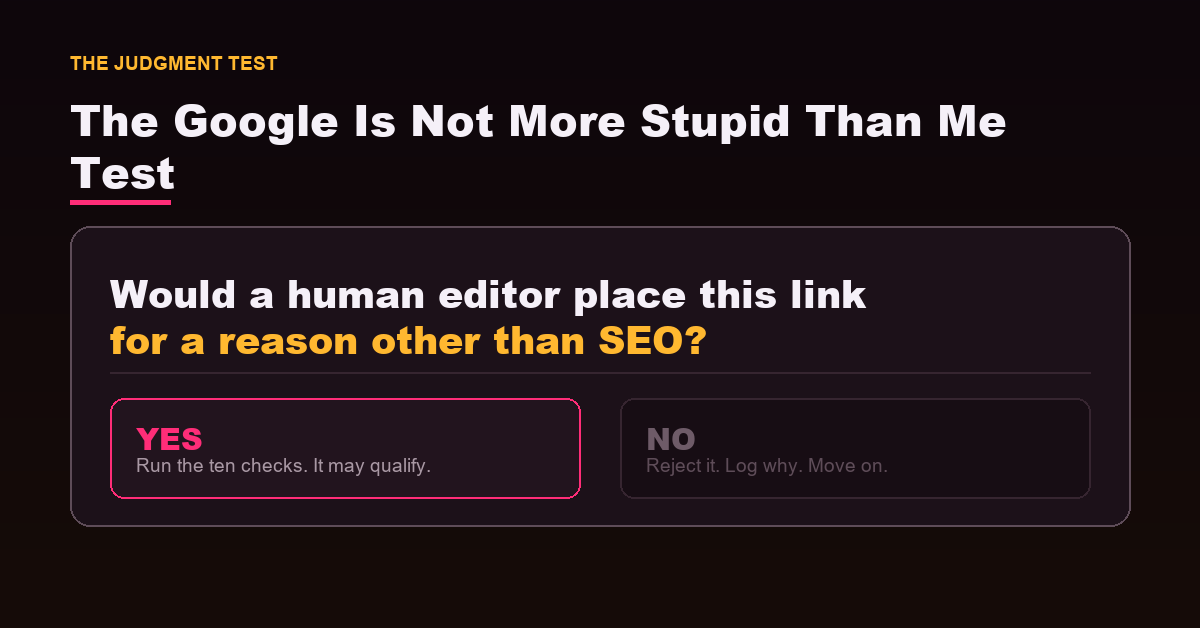
Before you spend two minutes on the ten checks, spend ten seconds on one question. Kristiyan’s version of it is the most useful heuristic we have added to this process in a year.
If I look at a link-building opportunity and it makes sense to me, it would be the same for Google, because Google is definitely not more stupid than me. It’s quite the opposite — it’s actually smarter.— Kristiyan Yankov, Above Apex
Run it as a gate, phrased from the other side of the transaction: would a human editor place this link for a reason other than SEO?
If the honest answer is no — if the only reason that link could exist is that someone wants a link — then no combination of metrics rescues it, because the thing you are hoping to fool is smarter than the person trying to fool it. Reject it and move on. You have just saved yourself the ten checks and an outreach email.
If the answer is yes, the prospect has earned the two minutes. Proceed.
Ten Checks Before You Send The Email
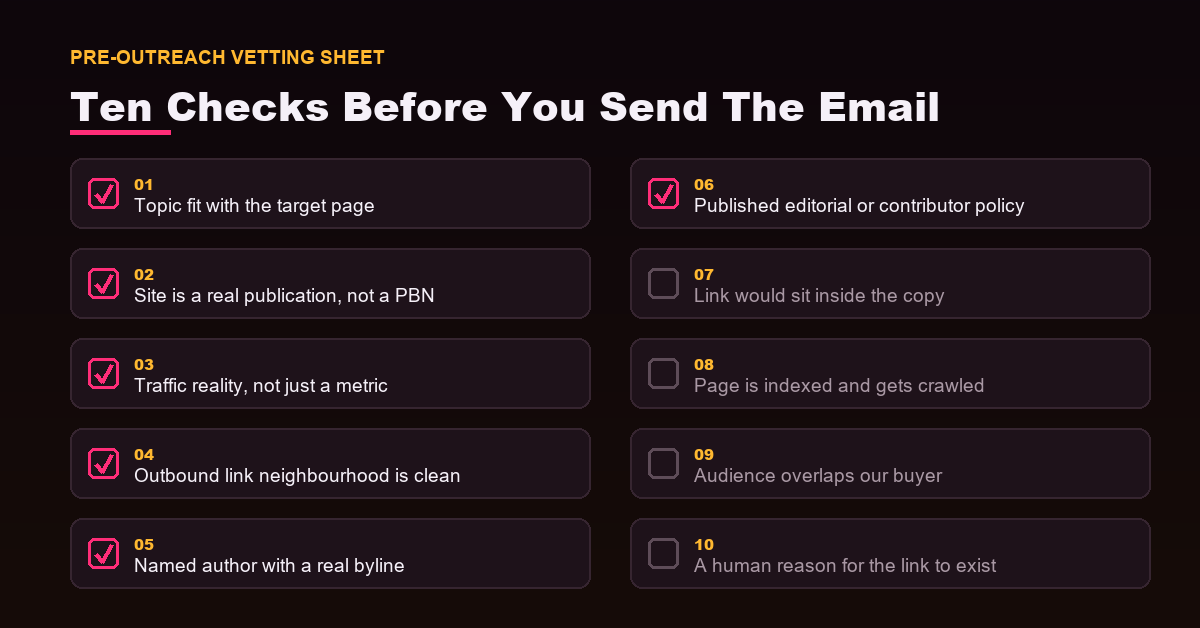
Run these in order. The early ones are cheap and disqualify fastest, which is the whole point — you want most of a bad list gone before you have paid a tool a single API call.
- Topic fit with the target page. Not the domain and the client. The specific page the link will sit on, and the specific page it will point at. Write the connection in one sentence. If the sentence needs a “well, broadly speaking,” it fails.
- Genuine site, not a network. Kristiyan’s explicit check: does this website serve a purpose beyond hosting links? Look for a real about page, a real contact route, and a reason for the site to exist.
- Traffic reality. Not a traffic estimate treated as gospel — evidence of humans. Comments, shares, a newsletter, a forum thread linking in, anything that indicates readership rather than existence.
- Outbound link neighbourhood. Open the last few published posts and look at who they link out to. A marketing site that also links to casino and loan pages has told you exactly what it is, regardless of its metrics.
- Named author with a real byline. A person who exists elsewhere on the internet, with a profile that predates the site. Anonymous or single-generic-author sites are a strong negative signal.
- Published editorial or contributor policy. Its existence tells you there is a process. Its absence does not disqualify a site outright, but it moves the burden of proof onto you.
- The link will sit inside the copy. Kristiyan’s phrasing is that the link should be seamlessly integrated into the article itself. Author bio boxes, footers and resource dumps are not that.
- The page is indexed and crawled. Trivial to check, embarrassing to skip. A placement on a page that is not in the index is a placement that does not exist.
- Audience overlap with the buyer. Topical relevance and audience relevance are not the same thing. A developer blog can be perfectly on-topic for your product and read entirely by people who will never hold the budget.
- A human reason for the link. The gate from the previous section, applied one final time now that you know more. If nothing you learned in checks one through nine changed the answer, you are clear to pitch.
Checks two, three, four, seven and ten map directly onto what Kristiyan described. The rest are ours, added because they are the disqualifiers our own reviews kept catching late. Once a prospect clears all ten, it belongs in a real campaign structure rather than a one-off blast — that is what our outreach and content link building process is for.
Logging Rejections So The Team Learns
This last step is entirely our own practice rather than anything Kristiyan prescribed, and it is the one most teams skip.
Every rejection gets one line in a shared sheet: the domain, the check number it failed on, and a five-word reason. That is the whole format. It takes about eight seconds and it does three things that compound.
It stops you re-prospecting the same dead domain in four months, which every team does. It shows you which check is doing the most work, so you can move it earlier and disqualify faster. And it turns a subjective judgement into a training artefact — a new team member reads two hundred logged rejections and absorbs the standard far faster than from any document.
Kristiyan mentioned that when his team faced an unusually demanding client with hyper-specific criteria, they deliberately treated it as a case study for their own team rather than dismissing it. Anything that stress-tests your standard is worth capturing.
Review the log monthly. If one check accounts for most of your rejections, your prospecting source is the real problem, not your vetting. If you are documenting this as a team process, our DIY link building SOPs cover the surrounding workflow.
Verify, do not trust. Then write down what you verified.