Ask most teams for a linkable asset and you will get a long article. It is the default because it is the thing content teams already know how to make. It is also the thing every other team in your niche is making this quarter, which is precisely why it no longer earns anything.
Christopher Gimmer has built two bootstrapped SaaS products, Snappa and GoodMetrics, and got his original distribution from exactly that kind of article — a free stock photos post that ranked first and went viral. He is now unusually clear-eyed about why that playbook has stopped paying.
The Linkable Asset Nobody Builds
On Unscripted SEO he connected two things that are usually discussed separately: the collapse of cold outreach, and what people are actually willing to link to now.
Another benefit of the tools and stuff is that it’s hard to do traditional link building now, just because everyone’s inbox is full of spam. So I think people are more willing and likely to link out to a really good tool that actually solves a problem versus yet another blog post with a wall of text.— Christopher Gimmer, Snappa & GoodMetrics
Both halves matter. Outreach got harder because every inbox is saturated, and the asset most people are pitching got weaker at the same time. A tool changes the arithmetic on both sides at once.
He also described where he is putting effort for GoodMetrics, and it is not the blogging treadmill. His view is that the top of the funnel is more or less dead because those queries are being answered by AI Overviews, so the investment has gone into comprehensive documentation, landing pages that describe the product in detail, and free or interactive tools rather than posts.
That is the opportunity. Almost nobody in your niche is shipping small tools, because it feels like an engineering project. Scoped properly, it is not.
Scoping A Tool You Can Ship In A Week
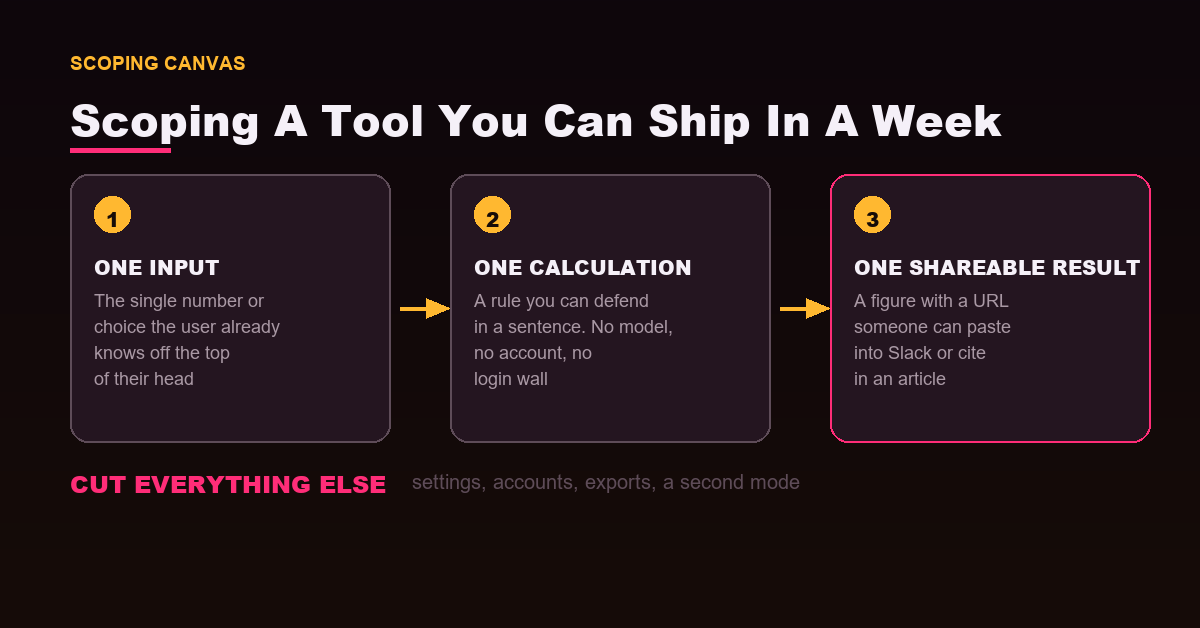
The reason most linkable tools never ship is that they get scoped like products. Cut them to three things instead. This scoping frame is our own; Christopher named the category, not the method.
One input. A single number or choice the user already knows without looking anything up. If your tool needs three fields, you have a form, and forms do not get linked. If it needs data the user has to go and find first, most of them will not come back.
One calculation. A rule you can defend in a plain sentence, published openly on the page. No account, no login wall, no model. The transparency is not a nice-to-have — an editor deciding whether to cite you needs to see the method, and a black box is not citable.
One shareable result. A figure or verdict at a URL that someone can paste into Slack or reference in an article. If the result cannot leave your page, the tool cannot earn a link.
Then cut everything else. Settings, saved history, export, a second mode, an accounts system: every one of those is a week of work that adds nothing to the linkability of the thing. Ship the narrowest useful version and let demand tell you what to add.
The best candidates are usually the calculation your own team already does by hand for every client in a spreadsheet. You have already validated that it is useful and you already know the rule. Publishing it is mostly a matter of putting a front end on something that exists.
Where The Data Comes From
This section is practitioner guidance rather than anything from the interview, and it is where most tool projects quietly die, so it is worth being concrete. There are four honest sources, roughly in order of how much work they cost.
A published rule. Tax bands, postage rates, building code minimums, standard industry formulas. Zero data collection. You are packaging a lookup that is annoying to do manually, and the maintenance burden is one update a year.
Your own operational data. Benchmarks derived from work you have already done, anonymised and aggregated. This is the strongest option because nobody can replicate it, and it is the one most likely to get cited by name rather than just linked.
A public dataset. Government statistics, open APIs, published industry surveys. Free, credible, and the citation obligation cuts both ways — naming your source clearly makes your tool more linkable, not less.
A one-off survey. The most expensive and the most defensible. Only worth it if the tool is a genuine pillar asset rather than an experiment.
Whichever you choose, put the source and the last-updated date on the page. It is the cheapest thing you can do to make a journalist comfortable citing you.
Outreach For A Tool Versus Outreach For A Post
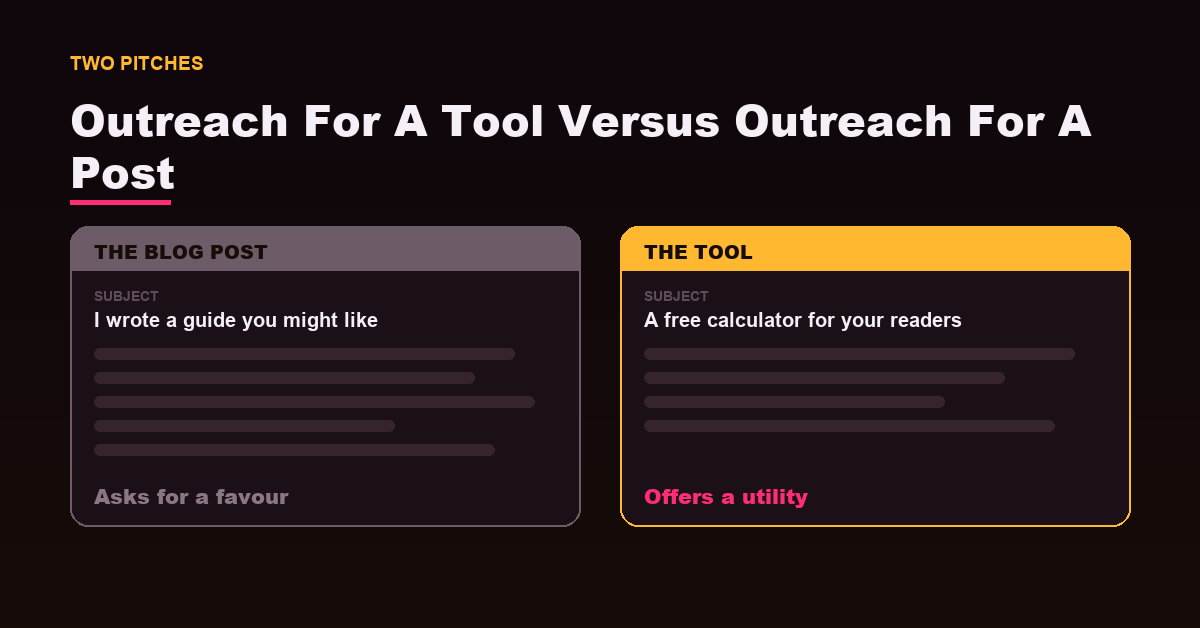
The pitch is structurally different, and this is the part teams get wrong by reusing their article template.
Pitching a post asks for a favour. You have written something and you would like the recipient to link to it, and the only benefit on offer is that it is good. In an inbox already full of that exact message, it is indistinguishable from spam even when it is sincere.
Pitching a tool offers a utility. The message is that their readers have a job to do and here is something free that does it, no signup required. That is a different email: shorter, specific about which of their existing pages it belongs on, and with the value stated in terms of their audience rather than yours.
Three differences worth building into your template. Name the exact page you think it fits and why, because a tool has an obvious home in a way an article does not. Lead with what it does, not how you built it. And make the no-strings part explicit — no email gate, no account — because the recipient will assume it is a lead magnet in disguise.
The other route worth running in parallel is to get the tool into the hands of people who already publish in your space, which overlaps heavily with how attribution-driven expert roundups and graphics earn placements. If the surrounding campaign structure is new to you, start with outreach and content link building and slot the tool in as the asset.
Keeping The Tool Alive So Links Persist
Also our guidance rather than Christopher’s, and the least glamorous section here. A tool is not a campaign that ends. It is an asset with an ongoing failure mode that an article does not have: articles get stale, tools get wrong, and a wrong tool loses links permanently rather than gradually.
Four habits keep it earning.
Put a visible last-reviewed date on it and honour it. An editor deciding whether to keep a citation checks whether anyone is still home.
Monitor it like infrastructure, not content. An uptime check and an alert. A broken calculator that nobody notices for three weeks costs you every link pointing at it, and those referring pages will not tell you.
Never change the URL. If you rebuild it, rebuild it in place. The accumulated links are the entire return on the project and a migration is the most common way teams throw them away.
Re-pitch on genuine updates. New data or a new capability is a legitimate reason to contact everyone who linked before, and it is a far warmer email than the original pitch was.
Do that and one week of work keeps compounding for years, which is more than the article you were going to write instead would have done. If you are working through the fundamentals of what earns a link in the first place, our learn how to link build guide is the place to start.