There is a category of link that requires no prospecting, no relationship building and no persuasion, because the hard part already happened: somebody wrote about you and did not link. The page exists, the editor already decided you were worth mentioning, and the only thing missing is an anchor.
This is a weekend sprint. It has a beginning and an end, and most businesses have never run it once.
Why Unlinked Mentions Are The Cheapest Win
Every other link acquisition method has to overcome the same objection: why should this page reference you at all. Reclamation skips it entirely. The editorial judgement has been made, in your favour, by someone who was not asked.
That changes the email you are sending from a pitch into a correction, and corrections have a completion rate that pitches do not. You are not asking anyone to endorse you. You are pointing out that a reference they already made is missing the thing that makes it useful to their reader.
It also has a natural ceiling, which is why it is a sprint rather than a programme. Most businesses have somewhere between a handful and a few dozen unlinked mentions accumulated. You clear them, you set up monitoring, and you move on.
Five Places To Search For Your Own Name
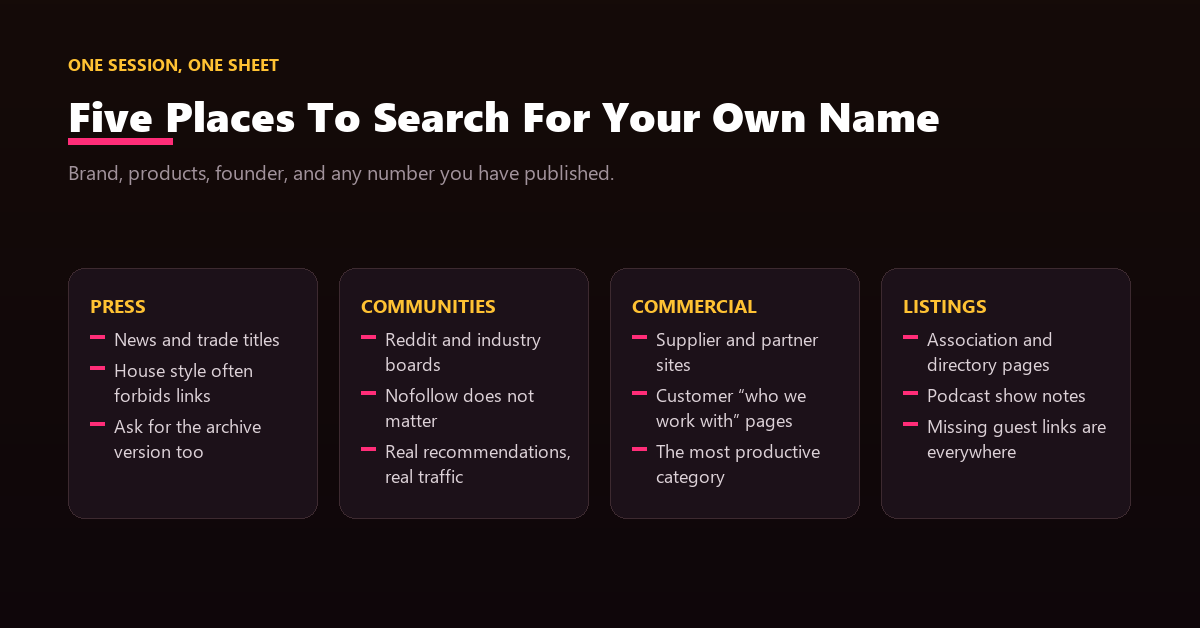
Search your brand name, your product names, the founder’s name, and any proprietary number or phrase you have published. Then work these five sources.
- News and trade press. Anywhere you were quoted, listed or referenced. Trade publications are the most likely to mention without linking, because house style often forbids it — ask anyway, and ask for the archive version.
- Forums and communities. Reddit, Stack Exchange, industry boards. Many are nofollow and it does not matter; a recommendation from a real user is worth having as a citation and often as traffic.
- Supplier, partner and customer sites. The most reliably productive category and the one everybody forgets. Companies list who they work with constantly and link inconsistently.
- Directories and association pages. If you are a member of anything, check whether the listing actually links. A startling proportion do not.
- Podcast show notes and transcripts. If anyone from your business has ever been a guest, check the episode page. Missing guest links are extremely common and are fixed in a day by a friendly host.
Do it in one session and keep a single sheet: URL, where the mention appears, who to contact, sent, outcome. The sheet is what makes the sprint finishable.
The Two-Sentence Reclamation Email
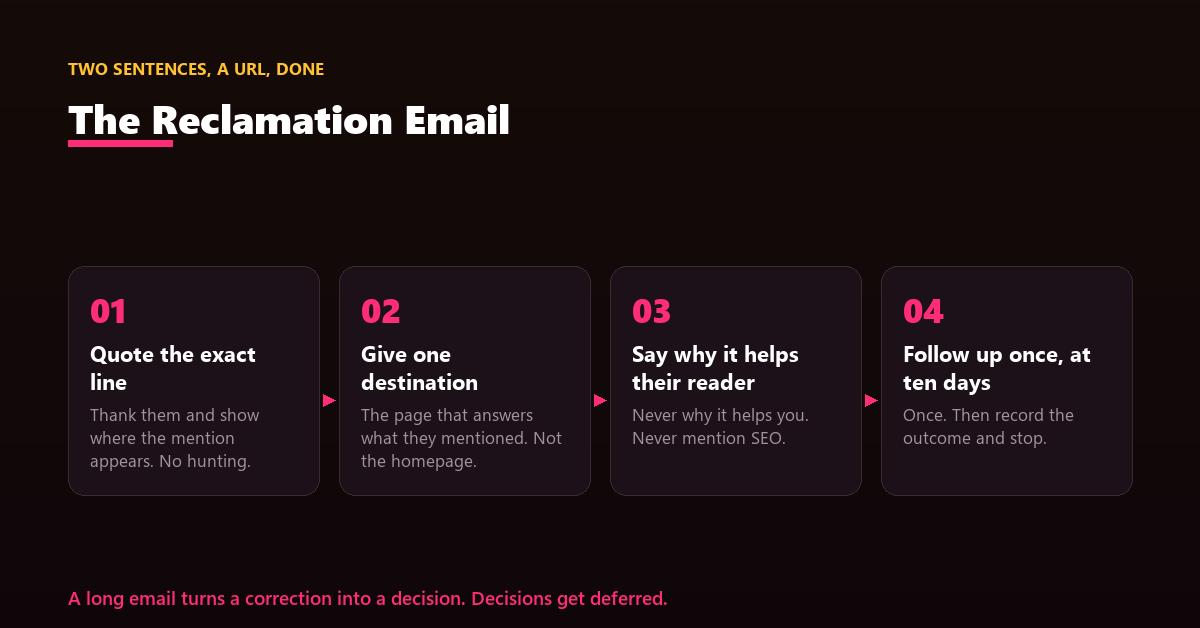
Length is the most common mistake. A long email turns a trivial correction into a decision, and decisions get deferred. Two sentences, a URL, done.
Sentence one: thank them and quote the exact line where the mention appears, so they do not have to go looking. Sentence two: give the URL you would like it to point to and say why it helps their reader — not why it helps you.
- Send it to a person. The author or the editor by name. Contact forms are where these die.
- Never mention SEO. The moment you do, you have converted a helpful correction into a favour with a commercial motive attached.
- Give the exact destination. Not your homepage. The page that actually answers the thing they mentioned.
- Follow up once, after ten days. Once. Then stop.
What To Do When They Say No
Some publications have a blanket policy against outbound commercial links, and the correct response is to believe them and be gracious. You have just had a friendly exchange with an editor who already thinks you are worth mentioning, which is a better position than you were in an hour ago.
- Ask if they will correct anything factual instead. A wrong job title or an out-of-date figure is worth fixing on its own merits, and it makes the mention more useful.
- Offer to be a source. “If you cover this again, I am happy to be quoted” converts a dead end into a relationship. This is where reclamation quietly turns into digital PR.
- Record the no. Put it in the sheet so nobody on your team asks the same publication again in eight months.
- Leave it alone. An unlinked mention still contributes as a citation. Not every mention has to become a link to have been worth something.
Then set up monitoring so this never becomes a backlog again — an alert on the brand name, checked monthly, turns a recurring sprint into a five-minute habit.
The detailed tactic pages are reclaim unlinked brand mentions, finding unlinked brand mentions, and recovering lost links, which is the adjacent job of repairing links that used to exist.