Outreach has a structural problem: almost every template asks a stranger for something before giving them anything. Guest post pitches ask for space. Link requests ask for an edit. Skyscraper emails ask for a swap. The recipient’s first thought is always the same, and it is not a warm one.
There is one common outreach format that inverts this completely, and it is the reason we keep recommending it: asking to interview someone.
Why Nobody Refuses An Interview
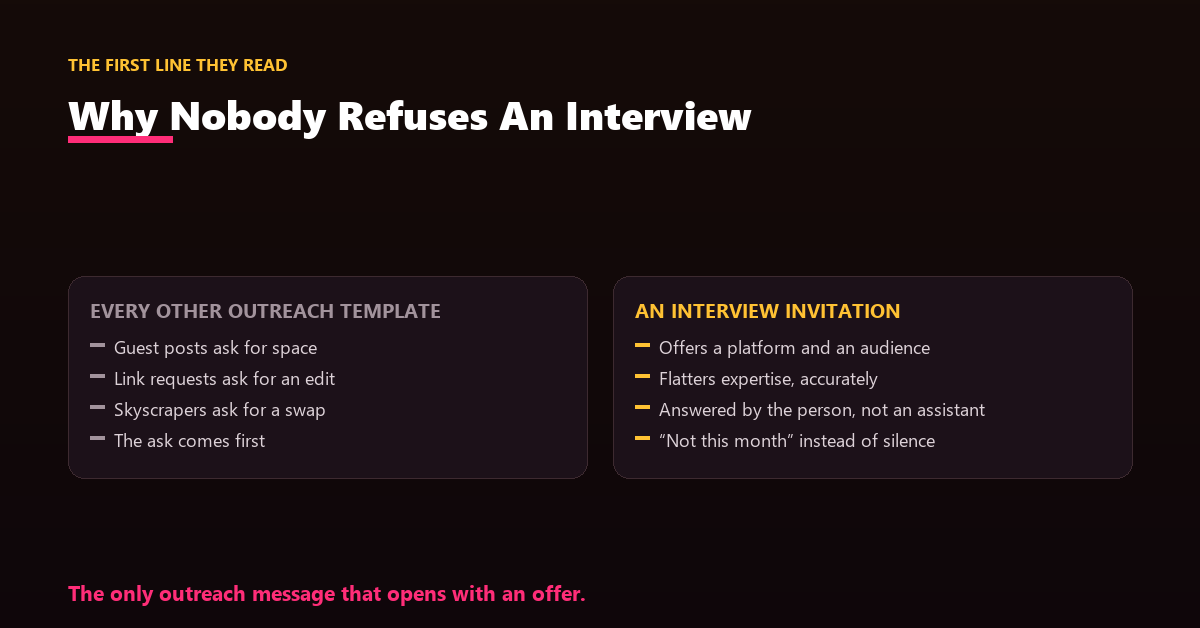
An interview invitation is the only outreach message where the first thing the recipient reads is an offer. You are proposing to give them a platform, an audience and a transcript that flatters their expertise, in exchange for an hour.
It is also, unusually, an ask that is easy to say yes to for reasons that have nothing to do with you. People like talking about their work. People want to be seen as the expert in their field. Very few people are asked. That combination is why the format converts where better-written pitches do not.
We are not going to give you a response-rate figure, because we do not have a clean one and neither does anybody else quoting them at you. What we can say from running both is that the shape of the reply is different: interview requests get answered by the person, not by an assistant, and the no is usually “not this month” rather than silence.
Value Before The Ask
Greg Digneo, who ran growth at Time Doctor and now runs Content Guppy, describes the strategic version of this — not as an outreach tactic, but as where brand conversation now happens. Asked how the approach had changed, his answer moved the activity off the blog entirely:
We’re going to put that stuff on Reddit. We’re going to put that stuff on other publications. We’re going talk about that in podcasts. We’re going to talk about that in YouTube channels— Greg Digneo, Content Guppy, Unscripted SEO
He is describing where the audience actually is rather than a link-building play, and we want to be exact about that rather than recruit him to an argument he did not make. What he does confirm is the payoff from the recipient side: describing why Time Doctor’s outbound and inbound were both warmer, he says people already knew them — they had signed up for the newsletter and forgotten, or read the blog once, “or because they had heard us on a podcast.”
His related warning is worth carrying: an SEO focused only on links and content is, in his words, siloed. The interview format is one of the cheapest ways out of that silo, because it produces a conversation, a page, a relationship and a link from a single hour.
One thing Digneo did not say, and we are flagging it because the claim circulates: he did not tell us that an hour on a microphone outperforms reworking your own content. That is not in the interview. What is in it is the argument for building and borrowing distribution rather than relying on a channel you do not own.
Setting Up A Q And A Both Sides Publish
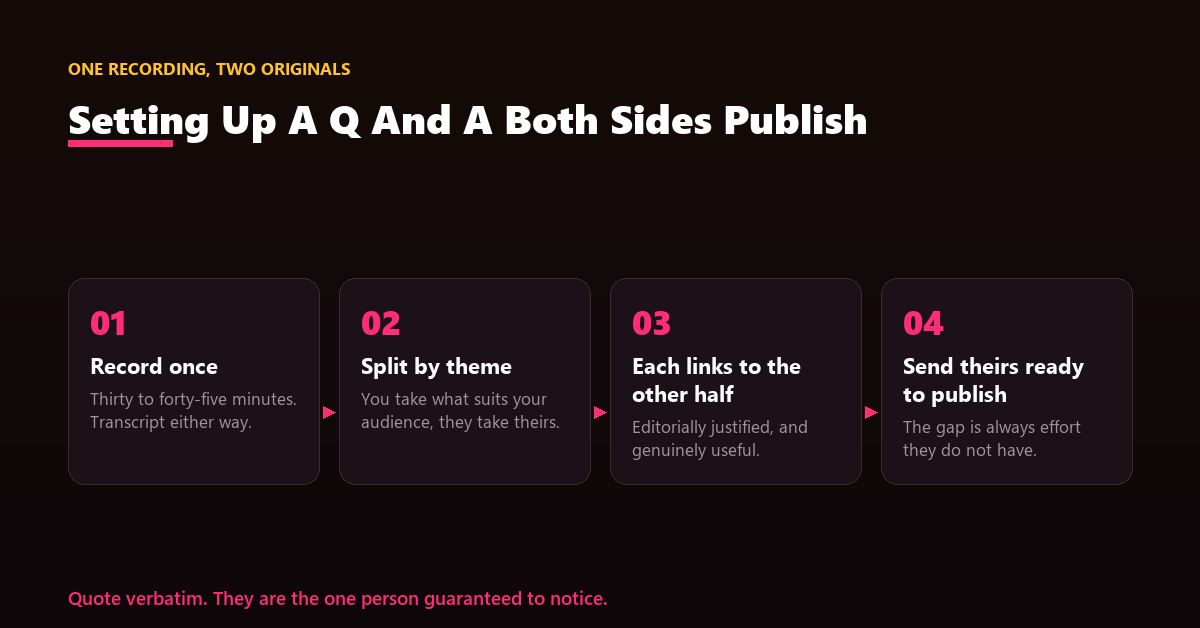
The version that reliably produces a link on both sides. The key is that neither party publishes the same text, so both have something original.
- Record once, properly. Thirty to forty-five minutes, video if they will, transcript either way.
- Split by theme, not by half. You publish the part that suits your audience; they publish the part that suits theirs. Two distinct pieces from one conversation.
- Each side links to the other half. Natural, editorially justified, and genuinely useful to the reader, who may well want the rest.
- Send them their half ready to publish. Formatted, quotes checked, images included. The gap between a willing participant and a published page is almost always effort they do not have.
- Keep the transcript. It is your evidence for every quote and it is where the next three pieces of content come from.
The Link That Follows Without Being Requested
The link is rarely the thing you ask for, and that is why the format works. Someone who has spent an hour talking to you, been quoted accurately, and received a finished page they can publish under their own name will almost always link back, mention it, or send it to their list.
The one discipline that decides this: quote them verbatim. A subject who reads a tidied-up version of their own words, however flattering, immediately trusts you less — and they are the one person guaranteed to notice. Accuracy is the whole basis of the reciprocity.
Scaling To Four Interviews A Month
Four a month is a realistic ceiling for one person doing this alongside other work, and it is enough to change a link profile within two quarters.
- Batch the outreach. Twenty invitations in one sitting, monthly. It is the same twenty minutes whether you send two or twenty.
- Batch the recording. Two afternoons a month, back-to-back slots. Context switching is what kills this.
- Standardise the question set. Six core questions, two specific to the person. Comparable answers across interviews are worth more than bespoke ones, because they become roundups later.
- Fix the turnaround. Publish within ten working days, every time. Late delivery is the single fastest way to lose the referral to the next guest.
The tactical versions are the two-way Q&A guest post, podcast guesting as a link channel, and reverse guest blogging.