There is a set of pages in every industry that almost nobody competes for, that are maintained by companies who want them to be comprehensive, and that link out by design. They are the where-to-buy pages, dealer locators, partner directories and approved-installer lists run by the suppliers you already pay.
This is the least competitive link source in most industries and it is usually overlooked because it is not exciting.
The Pages Your Suppliers Already Maintain
Consider the incentive from the other side. A manufacturer’s where-to-buy page exists so their end customers can find someone to buy from. An incomplete list costs them sales. A partner directory exists to make the company look established and well-supported; a thin one is embarrassing. These pages want more entries.
Which means you are not asking for a favour. You are offering to solve a problem the page exists to solve. That is a fundamentally different conversation from every other kind of outreach, and it is why the completion rate is so much higher.
The categories worth checking, in rough order of yield:
- Where-to-buy and stockist locators. The classic. If you resell anything, you probably qualify already.
- Approved installer or certified partner lists. If anyone on your team holds a certification, there is very often a public directory attached to it that nobody told you about.
- Software and platform partner directories. Every tool you pay for monthly likely has one, and they are frequently self-service.
- Trade association member listings. You are already paying the membership. Check the listing actually links.
- Franchise, distributor and regional-agent pages. Where they apply, they are usually the strongest pages of the lot.
Auditing Your Own Accounts Payable For Prospects
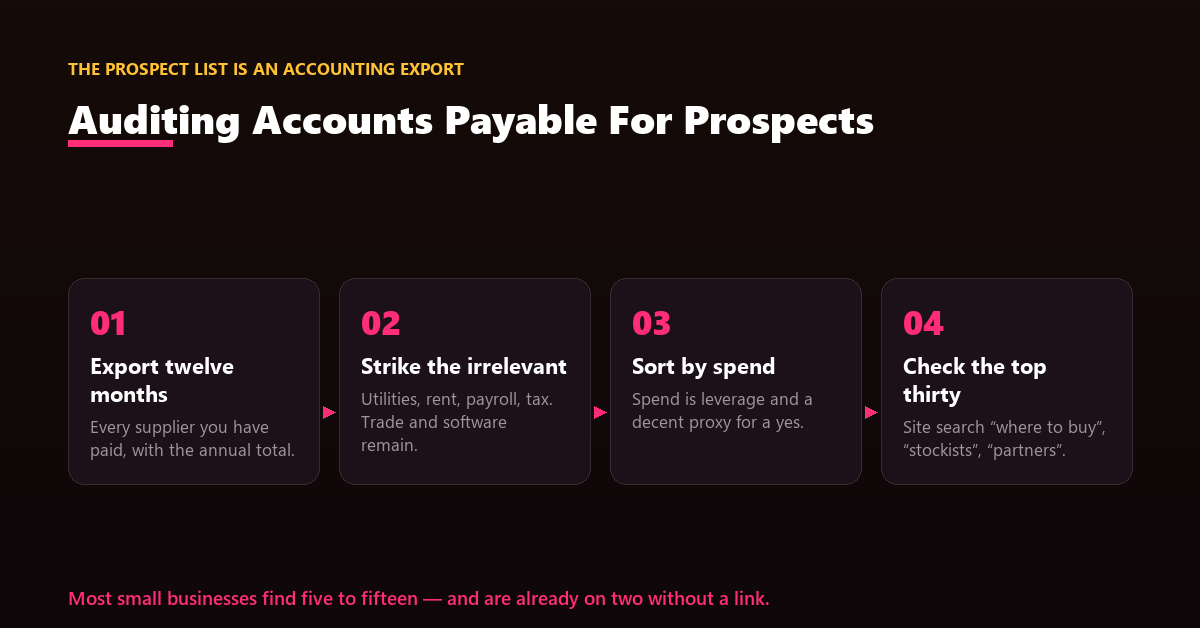
The prospect list is not something you research. It is an export from your accounting system, and this is the single most useful hour in the whole play.
- Export twelve months of supplier payments. Every company you have paid, with the annual total.
- Strike out the irrelevant. Utilities, rent, payroll, tax. What remains is trade suppliers, software and services.
- Sort by annual spend, descending. Spend is leverage, and it is also a reasonable proxy for how likely they are to say yes.
- Check the top thirty for a partner page. Site search for “where to buy”, “stockists”, “partners”, “find a…”, “approved…”. Five minutes each.
- Note who your contact is. The account manager, by name. This is what makes the email work.
A typical small business finds somewhere between five and fifteen qualifying pages, and is usually already listed on two of them without a link.
The Request That Takes One Email
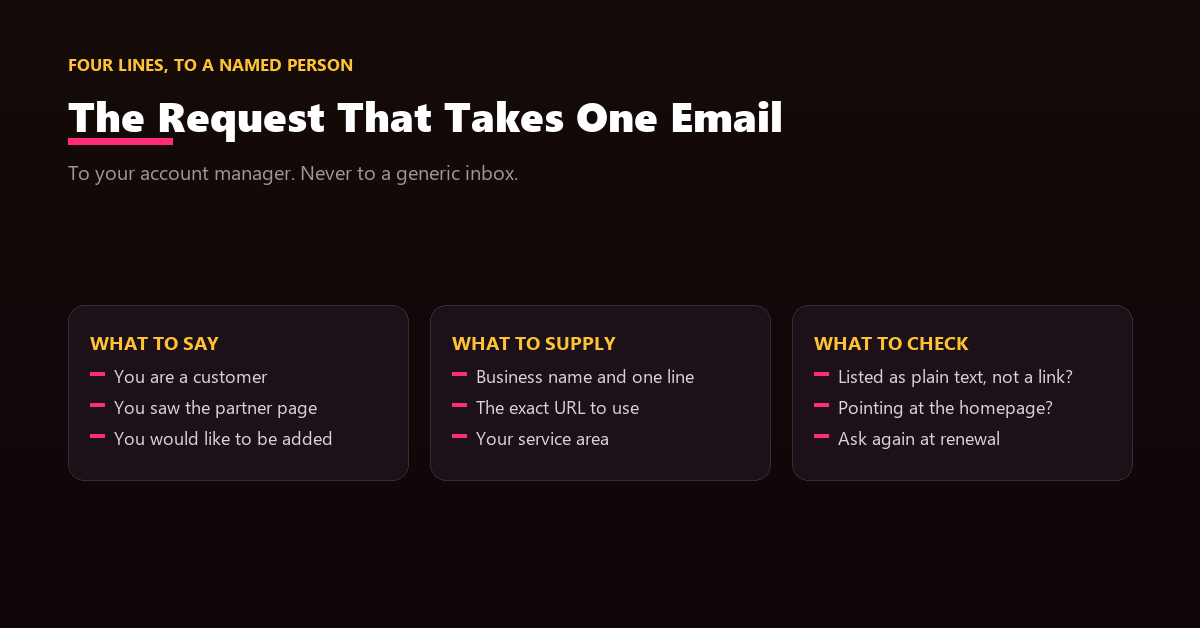
Send it to your account manager, not to a generic address. They are commercially motivated to keep you happy and they know exactly who internally owns the website.
Keep it to four lines: you are a customer, you noticed the partner page, you would like to be added, and here are the exact details to use — business name, one-line description, the URL, the service area. Supplying the copy removes the only real obstacle, which is that somebody would otherwise have to write it.
- Never mention SEO. You are a customer asking to be listed on a customer listing. That is all this is.
- Ask for the right destination. The relevant service page, not the homepage, if the directory allows it.
- Check what is there afterwards. Listings frequently go up with the business name as plain text. A one-line reply fixes it.
- Do it at renewal. If you are about to place an order or renew a contract, that is the moment with the most goodwill in it.
Reciprocal Partner Pages Done Honestly
The obvious next step is a partner page of your own, and it is worth doing for reasons that are not primarily about links. A genuine “who we work with” page helps customers understand what you install, what you stock and who stands behind it.
The honest version is straightforward. List the suppliers you actually use. Say what the relationship is. Do not build a page whose only function is to trade links with anyone who will trade back, and do not solicit reciprocity as a condition — a partner page that exists to be swapped looks exactly like what it is, to editors and to search engines.
Built properly, it also gives you something to offer first. Adding a supplier to your page before asking about theirs converts the request into a reciprocation, which is an easier thing for anyone to agree to.
The tactic page is partner and supplier where-to-buy links; the adjacent play is generating links through complementary business partners, and the process documentation lives in our DIY link building SOPs.