If you accept that a meaningful part of modern SEO is public relations, the immediate problem is that PR is hard to start. You cannot decide to be covered by a trade publication. You can, however, decide to be on a podcast, and there are more shows looking for guests than there are people volunteering.
The Two Types Of SEO Left
Zak Ali, who leads SEO at Finder in the US, put the shift more sharply than anyone we have interviewed:
there’s two types of SEOs that exist today. There are the technical SEOs, and there are SEOs who haven’t realized yet that their job is digital PR and branding.— Zak Ali, Finder US, Unscripted SEO
He is not speaking hypothetically. He describes deciding, in May of the previous year, to dissolve his SEO team and run a generalist marketing team instead — telling people who had spent years building the discipline that they were growth marketers now. He describes it as rough at the beginning. That is a real organisational cost, paid on the strength of the argument.
The relevant consequence for link building is that if the job is PR, then the deliverable is coverage rather than placements, and the cheapest coverage available to a person with no media relationships is a conversation on somebody else’s show.
Why Guesting Is PR You Can Actually Book
Jason Wade makes the supply-side argument for the same conclusion, and it is the most practical case for this channel we have heard. His observation is about how few people ever actually do it: on his account most podcasts that start do not get far — he cites seven episodes as the typical stopping point — and only a small fraction of people even say they want to.
His conclusion is about friction: “If a company can take that friction away of the work and you can do that, you or I can take that friction away and do the stuff they won’t do. That’s where the magic was.” The same logic runs in reverse for a guest. Hosts need people willing to talk. Most people are not. Being willing is most of the qualification.
Wade is also direct about the ranking side, from his own experience: “I did a podcast and it ranked instantly.” He attributes it to nobody else competing for the space, and is specific that it works best when the subject is specific or when the guest has an unusual name. His summary is worth stealing: if you know that works, do a podcast every time.
One caveat we would add and he did not: that is his account of his own results in his own niches, not a general law. A guest spot on an unindexed show about a saturated topic will not rank instantly for anybody.
The Show-Note Link And What It Is Worth
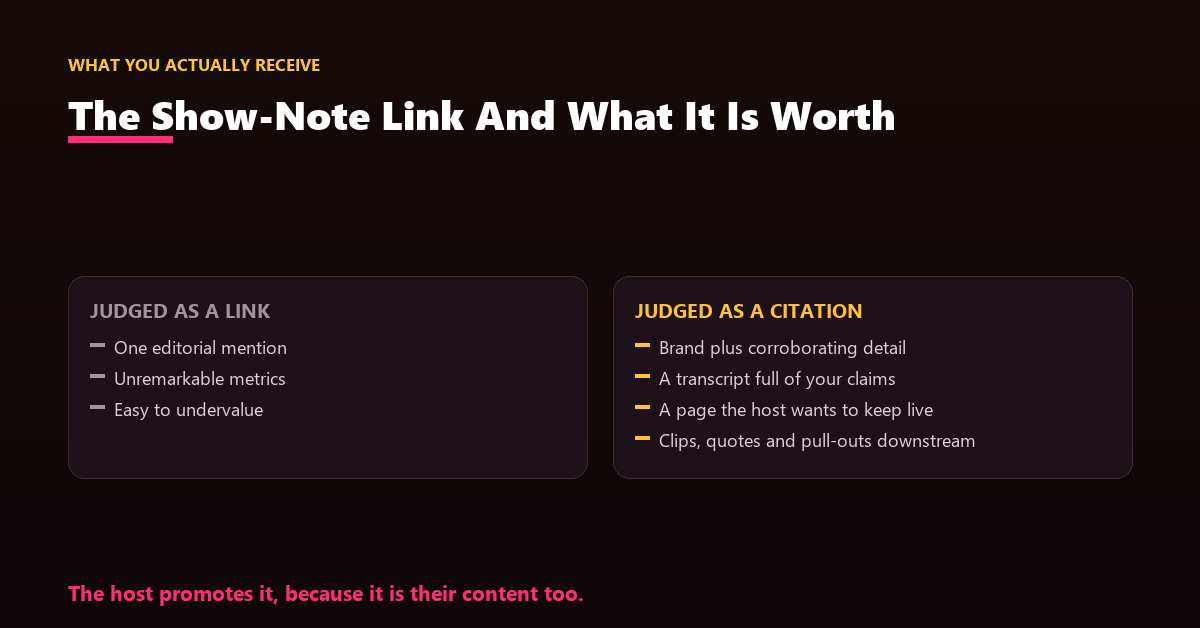
Our own assessment of the asset, since neither guest priced it. A show-notes link is an editorial mention on a page that exists specifically to be about you for an hour. It usually sits alongside a transcript containing your name repeatedly, your company, what you do, and sentences you actually said.
Judged purely as a link it is unremarkable. Judged as a citation — a brand reference with corroborating detail, on a page a machine can read — it is one of the densest artefacts you can produce in an hour. And unlike a guest post, the host wants to publish it, promote it and keep it live, because it is their content too.
The second-order effect is the one people miss. A good episode produces clips, quotes, a transcript and a set of claims attributed to you by name on somebody else’s domain. Wade’s framing of that is that one podcast could become fifty assets. That is his estimate of the ceiling, not a promise, but the direction is right.
A Twelve-Week Guesting Plan
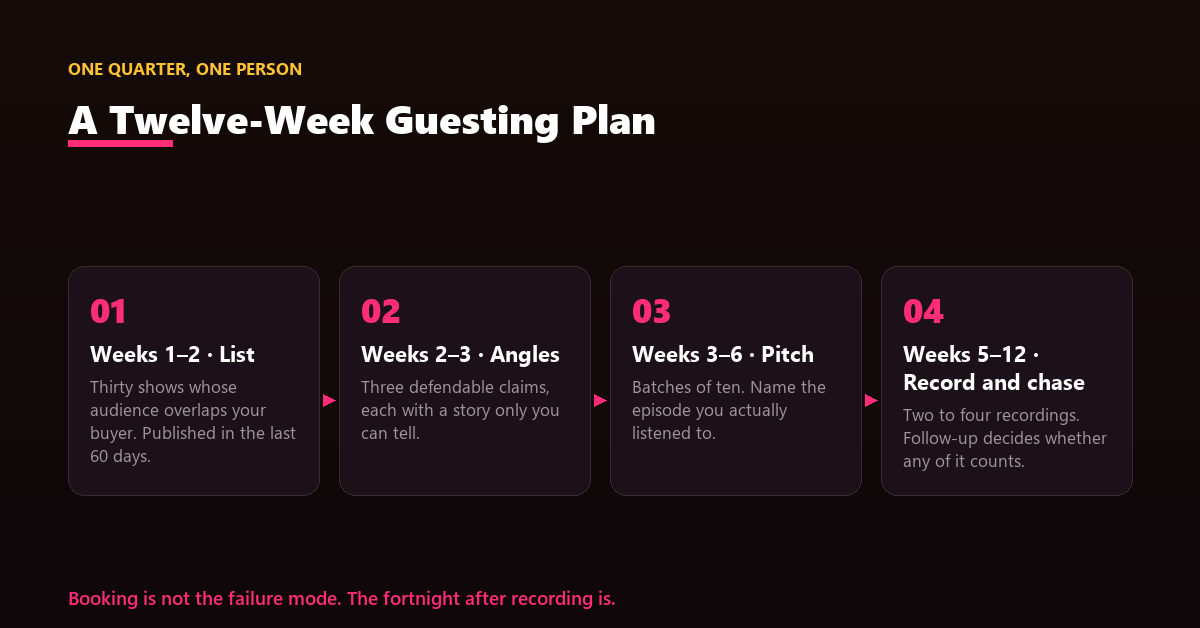
This plan is ours. Neither Ali nor Wade laid out a schedule; we are turning their argument into something a person can put in a calendar.
- Weeks 1–2: build the list. Thirty shows whose audience overlaps your buyer. Check they have published in the last sixty days — a dormant show is a dead link.
- Weeks 2–3: prepare three angles. Not topics. Angles, with a specific claim you will defend and one story only you can tell. Hosts book angles, not CVs.
- Weeks 3–6: pitch in batches of ten. Short, specific, name the episode of theirs you actually listened to. Expect most to go unanswered and treat that as normal.
- Weeks 5–10: record. Two to four is a realistic quarter for one person with a job.
- Weeks 6–12: follow up. This is the step that determines whether any of it counts.
Following Up So The Link Goes Live
The failure mode of this channel is not booking. It is the fortnight after recording, when the episode sits in an edit queue and everyone forgets. Our own follow-up sequence:
- Same day, send the host exactly what you want in the notes — name, one-line description, the URL, correctly spelled. Do not make them retype it from the recording.
- Send anything that makes their job easier: a headshot, three pull-quotes, the links you mentioned. Hosts remember guests who reduce work.
- When it publishes, check the notes actually contain the link. A surprising share do not, and this is the single highest-yield check in the whole process.
- Promote it properly from your side. The reciprocity buys you the next booking, and the next booking is where this channel starts compounding.
The longer case for this channel is in podcast guesting as a link channel. The mechanics of the citation are in guest citation links, and the host-side version is podcast link building.