Location pages are the most-produced and least-linked asset in local SEO. Agencies build them by the hundred, they occasionally rank, and in years of link building we have never once seen anybody link to one voluntarily. Melissa Popp, who runs content strategy at Rickety Roo, explains why in language we are not going to soften.
Nobody Links To A Find-And-Replace Page
Popp’s assessment of the category is unambiguous:
anybody who works in local will tell you that location pages are probably some of the worst content that’s ever existed in search.— Melissa Popp, Rickety Roo, Unscripted SEO
Her diagnosis is about intent rather than effort. The amount of low effort that goes into these pages, she says, is because the sole idea is that they need to rank on page one — and then that is it. The conversion job is ignored entirely. She describes what that produces: pages where the cities have simply been swapped out, and pages that still have lorem ipsum on them, ranking anyway because the competitive space is thin.
And, plainly:
the majority of location pages I see out there. They suck I’m not gonna mince words there— Melissa Popp, Rickety Roo
For a link builder the consequence is mechanical. A page produced by find-and-replace contains nothing a third party could have a reason to reference. There is no fact, no name, no photograph, no number — nothing a chamber newsletter, a local blog or a supplier could point at and say this is the useful bit.
The Local Proof That Makes A Page Citable
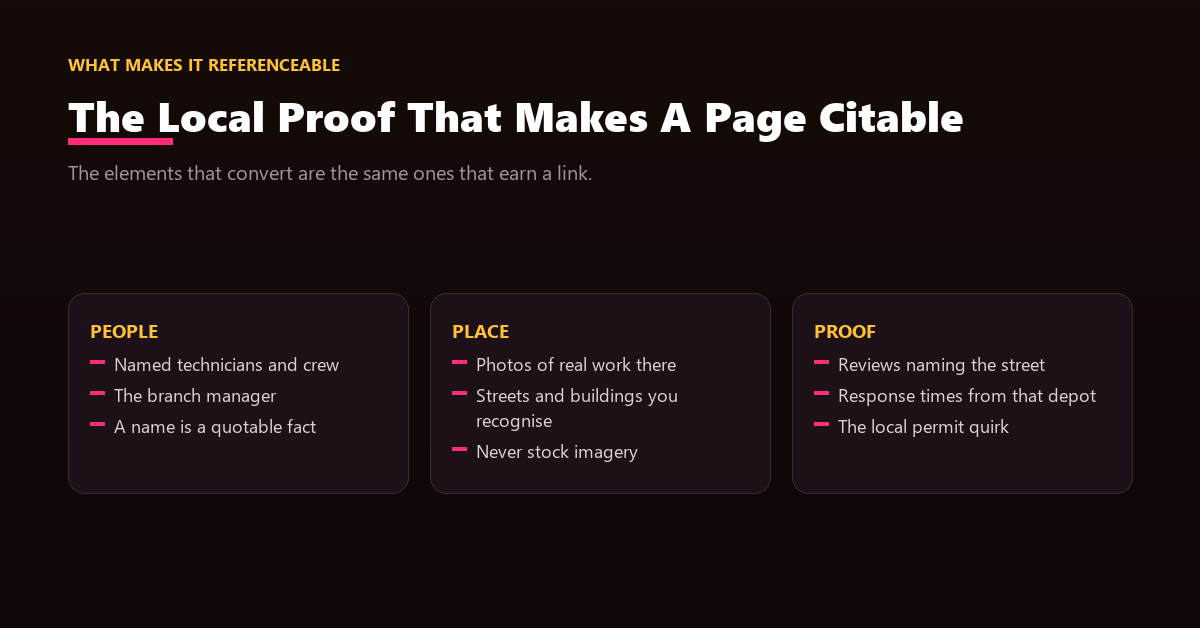
Popp is clear about what the page is for. In her framing, location pages are supposed to be bottom-of-funnel content — people landing there should already be convinced or have an immediate need, and should take an action rather than come back to it later. Her own team’s approach is to build pages that actually convince someone who lands on them to click to call or fill out a form.
What follows is our own translation of that into link-earning terms, not her checklist. The elements that make a page convert are, conveniently, the same elements that make it referenceable, because both require the page to contain something true and specific.
- Named people. The technicians, the branch manager, the crew who actually work that area. A name is a fact and facts are quotable.
- Photographs of real work in that place. Recognisable streets, buildings, projects. Stock imagery is the visual equivalent of find-and-replace.
- Specifics only a local would know. Response times from that depot, the permit quirk in that town, the two neighbourhoods you actually cover versus the one you do not.
- Reviews with detail in them. Not five stars — a customer naming the street and the problem.
- Something genuinely useful. The local permit process, the seasonal timing, the thing everyone in that town asks. This is the part a community site can link to.
Popp also makes the coverage argument that gets these pages built in the first place, and it is worth keeping: for service-area businesses in particular, having location pages for the suburbs, neighbourhoods and neighbouring cities is how you show up organically outside the map pack, which she considers incredibly important where the proximity factor works against you.
Getting A Community Site To Link To A Service Page
Our own play, and the one that turns the above into links. Popp did not discuss outreach; this is what we do with pages built to her standard.
- Find the page that already lists businesses like yours. A chamber directory, a town-centre association, a “local services” roundup on a community site. Ask to be listed where you already qualify before asking for anything else.
- Give them the useful section, not the sales page. If your Chesterfield page contains a genuinely helpful explanation of the local permit process, that is the thing worth referencing, and it is a much easier ask than “link to our service page”.
- Offer the named human. Community sites and local press want a person to quote. The named technician on your location page is a source.
- Make the page independently worth the click. Nobody links to a page they would be embarrassed to send a neighbour to.
Anchor Text For Brand Plus Service Plus Location
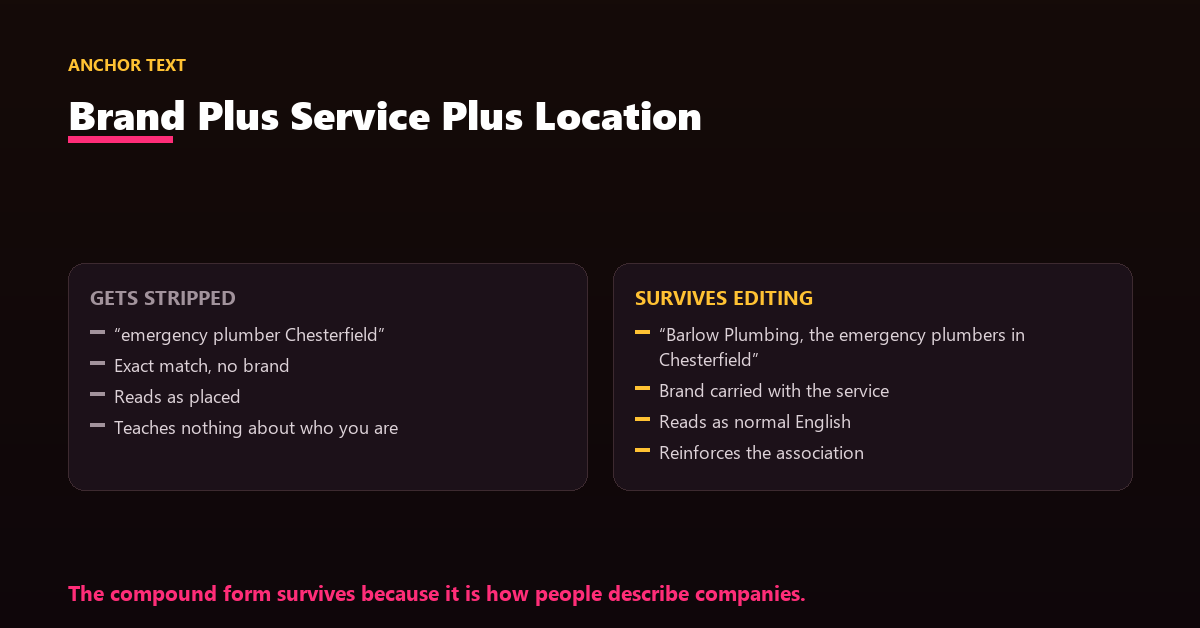
Our standing guidance, unchanged by this episode but worth restating in context. The compound form — brand plus service plus place — reads as a normal English description of a company, which is exactly why it survives editorial review and why it reinforces the association you actually want.
The failure mode is the exact-match service-plus-city anchor with no brand attached. It looks like what it is, editors strip it, and it teaches nothing about who you are. Our full treatment is in the brand + service + location anchor formula.
Auditing Your Existing Location Pages
If you already have forty of these, do not rewrite forty. Sort them by whether they currently receive anything — traffic, calls, form fills — and then apply one test to the top ten: cover the city name and read the page. If it could be about anywhere, it will never be linked to and probably will not convert either.
Rebuild those ten properly, to Popp’s standard rather than to a word count. Leave the rest until you have evidence the rebuilt ones perform. A smaller number of pages that contain real local proof beats a complete set of pages nobody would cite.
The relationship-side companion to this is local and offline link building, and if your brand is already being named in your service areas without a link, start with reclaiming unlinked brand mentions.