The most linkable thing most agencies could produce this quarter is not a guide. It is a number nobody else has, about something everybody argues about, gathered by doing something tedious that no competitor will bother to repeat.
Jake Melendy of Ignitvio did exactly that, more or less by accident, and the result is a useful worked example of what a small original study looks like when you are not a research firm.
Why Original Calling Data Earns Links
Melendy’s study did not start as a study. His mother called five roofers for a quote and none got back to her within three days. Two months later he called five local law firms on a Sunday afternoon as a prospective client, left voicemails, and none of them called back either. His reaction: “okay, this has got to be happening everywhere. So then we started testing it.”
That origin is the point. The research question came from an irritation he had personally experienced twice, which is why it was worth answering and why the answer is interesting to anyone in the industry. Studies designed backwards from a desired headline read like what they are.
The other reason this format earns links is supply. Opinions about follow-up speed are infinite and free. Measurements are rare, because measuring requires somebody to actually make the calls.
Designing A Study You Can Finish In Two Weeks
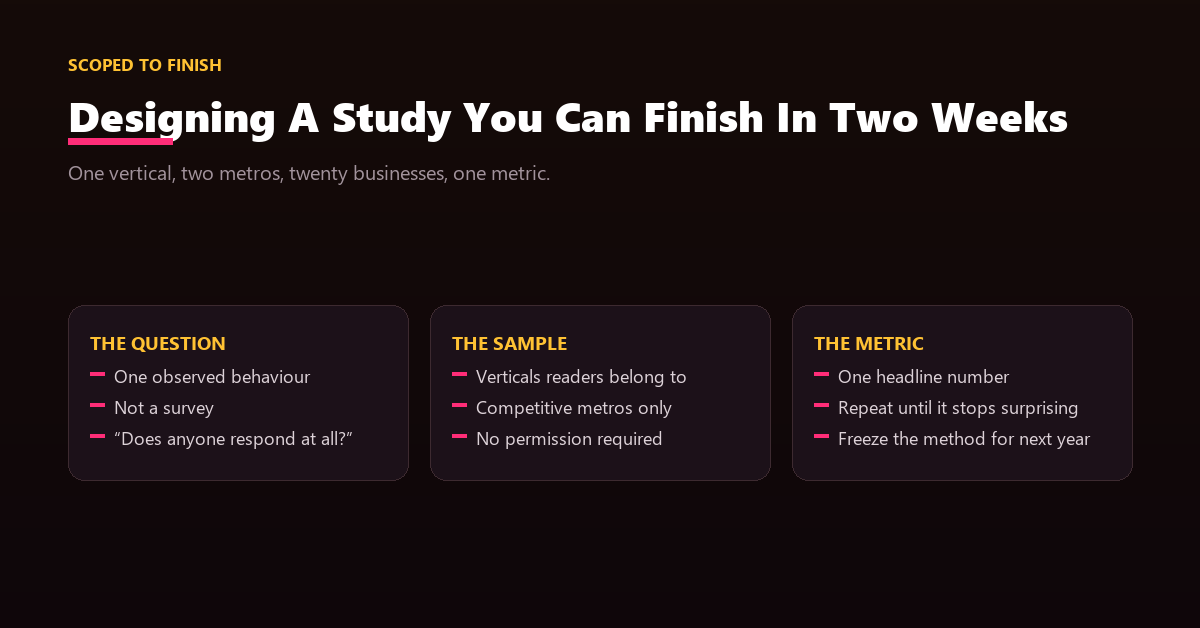
Melendy describes his method in outline: “I started running these tests in individual metros — in the most competitive metros for certain verticals. So roofing, HVAC, accounting, dentists. And every single time the same thing kept happening.”
The design principles worth copying, as we read them, are ours to state but his to demonstrate:
- One question. His was: if I present as a real prospect, does anyone respond? Not a survey. One behaviour, observed.
- Verticals a reader belongs to. Roofing, HVAC, accounting, dental. Every business in those categories has a personal stake in the answer, which is what makes it shareable.
- Competitive metros. Choosing the hardest markets pre-empts the obvious objection that the sample was full of amateurs.
- Repeat until it stops being interesting. The finding got strong because the same result kept appearing, not because one round produced a big number.
- Behaviour you can observe without permission. Nobody has to agree to participate for you to record whether they called back.
Two weeks is realistic for a scoped-down version. One vertical, two metros, twenty businesses, one contact method, one metric. That is a couple of afternoons of calls and a spreadsheet.
Melendy’s Numbers As A Benchmark
Here are his figures, in his words, with the framing he gave them:
Every single time, over fifty percent would never get back to me. And of the ones that did, only two percent followed up more than once, which is insane to me.— Jake Melendy, Ignitvio, Unscripted SEO
The second half is what makes it a story rather than a statistic. He sets it against a sales fundamental: “you need five touches generally to get a sale. The majority of sales happen after the fifth touch.” So the market is not merely slow — almost nobody in it is running the follow-up sequence that the sale actually requires.
He also supplies the line that turns the finding into a decision. His account of what happens when he tells a service business its three-hour response time is fine: “Yeah, but your competitors are responding within ninety seconds, and they’re booking that same person. So where are we really at?”
A note on precision, because it matters for anyone citing this. Melendy describes running these tests across those four verticals in competitive metros and getting the same result every time; he does not state a total sample size in the interview. If you reference the finding, reference it as he framed it — over fifty per cent, two per cent, across roofing, HVAC, accounting and dental — and do not attach a headline count he did not give.
Pitching The Study To Trade Publications
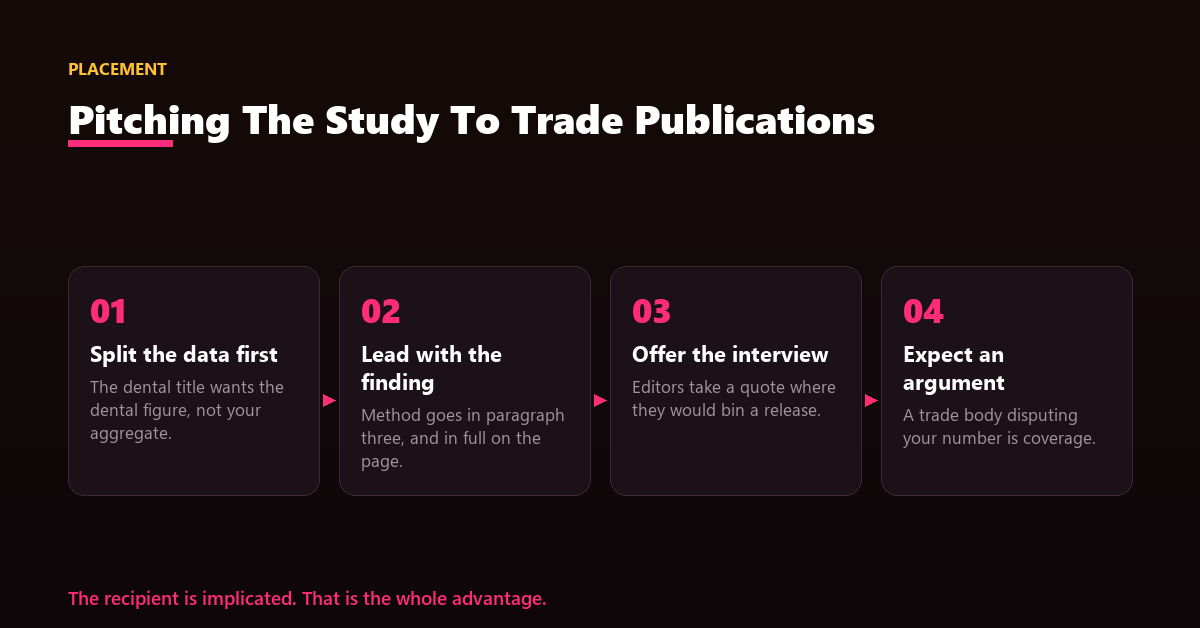
Our own guidance on placement. A finding like this has one enormous advantage over almost any other outreach asset: the recipient is implicated. A roofing trade editor reading “over half of roofers never returned a lead call” has a story whether they agree with you or not.
- Pitch the vertical its own number. Split the data before you send it. The dental publication wants the dental figure, not your aggregate.
- Lead with the finding, not the methodology. Method goes in paragraph three and on the page, where sceptics will look for it.
- Publish the method in full anyway. This is what separates a study from a marketing claim, and it is what makes the next journalist trust the first one.
- Offer the interview. An editor will often take a quote when they will not take a press release.
- Expect to be argued with. A trade body disputing your number is coverage, and usually links.
Refreshing The Data Next Year
An annual study is a different asset from a one-off, and the difference is worth more than the second dataset. Year two gives you a trend, a reason to contact everyone who covered year one, and a defensible claim to being the source on the question.
Keep the method frozen even where you have thought of improvements — a comparable number is more valuable than a better one. Record the exact scripts, times of day and selection criteria now, because in twelve months you will not remember them and an unreproducible study cannot be refreshed.
The related plays are local digital PR with owner quotes, the broader outreach content category, and asking for attribution on roundup graphics.