Every link builder eventually notices the asymmetry: the pages that get referenced by other people are rarely the pages that were built to be referenced. They are usually the ones that contained a fact somebody needed, stated clearly enough to be repeated.
Drew Dorenfest, who runs Client Magnet CRM, gave the clearest mechanical account of this we have heard, and it has a specific implication for how you rewrite what you already have.
The Verification Loop In Plain English
Dorenfest built content for a financial services client with offices in California and Las Vegas, going deliberately narrow: California versus Nevada tax code, gambling taxes, overtime taxes for Vegas service workers, student loan interest deductions. His account of why it worked:
The key to getting cited is to cite your sources. Link to IRS.gov, link to the tax research that backs your claims. When crawlers come and cross-reference your information against those sources and verify them, they go: okay, this company is legitimate, has been around for ten years, has great reviews — I will treat this as an authoritative source.— Drew Dorenfest, Client Magnet CRM, Unscripted SEO
The loop, stated plainly: a claim with a named source can be checked; a claim that checks out is safe to repeat; a page full of claims that check out becomes the thing other people repeat.
Dorenfest reports strong outcomes for that client — the student loan interest deduction post ranking above IRS.gov, HR Block and TurboTax within two weeks. He is careful about attribution, though, and so are we: he credits the combination of sourcing, content depth at a specificity the national brands lacked, and tax professionals reviewing every post for accuracy. Citing sources on a shallow page is not the play he is describing.
Where To Put The Source So It Gets Parsed
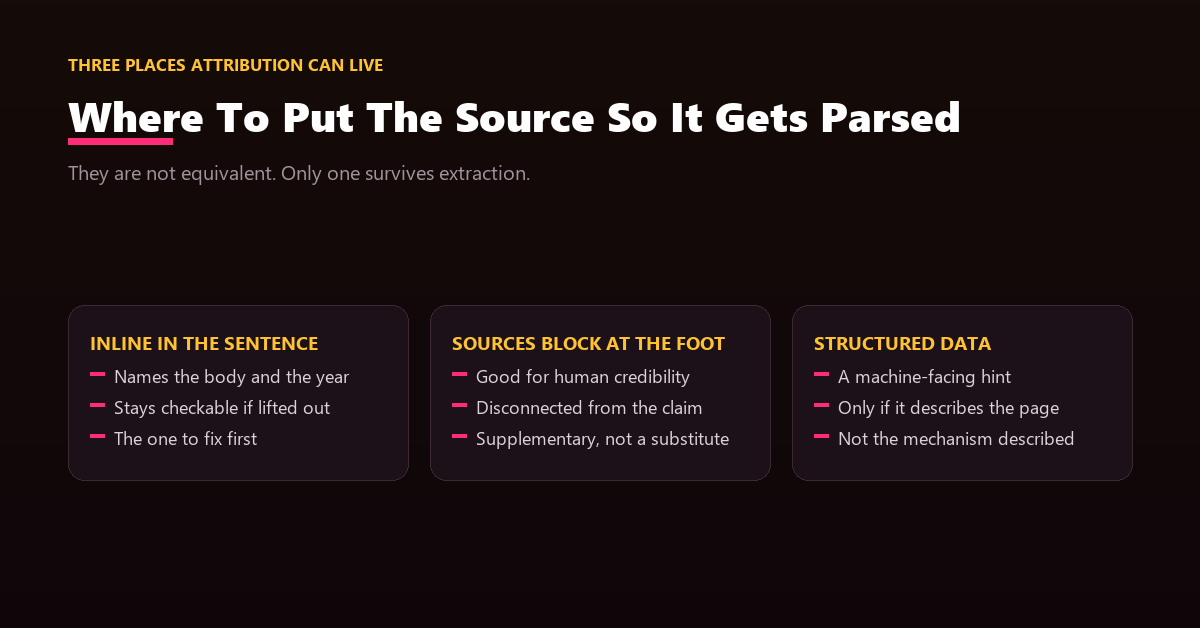
Our own guidance from here. There are three places attribution can live, and they are not equivalent.
- Inline, in the sentence. The strongest form. “According to the Office for National Statistics’ 2025 release, X” remains a complete, checkable statement if the sentence is extracted from the page entirely. A bare link on the word “research” does not.
- A sources block at the foot. Useful for human credibility and for anything that would clutter the prose, but it is disconnected from the claim it supports. Supplementary, not a substitute.
- Structured data. Worth having where it genuinely describes the page, and worth being honest that it is a machine-facing hint rather than the mechanism Dorenfest describes. His account is about the claim being checkable, not about the markup.
If you only change one thing, change the inline form. It costs nothing, it improves the page for humans, and it makes every sentence portable.
Turning Your Own Data Into A Citable Claim
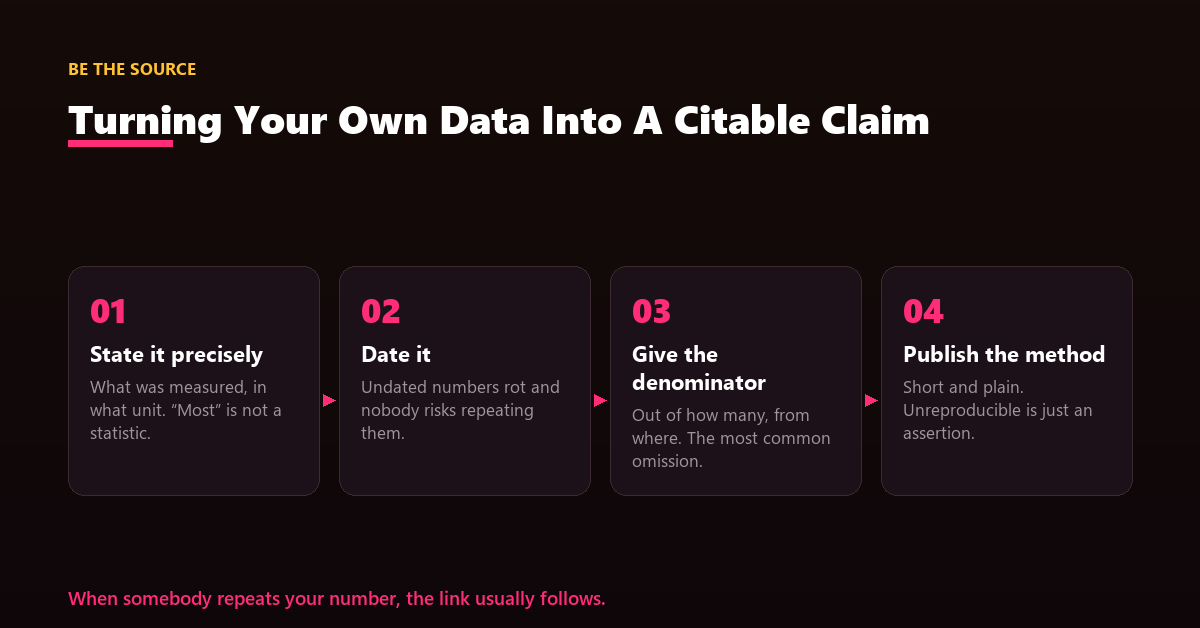
The other half of the loop, and the half most businesses ignore: you can be the source. Most companies are sitting on numbers nobody else has — job durations, failure rates, seasonal patterns, quote-to-close ratios, response times.
For how this plays out in reporting, see reporting SEO for a seasonal business on ZapDigits.
To turn an internal number into something citable it needs four things, and missing any one of them makes it unusable to anybody else:
- A precise statement. What was measured, in what unit. “Most” is not a statistic.
- A period. Undated numbers rot silently and nobody will risk repeating them.
- A denominator. Out of how many, from where. This is the single most common omission and the one that gets a claim dismissed.
- A method anyone could repeat. Short, plain, on the page. A number nobody can reproduce is an assertion with a decimal point.
Do that and the loop runs in your favour: your page is the source other people cite, and their citation is the link you did not have to ask for.
The Rewrite Pass On Your Top Twenty Pages
This is the practical programme, and it is deliberately small. Take the twenty pages that already earn something — traffic, leads, links. Do not start with the archive.
- Highlight every factual claim on the page. Most pages have between three and eight.
- For each one, find the origin. Some will be sourceable in a minute; some will turn out to be industry folklore nobody can trace.
- Rewrite the sourceable ones with the attribution inside the sentence.
- Cut or properly research the ones that are not. This is the uncomfortable step and the valuable one.
- Where the honest source is your own data, apply the four-part test above and make the page the citable original.
Budget about forty minutes a page. Twenty pages is a fortnight of afternoons, and it improves the pages for readers regardless of whether any machine ever notices.
What To Watch After The Rewrite
Do not measure this in referring domains for the first quarter; that is the wrong instrument and it will tell you it failed. Track instead: unlinked mentions of your brand and your specific claims; what the answer engines name when asked the questions your buyers ask, recorded monthly in identical wording; and whether the specific statistics you published start appearing in other people’s writing.
That last one is the real signal. When somebody repeats your number, the link usually follows, and when it does not you have a clean, courteous reclamation email to send.
The strategic version of this argument is digital PR for the AI consensus engine; the wider context is in our notes on link building in the age of AI overviews and the outreach content category.